Mastering the Martial Arts Landscape
Kinetic Striking Mechanics
Snap vs. Drive
At the heart of striking are two different philosophies of generating power: the snap and the drive. Karate embodies the snap. A Karate-ka's roundhouse kick is designed for speed and precision. The power comes from a violent, rapid rotation of the hips, often amplified by the hikite, or pulling hand. This counter-motion whips the kicking leg forward, striking the target and immediately retracting. The goal is to deliver a focused, penetrating impact and then return to a stable stance as quickly as possible, minimizing exposure.
Think of it like cracking a whip. The energy travels down the length of the body and is released in a final, explosive burst at the point of contact.
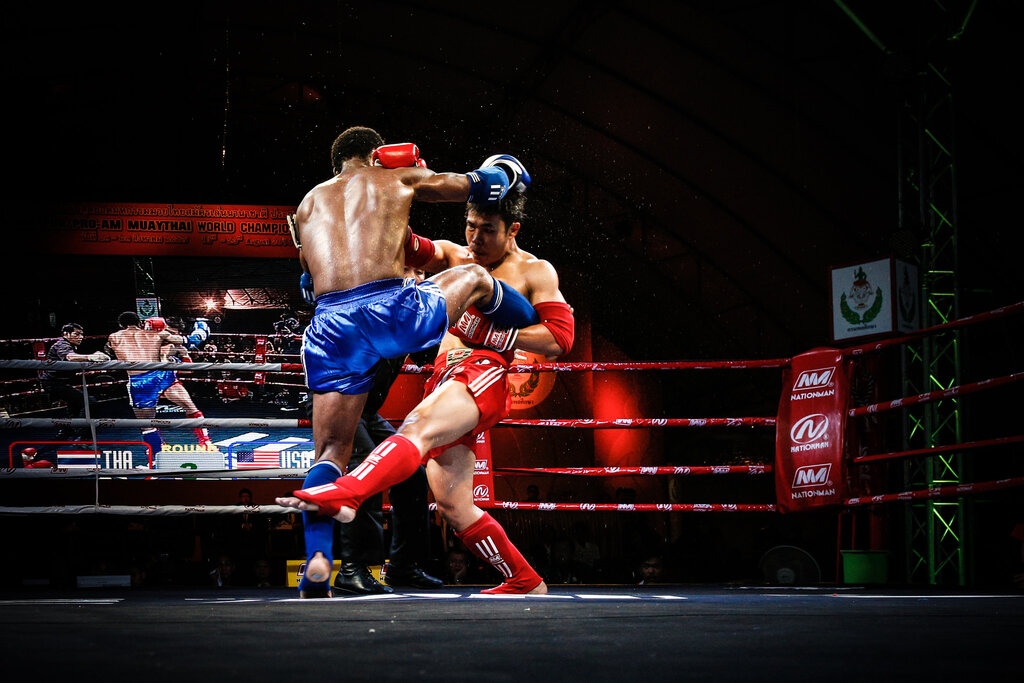
Muay Thai, in contrast, is all about the drive. The famous Thai roundhouse kick treats the leg not as a whip, but as a baseball bat. The fighter pivots on their standing foot, turns their hips completely over, and swings their entire body weight through the target. There is no retraction; the intent is to transfer maximum momentum and cause devastating damage. This commitment of body weight makes the kick slower to launch but vastly more powerful upon impact.
The Point of Impact
The choice of striking surface reflects these differing philosophies. Karate kicks often connect with the ball of the foot (for front kicks) or the instep (for roundhouse kicks). These smaller, harder surfaces are ideal for targeting specific pressure points or vulnerable areas, fitting the style's emphasis on precision. The kick chambers, snaps out, strikes, and returns along the same path.
A Muay Thai practitioner, or , almost exclusively uses the shin. The shin bone is one of the hardest bones in the body and presents a long, solid surface area. Conditioning the shins to withstand and deliver impact is a fundamental part of training. A shin kick landing on an opponent's thigh, ribs, or arm doesn't just strike the surface; it's meant to break through it, damaging muscle, bone, and nerve clusters with raw, driving force.
Hip Mechanics and the Kinetic Chain
The roundhouse kick provides a perfect case study in biomechanics. The entire sequence of movement, from the ground up through the striking limb, is called the kinetic chain. How each style utilizes this chain reveals its core principles.
The Karate kick begins with a distinct 'chamber,' where the knee is brought up high before the lower leg extends. This creates a Class 3 lever system, maximizing the velocity of the foot. The hips provide the initial rotational force, but the explosive knee extension is what generates the final 'snap'. The energy travels in a relatively linear path towards the target.
Conversely, the Muay Thai kick generates power through a circular path. The fighter turns their supporting foot outwards, opening the hips to allow for a full, unimpeded rotation. The power flows from the ground, up the pivoting leg, through the core, and into the swinging leg. It's a continuous, flowing motion that sacrifices quick retraction for a massive transfer of momentum.
Stance, Guard, and Strategy
These mechanical differences dictate strategy. The Karate-ka's ability to quickly chamber and retract strikes enables an 'in-and-out' blitzing style. They maintain distance, then explode forward to land a combination, and retreat before the opponent can effectively counter. Their stance is often bladed to facilitate this rapid linear movement.
The Muay Thai fighter's strategy is one of relentless forward pressure. Their stance is more square, providing a stable base for powerful kicks and absorbing incoming blows. Instead of retracting, they often use their 'Long Guard'—arms extended forward—to control distance, parry strikes, and initiate the clinch. This 'marching' approach is designed to walk opponents down, break their posture, and create openings for devastating knee and elbow strikes at close range.
Ultimately, neither approach is inherently superior; they are simply different solutions to the problem of striking. One prioritizes speed and surgical precision, the other, overwhelming force and attrition.
What is the core philosophical difference in power generation between a Karate kick and a Muay Thai kick?
In the context of striking biomechanics, what is the term for the entire sequence of movement from the ground up through the striking limb?