Mastering the Linux Scheduler
Introduction to Linux Scheduling
The CPU's Traffic Cop
Imagine a single-lane road with dozens of cars trying to use it at once. Without a traffic controller, you'd have chaos. In a computer, the CPU is that single lane, and the programs you run, or processes, are the cars. The operating system needs a way to manage which process gets to use the CPU at any given moment. This management is called process scheduling.
The Linux scheduler is the part of the kernel that acts as this traffic cop. Its main job is to decide which ready-to-run process gets the CPU's attention next and for how long. This creates the illusion of multitasking. Even on a single-core processor, you can browse the web, listen to music, and download a file seemingly all at once. In reality, the scheduler is rapidly switching the CPU between these tasks, giving each a tiny slice of time.
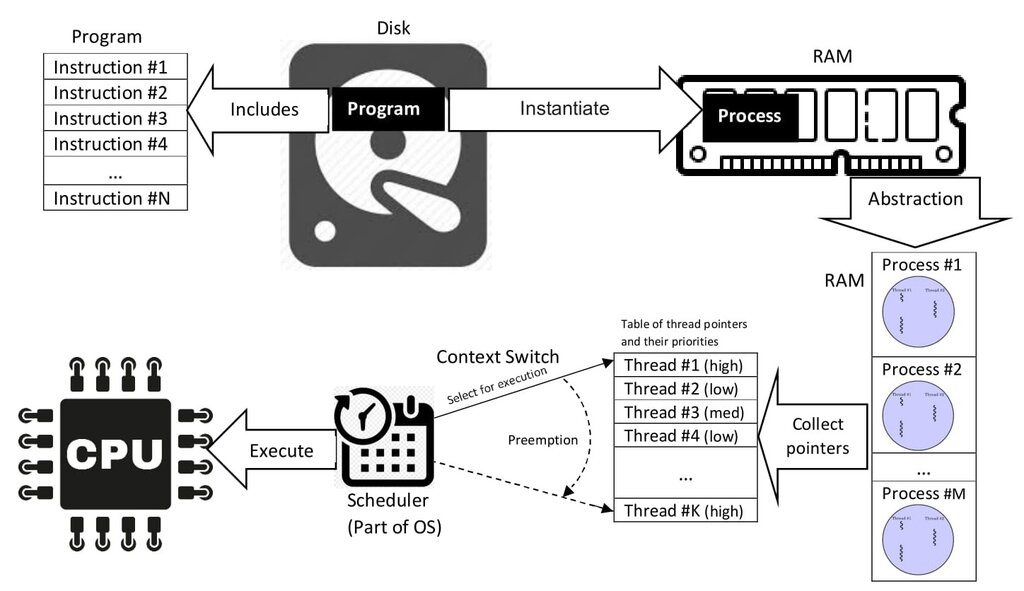
The scheduler's decisions are a constant balancing act. It aims to keep the CPU as busy as possible (high throughput), while also ensuring that interactive applications, like your mouse cursor or text editor, respond instantly (low latency). It also tries to be fair, preventing any single process from hogging all the resources.
An Evolving Approach
The Linux scheduler hasn't always been the same. It has evolved significantly over the years to keep up with changes in hardware and the way we use computers. The earliest schedulers were simple but had a major flaw: their performance got worse as the number of running processes increased. On a busy server, this was a serious problem.
This led to the creation of the O(1) scheduler. Its name refers to the fact that it could pick the next process to run in a constant amount of time, regardless of how many tasks were waiting. It was a huge step forward, especially for servers, but it had complex logic for determining which tasks were interactive versus CPU-bound.
The quest for a better approach continued, leading to the current standard: the Completely Fair Scheduler (CFS).
Introduced in kernel version 2.6.23, the CFS took a radically different approach. Instead of using complex heuristics to guess a process's priority, it operates on a simple principle: the ideal CPU would run every process at the same time, giving each an equal fraction of its power. Since that's impossible with a limited number of cores, CFS tries to emulate this by tracking how much CPU time each process has received. It then gives the CPU to the process that has had the least amount of runtime, ensuring fairness over time.
Scheduling Policies
Linux understands that not all tasks are created equal. A background data-processing job has very different needs from a real-time audio application where a delay of a few milliseconds could be disastrous. To handle this, the scheduler uses different scheduling policies.
These policies are sets of rules that govern how processes are selected. The default policy for normal tasks, SCHED_NORMAL (also called SCHED_OTHER), uses the Completely Fair Scheduler. For tasks that need to run with higher priority and more predictable timing, there are real-time policies like SCHED_FIFO (First-In, First-Out) and SCHED_RR (Round-Robin). These policies always take precedence over normal tasks, ensuring critical operations happen on time. We'll explore exactly how these work in more detail later.
What is the primary role of the Linux process scheduler?
The Completely Fair Scheduler (CFS), the default scheduler in Linux, operates on which core principle?
Understanding the scheduler's role is fundamental to understanding Linux performance. It's the mechanism that ensures the system feels smooth and responsive while making the most of the available hardware.