Mastering the Art of Movement
Advanced Weight Transfer
The Physics of Flow
Moving beyond basic steps means understanding that dance isn't just a series of poses; it's a constant conversation with gravity. Advanced weight transfer is about controlling this conversation. It’s about how you shift your center of gravity to create seamless, powerful transitions between movements. Think of it less like stepping and more like controlled falling.
Your body moves as a single, interconnected system known as the kinetic chain—a concept borrowed from biomechanics. An impulse that starts in your foot travels up through your ankle, knee, hip, and torso, influencing your entire posture. When you push off the floor, you're not just moving a leg; you're initiating a chain reaction that propels your entire body through space. A small, sharp push from the ball of your foot can result in a quick, explosive jump, while a slow, deliberate roll from heel to toe creates a fluid, gliding motion.
Effective dancers don't just move their limbs. They move their center of gravity, and the limbs follow.
The style of dance dictates how you manipulate this center. In contemporary dance, the emphasis is often on being grounded. Dancers use a lower center of gravity, sinking their weight to connect with the floor. This allows for fluid, sweeping movements and stable off-balance poses. You actively press into the floor to create energy.
In contrast, hip-hop often values an upright posture and a lighter, bouncier feel. The center of gravity is higher, allowing for quick, intricate footwork and explosive, upward movements. Here, you use the floor as a springboard, pushing off it to achieve elevation and air.
The Foot-Floor Connection
Your feet are the primary tools for controlling momentum. The way you apply pressure through them can radically change the quality of your movement. Mastering this involves understanding the distinct roles of different parts of your foot.
Using the (the balls of your feet) allows for quick pivots, sharp stops, and spring-like pushes. It's the accelerator. Pressing through your heels, on the other hand, acts as the brakes. It grounds you, providing stability and stopping power. Seamless transitions happen when you learn to roll your weight smoothly between these two points, blending acceleration and deceleration into a single, continuous flow.
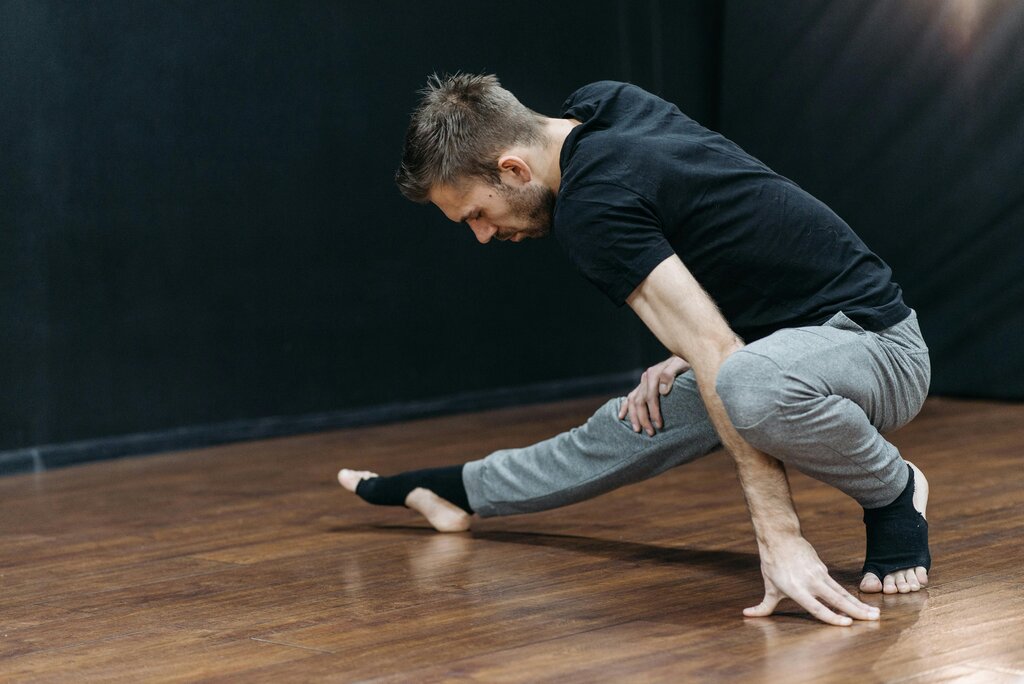
Consider a rapid change of direction. Instead of just picking up your foot and placing it elsewhere, a skilled dancer will first sink their weight into the supporting leg, push off forcefully from the inside edge of that foot, and then drive their center of gravity towards the new direction. The other leg simply comes along for the ride, landing softly to absorb the momentum. This principle of dynamic balance is what allows for sharp, clean turns and transitions without stumbling.
During transitions and weight shifts the weight ideally is on one foot, keeping the body upright.
Putting It into Practice
To develop this skill, focus on exercises that challenge your balance during movement. One simple drill is to shift your weight from one foot to the other in a slow, controlled motion, feeling the pressure roll from your heel, across the arch, to the ball of your foot, and then to the other leg. Pay attention to how your hips initiate the movement. As noted, all movement should originate from the body's core.
Once comfortable, try speeding up the shifts. Then, add changes in direction or level, like sinking into a lunge or rising onto the balls of your feet. The goal is to make these transitions feel like a single, uninterrupted thought, where your body responds instantly to your intention. This is the essence of fluid, dynamic dancing.
The concept that describes the body moving as a single, interconnected system, where an impulse in the foot travels up through the entire body, is known as the ________.
How does the use of the center of gravity typically differ between contemporary dance and hip-hop?
By mastering these principles, you move from simply executing steps to truly dancing with intention and control.