Mastering Strategic Chess Play
Tactical Patterns and Calculation
Spotting Tactical Patterns
Knowing how the pieces move is just the start. Winning in chess means looking for opportunities to force your opponent's hand. These forcing sequences, or tactical motifs, are the building blocks of a strong attack. They allow you to win material, disrupt your opponent's plans, and create decisive advantages.
Tactics are short, forcing sequences—like forks, pins, skewers, and discovered attacks—that win material or deliver checkmate in just a few moves.
Recognising these patterns is the first step. The next is learning how to create them.
The Pin
A pin is a tactic where an attacking piece prevents an opposing piece from moving. If the defending piece were to move, it would expose an even more valuable piece behind it to capture. There are two main types of pin.
Pin
noun
A tactic in which a defending piece cannot move without exposing a more valuable defending piece on the other side to capture by the attacking piece.
An absolute pin is one where the piece behind the pinned unit is the king. Because you can't legally move into check, the pinned piece is literally unable to move. It's stuck.
A relative pin is less severe but still powerful. Here, the piece behind the pinned one is valuable, like a queen or a rook, but it isn't the king. The pinned piece can legally move, but doing so would likely result in losing the more valuable piece behind it. It’s a bad trade, so the piece is effectively paralysed.
The Fork and Skewer
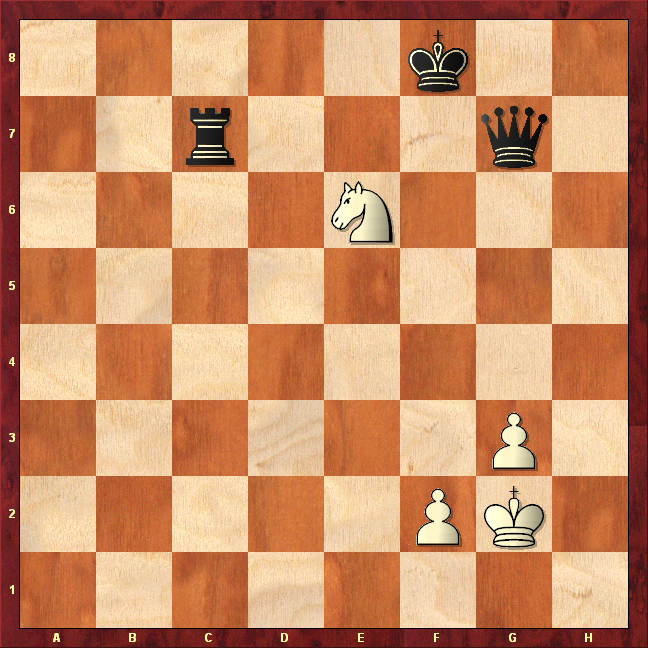
The fork, or double attack, is when a single piece attacks two or more of your opponent's pieces at the same time. The opponent can usually only save one of them, allowing you to capture the other. The knight is the master of the fork due to its unique L-shaped move, often catching players off guard.
A skewer is the inverse of a pin. In a skewer, a valuable piece is attacked directly. When it moves out of the way to safety, a less valuable piece behind it is exposed and can be captured. It's like a pin in reverse: the more valuable piece is in front.
The Discovered Attack
A discovered attack is a subtle but deadly tactic. It occurs when one piece moves out of the way to unveil an attack from another piece behind it. For example, a bishop might be blocked by its own knight. When the knight moves, the bishop's attack is suddenly revealed. This can be devastating if the moving piece, the knight in this case, also makes a threat of its own. Your opponent is then faced with two threats at once and may not be able to deal with both.
A discovered check is the most powerful version of this. When the revealed attack is a check on the opponent's king, they are forced to deal with the check, often allowing your other piece to carry out its threat without opposition. Even stronger is a double check, where both the moving piece and the revealed piece give check simultaneously. A double check is so forceful that the only possible response is to move the king, as you cannot capture two pieces or block two lines of attack in one move.
Calculating Your Moves
Spotting a potential tactic is one thing, but making sure it actually works is another. This requires calculation. Before launching an attack, you need to look ahead and consider your opponent's possible replies. The key is to focus on forcing moves—checks, captures, and threats—as these drastically limit your opponent's options and make the position easier to calculate.
Start by identifying your candidate moves for a given position. These are the moves that seem most promising. For each candidate, mentally play it out. What is your opponent's best response? What about their second-best? A good method is to check all captures and checks first. By calculating these forced variations, you can verify if your tactic will lead to a better position or if your opponent has a surprising defence.
Let's check your understanding of these tactical motifs.
What is the key difference between an absolute pin and a relative pin?
A bishop attacks an opponent's queen. The queen moves to safety, but this exposes a rook that was directly behind it on the same diagonal, which the bishop then captures. What is this tactic called?
Mastering these patterns will transform you from someone who just plays moves to someone who plays with purpose. They are the tools you'll use to build winning positions.