Mastering Single Integrals
Introduction to Integration
The Opposite of Change
So far, we've explored differentiation, which is all about finding the rate of change. We can take a function that describes a car's journey and find its speed at any moment. But what if we have the opposite problem? What if we know the car's speed at every moment and want to figure out how far it has traveled?
This is where integration comes in. It's the reverse process of differentiation. If differentiation breaks a process down into its instantaneous rates of change, integration builds it back up by summing all those tiny changes together. This process of summing or accumulating is why integration is also known as antidifferentiation.
The Fundamental Theorem of Calculus states that differentiation and integration are inverse operations.
Think about the function . We know from differentiation that the derivative of is . So, the antiderivative of is . But wait, the derivative of is also . And so is the derivative of . Any constant disappears when we differentiate.
Because of this, when we find an antiderivative, we have to account for any possible constant that might have been there. We do this by adding a "constant of integration," which we write as .
The Language of Integrals
Just like differentiation, integration has its own special notation. When we want to find the integral of a function , we write it like this:
Let's break that down:
- The symbol is called the integral sign. It looks like a stretched-out 'S', which stands for 'sum'.
- The function is called the integrand. It's the function we are integrating.
- The tells us that we are integrating with respect to the variable . It represents an infinitesimally small 'slice' of .
- is the antiderivative of .
- is the constant of integration we just talked about.
This entire expression is called an indefinite integral because it represents a whole family of functions (differing only by the constant ), not one specific value.
A Picture of Accumulation
So what does an integral actually look like? The most common way to visualize it is as the area under a curve.
Imagine we have a function graphed on a coordinate plane. The integral of that function between two points, say from to , represents the area of the region bounded by the function's curve, the x-axis, and the vertical lines and .
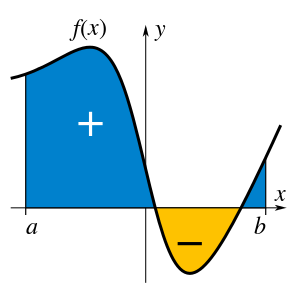
This is called a definite integral. It has starting and ending points, called limits of integration. We write it with the limits on the integral sign:
This expression gives us a single numerical value representing that specific area. Why does this work? Think about multiplying height by width to get the area of a rectangle. The integral is doing something similar. It's summing up the areas of an infinite number of incredibly thin rectangles under the curve. Each rectangle has a height of and an infinitely small width of . By adding them all up from to , we get the total area.
Integration is the tool we use to calculate accumulation. Whether it's the accumulation of distance, volume, or area, the core idea is the same: summing up infinite tiny pieces to find a whole.
Let's test your understanding of these foundational concepts.
What is the fundamental relationship between differentiation and integration?
Why must a constant of integration, often written as 'C', be added to an indefinite integral?