Mastering Retrieval-Augmented Generation
Introduction to RAG
What is Retrieval-Augmented Generation?
Large language models (LLMs) are powerful, but they have a fundamental limitation: their knowledge is frozen in time. They only know the information they were trained on. Retrieval-Augmented Generation, or RAG, is a technique that fixes this problem by giving an LLM an open book to the world's information.
Think of a standard LLM as a student taking a closed-book exam, relying only on what they've memorized. A RAG-powered LLM is like a student in an open-book exam, able to look up facts and figures from a library before answering.
Essentially, RAG connects an LLM to an external knowledge source, like a company's internal documents or a specific database. When you ask a question, the system first retrieves relevant information from that source and then uses it to generate a more accurate, timely, and context-aware answer.
Why LLMs Need Help
Without RAG, LLMs face a few key challenges. First is the knowledge cutoff. A model trained in 2022 has no idea what happened yesterday. This makes it unreliable for questions about current events or rapidly changing information.
Second, they are prone to hallucination, which means they can confidently invent facts or details when they don't know the answer. This happens because their goal is to produce plausible-sounding text, not necessarily factual text.
Finally, LLMs lack access to private or domain-specific data. A general-purpose model won't know your company's specific product details, internal policies, or the contents of your personal notes. RAG bridges this gap by letting the model access this information on demand.
How RAG Works
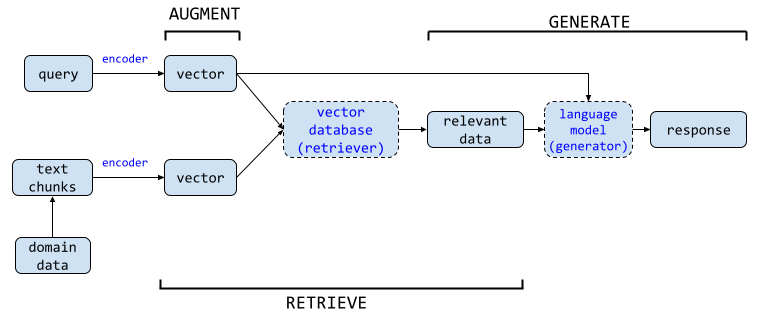
The RAG process can be broken down into two simple steps: retrieval and generation.
Retrieval
noun
The process of finding and fetching relevant information from a knowledge source based on a user's query.
When a user submits a prompt, the system doesn't immediately send it to the LLM. First, the retriever component searches the connected knowledge base (like a collection of PDFs, a database, or a website) for snippets of text that are most relevant to the query.
Generation
noun
The process of creating a human-like text response using a language model.
Next, the system takes the original prompt and combines it with the relevant information retrieved in the first step. This augmented prompt is then fed to the LLM. The generator (the LLM) uses this extra context to formulate a comprehensive and factually grounded answer.
RAG in the Real World
RAG isn't just a theoretical concept; it's already powering smarter AI applications across many industries. By grounding responses in specific, verifiable data, RAG makes LLMs more trustworthy and useful for practical tasks.
| Industry | Application | Why RAG is Useful |
|---|---|---|
| Customer Support | AI chatbots that answer customer questions about products or services. | Can access the latest product manuals and company policies for accurate answers. |
| Healthcare | Tools that help doctors quickly find information in medical research. | Summarizes findings from vast, up-to-date databases of clinical studies. |
| Finance | Systems that analyze financial reports and market data. | Provides answers based on current, proprietary financial data, not just old info. |
| Legal | Assistants that search through case law and legal documents. | Quickly locates relevant precedents from a firm's specific legal archives. |
Let's check your understanding of these core concepts.
What is the primary purpose of Retrieval-Augmented Generation (RAG)?
An LLM that was trained in 2022 is asked about the winner of the 2023 World Cup. Without RAG, it confidently states a plausible but incorrect winner. This is an example of:
By retrieving information before generating an answer, RAG makes language models more reliable. Now that you understand the what and why of RAG, we can dive deeper into how its components work.