I want to learn Negotiation
Welcome! I'm excited to help you master negotiation, which is truly one of the most valuable life skills you can build.
To make sure our practice sessions and examples hit home for you, what is driving your interest in learning this right now? Are you hoping to negotiate a higher salary, navigate agreements at work, handle personal situations like buying a car, or something else entirely?
Professional reasons (salary, promotions, client deals)
It's great to have you here! Since you are looking to level up your salary, secure promotions, and close better client deals, mastering negotiation will directly impact your career and income.
To give us a clear roadmap for our sessions, here is the learning path we will follow to build your negotiation skills step by step.

What Exactly is Negotiation?
Continue to the key objectives of a successful negotiation
Now that we have a solid grip on what negotiation is, let's look at what we are actually trying to achieve when we sit down at the table.
The Real Goal: More Than Just an Agreement
When most people think of a successful negotiation, they think of simply getting a "yes." But in the professional world, a signed contract is not enough.
A truly successful negotiation must satisfy three key objectives:
-
Value Creation: This is about expanding the pie before you divide it. Instead of just arguing over a single salary number, a skilled negotiator will introduce other variables—like remote work days, professional development budgets, or performance bonuses—to make the overall deal more valuable for everyone.
-
Value Capture: While we want to create a bigger pie, we also need to make sure we secure a fair and beneficial slice for ourselves. In your case, this means actually walking away with the higher salary, the promotion, or the profitable contract margins you deserve.
-
Relationship Preservation: This is the most frequently neglected objective. If you win a client contract but leave the other party feeling cheated, they likely won't renew or recommend you. A great negotiation achieves your business goals while leaving the intact, ensuring a healthy working relationship for the future.
If you only focus on capturing value, you risk damaging the relationship. If you only focus on the relationship, you might give away too much value. The magic happens when you balance all three.
Continue to the difference between distributive and integrative negotiation
Now we are getting to the heart of how you should approach your next deal. In the world of negotiation, there are two primary styles that dictate how the conversation flows: distributive and integrative.
Fixed Pies vs. Expanded Pizzas
A side-by-side comparison of a single circle being pulled apart versus a larger multi-layered gear being assembled from puzzle pieces.
I'm launching a visual diagram to help make this concept crystal clear. It contrast these two mindsets: one where you compete over a fixed resource, and one where you collaborate to build a larger pool of options.
Continue to the next subtopic: Preparation Strategies
You are making incredible progress! Now that we have covered the basic mindsets, we are moving into the most critical phase of any deal: Preparation.
There is an old saying among master negotiators: "The battle is won before it is even fought." In fact, research shows that [] comes down to what you do before you even walk into the room.
The Holy Trinity of Negotiation prep
To prepare like a pro, you must define three specific numbers or boundaries for yourself. Think of this as your strategic GPS—it prevents you from making emotional decisions in the heat of the moment.
Let's break down the first and most powerful of these concepts: the BATNA (Best Alternative to a Negotiated Agreement).
Your BATNA is your absolute fallback plan. It is what you will do if the current negotiation completely falls apart and you have to walk away.
For example, if you are negotiating a raise with your current boss, a solid BATNA would be a concrete, written job offer from another company for $90,000. If your boss refuses to budge, you know exactly what your alternative is.
Having a strong BATNA is where your leverage comes from. If you have no alternative, you have no real power to walk away.
A negotiation slider representing a current offer positioned on a scale between a BATNA and a target price.
I have created an interactive visualization tool to show you how this leverage works in real time.
Notice how having a strong, high-value alternative acts like a safety net, automatically raising the minimum offer you are willing to accept.
Continue to Reservation Price and Target Price
Now that we have established your safety net with the BATNA, let us focus on the remaining two pillars of preparation: your Reservation Price and your Target Price.
Your Boundaries: Walk-away vs. Dream Outcome
Continue and show me how BATNA, Reservation Price, and Target Price work together to define my strategy
Now that you have defined your safety net (BATNA), your walk-away point (Reservation Price), and your dream outcome (Target Price), we can put them all together to map out your strategic landscape.
Mapping Your Negotiation Strategy: The ZOPA
When you align your limits with the other party's limits, you reveal the actual boundary where a deal can take place. This boundary is called the , or ZOPA.
To see how this works in a professional context, let us look at a concrete, step-by-step example of a salary negotiation between you and a hiring manager.
Imagine you have a solid BATNA: a written offer from another company for $85,000.
Because of this alternative, you set your Reservation Price at $90,000 (to make moving jobs worth the effort) and your ambitious Target Price at $105,000 based on your market value.
Now, let us look at the hiring manager's side of the table.
They have a maximum budget of $100,000 allocated for this role—this is their Reservation Price. They cannot spend a single dollar more without executive approval. However, their Target Price is to hire you for $80,000 to save team budget.
When we lay these two strategies side by side, we find the overlap where a deal is actually possible:
| Parameter | Your Boundaries (Candidate) | Their Boundaries (Employer) |
|---|---|---|
| Target Price (Ideal) | $105,000 | $80,000 |
| Reservation Price (Limit) | $90,000 (Your floor) | $100,000 (Their ceiling) |
| ZOPA | $90,000 to $100,000 | $90,000 to $100,000 |
Because your floor ($90,000) is lower than their ceiling ($100,000), a ZOPA exists! Any agreement signed between $90,000 and $100,000 will make both of you better off than walking away.
Your actual strategy in the room is simple: use your target price to anchor high, and pull the final agreement as close to their $100,000 ceiling as possible, while protecting your $90,000 floor.
A horizontal double-bar scale representing a salary negotiation, showing the overlap between a candidate's range from $90,000 to $105,000 and an employer's range from $80,000 to $100,000.
I've generated a visual representation of this exact salary scenario.
Seeing these ranges side-by-side makes it clear how your floor and their ceiling lock together to form the ZOPA.
Continue to execution techniques like active listening
It is wonderful to see how quickly you have grasped the geometry of the ZOPA. Now that you have your backend strategy locked down, let us pivot to the room itself, starting with the single most underused superpower in business: active listening.
The Counterintuitive Power of Silence
Most people walk into a salary or client meeting believing that negotiating is about convincing, arguing, and dominating the airwaves. In reality, the person who talks the most during a meeting is usually the one giving away all their leverage.
Active listening is not just politely waiting for your turn to speak. It is a strategic tool designed to gather [] to help you uncover the other party's hidden constraints and true interests.
By letting the client or hiring manager speak first, you might discover that while their salary budget is tight, they have a massive, underutilized sign-on bonus pool, or they are desperately trying to fill the position before the end of the quarter. That is valuable intelligence you can use to frame your next proposal.
To use this effectively in your professional deals, you want to master the art of the open-ended question and the tactical pause.
Instead of asking closed questions like "Is this your final budget?" (which invites a quick "yes"), use open-ended prompts that force them to explain their perspective. For instance, "What is the main challenge your team is trying to solve with this hire?" or "How does this contract structure fit into your quarterly targets?"
Once they answer, resist the urge to jump in immediately. A deliberate three-second pause of silence often prompts the other person to fill the void, frequently revealing key concessions or motivations they did not intend to share initially.
Continue to building rapport at the table
Now that you have learned how to gather deep insights through active listening, let us explore the human bridge that makes those insights usable: building rapport.
The Chemistry of Consensus
Many professional negotiators treat a meeting like a math equation—purely logical and transactional. But humans are emotional creatures, and we are far more likely to make concessions for people we like, respect, and trust. This is where building becomes a strategic imperative, rather than just polite chitchat.
Rapport is not about superficial flattery or pretending to share the same hobbies. In a professional negotiation, real rapport is built on mutual respect and active validation of the other party's constraints.
If a client tells you their department is facing massive budget cuts, building rapport means saying, "I completely understand that you're under pressure to keep costs down this quarter. Let's find a creative way to make this work within those limits."
By acknowledging their reality, you lower their defensive guards. They stop seeing you as an adversary trying to take their money, and start seeing you as a partner trying to solve their problem.
One highly effective tool for establishing this trust is behavioral mirroring.
This does not mean awkwardly copying their physical movements like a mime. Instead, match their speech rate, volume, and key vocabulary.
If a client speaks slowly and values "stability," adapt your pacing and frame your proposals around security and reliability. If they are fast-talking and focused on "disruption," match that energy and focus on growth and speed.
By subtly matching their communication style, you make them feel instinctively understood and comfortable.
Continue to framing offers and counter-offers
Now that you've laid down the groundwork of listening and rapport, we have arrived at the ultimate moment of execution: framing your offers and counter-offers.
The Architecture of the First Offer

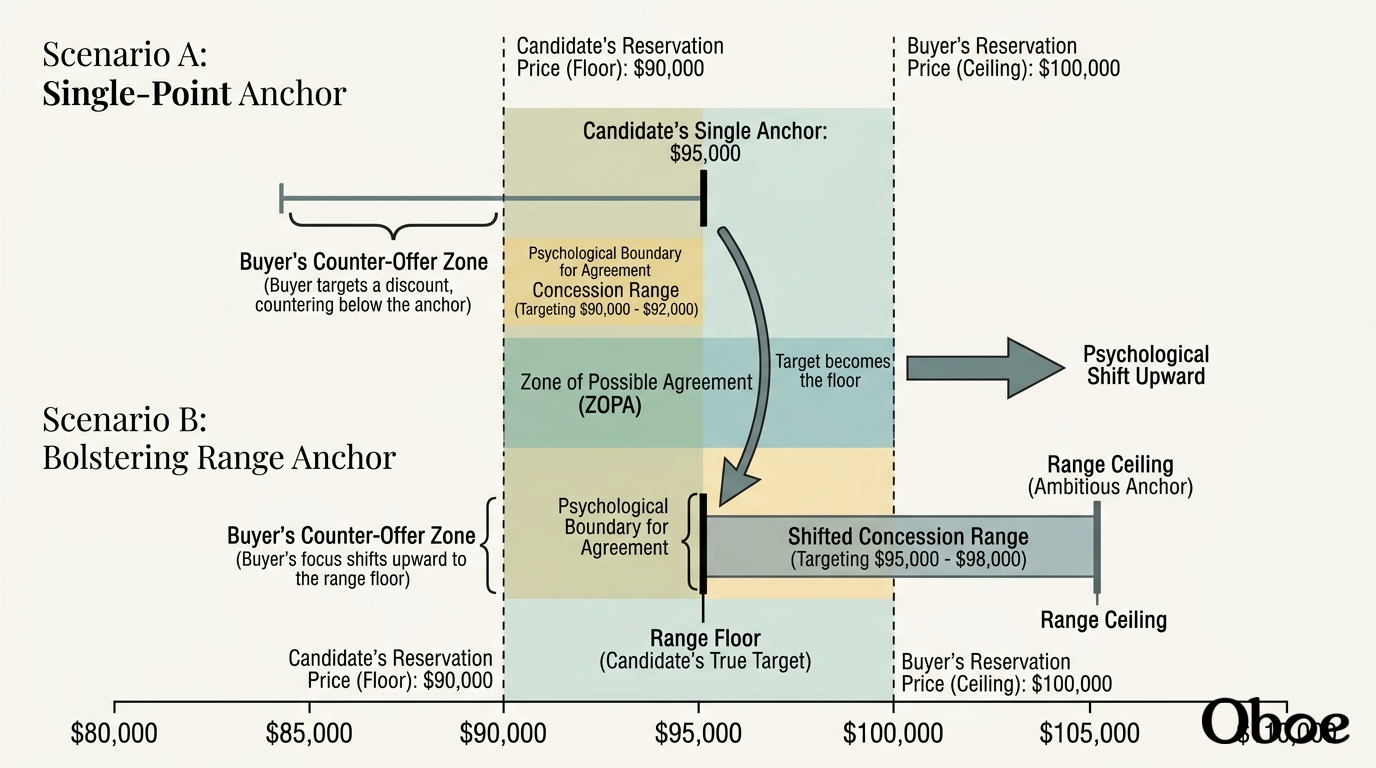
I've queued up a diagram to show how a bolstering range functions as a softer, more effective psychological anchor compared to a single hard number.
Continue to closing the deal and handling deadlocks
It is exciting to see how quickly you have mastered the prep and execution phases of dealmaking! Now, we are stepping into the final, high-stakes phase of our journey: Closing and Conflict Resolution.
The Wall: Recognizing When You are Stuck
No matter how much rapport you build or how beautifully you anchor, you will eventually encounter a moment where the momentum completely stalls. This is a , and it is a perfectly natural part of any complex business discussion.
A deadlock, or impasse, occurs when both parties believe they have made their final concessions and refuse to move any further. In a salary negotiation, this looks like your boss insisting that $92,000 is the hard corporate budget limit, while you know your absolute walk-away floor is $95,000.
The mistake most professionals make is trying to push through a deadlock by simply repeating their arguments louder or waiting for the other side to blink. This rarely works and often damages the relationship.
Instead, you must learn to read the room. An impasse is not a sign that the deal is dead; it is a sign that you have run out of road on that specific issue. To break the deadlock, you have to change the game entirely.
Give me a worksheet to diagnose negotiation barriers
Ask and you shall receive! I have just the thing to help you step back, analyze your current deal, and figure out exactly what is blocking your path.

I have queued up a custom diagnostic worksheet designed to help you pinpoint the exact friction points in your client deals or career discussions. It will help you see if you are facing a structural limit or simply a communication gap.
Now that you have a tool to diagnose where things go wrong, let us look at how we actually break through these barriers. To move past a , we have to master the art of overcoming impasses.
Continue to overcoming impasses and expanding the pie
Shifting the Game: Trading What You Value Less
A three-panel sequence showing a geometric expansion from a single red zero-sum line segment, to a two-dimensional square trade-off space, to a three-dimensional isometric cube of opportunity.
I have activated a 3D visualization showing exactly how this works in practice. Notice how a flat, one-dimensional line (where you can only go left or right on price) instantly expands into a spacious, multi-dimensional room of opportunity once you drop in fresh variables like flexibility, timelines, and bonuses.
The moment you bring these extra variables to the table, the deadlock evaporates because you are giving the other side a way to say yes without breaking their core constraints.
Continue to how to finalize agreements and avoid final-stage pitfalls
Crossing the Finish Line: Finalizing and Avoiding Pitfalls
You have navigated the strategic prep, built deep rapport, and successfully broken through the impasse. Now, you are at the five-yard line. This is where many professionals make a critical mistake: they assume the deal is done because everyone smiled and agreed in principle.
In reality, the closing phase is where a deal is either cemented or quietly falls apart. To secure your hard-won value, you must proactively protect the agreement from and late-stage misunderstandings.
To cross the finish line successfully, you need to master two final-stage habits:
-
The Written Confirmation (The "Paper Trail"): The moment you agree on terms, do not leave it to memory. Send a prompt, polite email summarizing the key points of agreement. Frame it as a collaborative recap: "To ensure we are fully aligned on our exciting next steps, here is a quick summary of what we agreed to today..." This prevents "memory drift" and locks in the terms before legal contracts are drawn.
-
Managing the "Nibble": A classic, slightly underhanded tactic is . This happens when the other party agrees to the main contract, but right before signing, they quietly ask for one more small concession—like "Oh, by the way, can you also include free maintenance for the first month?" because they know you are too emotionally invested in closing to say no.
To handle a nibbler without blowing up the relationship, simply offer a polite, reciprocal trade: "We'd love to include that maintenance for you. If we do that, we'll just need to adjust the start date of the contract by two weeks. Does that work?" This gently signals that nothing is free, quickly stopping the nibbling behavior.