Mastering MLOps
Introduction to MLOps
From Laptop to Real World
A data scientist builds a fantastic machine learning model. On their computer, it predicts customer churn with stunning accuracy. The team is thrilled. But when they try to use it in their live app, everything breaks. The model is slow, crashes under real user traffic, and its predictions get worse as new data comes in. What went wrong?
The problem isn't the model itself, but the gap between building it and running it. This is where MLOps comes in.
MLOps
noun
A set of practices for collaboration and communication between data scientists and operations professionals to help manage the production machine learning lifecycle.
MLOps, short for Machine Learning Operations, is a discipline that combines machine learning, data engineering, and software engineering (specifically DevOps). Its goal is to create a smooth, automated process for taking models from the lab to live production and keeping them running effectively.
MLOps combines Machine Learning, DevOps, and Data Engineering to operationalize ML models at scale.
Think of it like an assembly line for machine learning. Instead of building each car by hand in a garage (the data scientist's laptop), MLOps builds a factory that can reliably produce, test, deploy, and maintain high-quality models at scale.
The MLOps Lifecycle
Just like traditional software, machine learning models have a lifecycle. It's not a straight line but a continuous loop. MLOps provides the structure to manage this cycle efficiently.
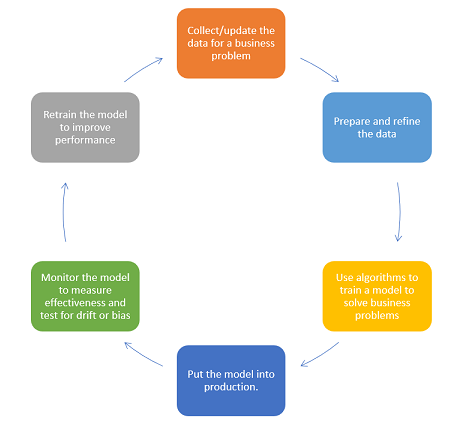
This process ensures that models don't just work once; they stay relevant and performant over time. MLOps grew out of the DevOps movement, which transformed how traditional software is built and released. As machine learning became more common in business, it became clear that a similar discipline was needed to handle the unique challenges of ML systems, like managing data, tracking experiments, and monitoring model performance.
The Three Pillars
The MLOps lifecycle is built on three core concepts, often called CI/CD/CT. They work together to automate and streamline the path from an idea to a working model in the hands of users.
Continuous Integration (CI): This is about more than just code. In MLOps, CI involves automatically testing and validating code, data, and models. Every time a data scientist commits a new piece of code, a change to the data, or a new model, an automated process kicks off to ensure it doesn't break anything. This catches errors early.
By integrating changes frequently, teams can collaborate without stepping on each other's toes.
Continuous Delivery (CD): Once a new model passes all the CI tests, Continuous Delivery takes over. It automatically deploys the model to a production environment. This step ensures that you can release new models quickly and reliably. Instead of a manual, error-prone deployment process that takes weeks, CD can make it happen in minutes.
This speed allows businesses to react quickly to new information and update their ML-powered features without delay.
Continuous Training (CT): Models can become stale. The world changes, and a model trained on last year's data might not be accurate today. Continuous Training is a process that automatically retrains the model on new data. When the system detects that the live model's performance is degrading, it can trigger a new training run to create an updated, more accurate version.
Together, these three pillars create a robust, automated system that makes machine learning in production manageable, scalable, and aligned with business goals. They turn the experimental nature of data science into a reliable engineering discipline.
Let's check your understanding of these foundational ideas.
What is the primary goal of MLOps?
The MLOps lifecycle is best described as a continuous loop.
MLOps provides the essential bridge between the creative work of model building and the practical reality of running it in a live environment, ensuring that the value of machine learning can be fully realized.