Mastering Integration
Introduction to Integration
The Other Side of Change
So far, we've focused on differentiation, the process of finding a function's rate of change. If you have a function describing the distance a car has traveled, its derivative tells you the car's speed at any given moment.
Now, let's flip that idea around. What if you know the car's speed at every moment and want to find the total distance traveled? You're not looking for a rate of change; you're looking for an accumulation of change. This reverse process is called integration.
Differentiation breaks things down to find rates. Integration builds things up to find totals.
The process of finding a function whose derivative is the function we started with is called finding the antiderivative. This is the core of integration.
Indefinite Integrals
An indefinite integral is the general form of the antiderivative. The notation looks like this:
Let's break that down:
- The symbol is the integral sign. It looks like a stretched-out 'S' for "sum."
- is the function you're integrating, called the integrand.
- tells us that we are integrating with respect to the variable .
- is the antiderivative, meaning that .
But what about the ? This is the constant of integration. Think about it: the derivative of is . The derivative of is also . The derivative of is still . Because the derivative of any constant is zero, when we go in reverse, we lose that information. The acknowledges this unknown constant.
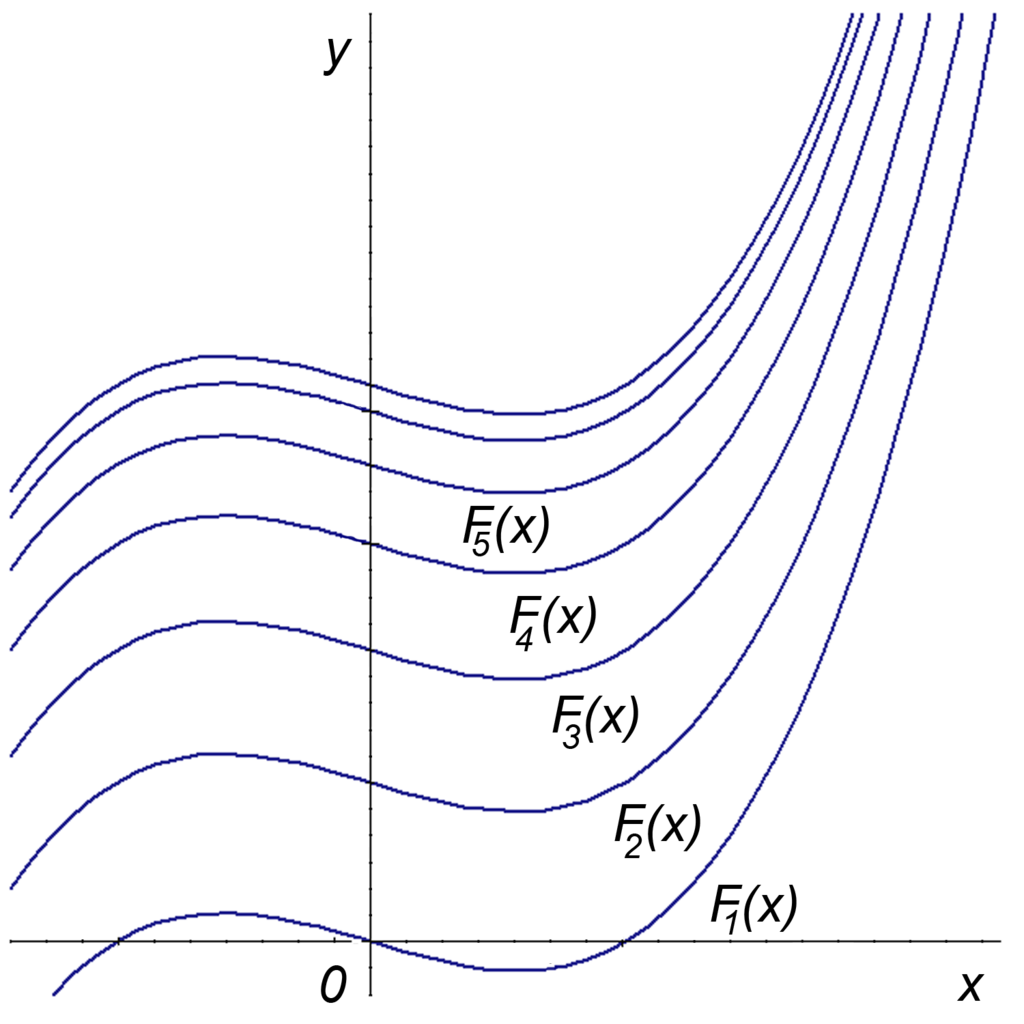
Just as we have rules for differentiation, we have rules for integration. The simplest one is the power rule, in reverse. To integrate , you add one to the exponent and then divide by the new exponent.
For example, the integral of is , which simplifies to . You can always check your work by taking the derivative of the result!
Definite Integrals and Area
While indefinite integrals give us a general function, definite integrals give us a specific number. This number often represents a total accumulation, like the total distance traveled or, most famously, the area under a curve between two points.
The notation adds boundaries, called limits of integration, to the integral sign:
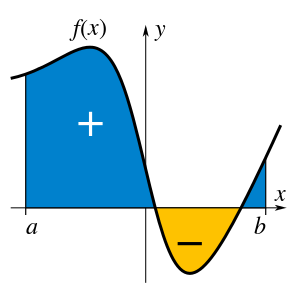
This expression means "the integral of from to ." It calculates the net signed area between the function's graph and the x-axis, from the vertical line to the vertical line . Area above the x-axis is positive, and area below it is negative.
So how do we calculate this value? This is where differentiation and integration come together in one of the most important theorems in all of mathematics.
The Fundamental Theorem of Calculus
The Fundamental Theorem of Calculus provides a powerful link between derivatives and integrals. It tells us how to solve a definite integral without having to sum up an infinite number of tiny rectangles (which is the formal definition of an integral).
The theorem states that if is an antiderivative of , then:
This is a stunning result. To find the area under the curve from to , you simply need to:
- Find the antiderivative, .
- Evaluate the antiderivative at the upper limit, .
- Evaluate the antiderivative at the lower limit, .
- Subtract the two results.
Notice that the constant of integration disappears in this process, since .
Let's find the area under the curve from to .
- The antiderivative of is .
- Evaluate at : .
- Evaluate at : .
- Subtract: . The area is 8.
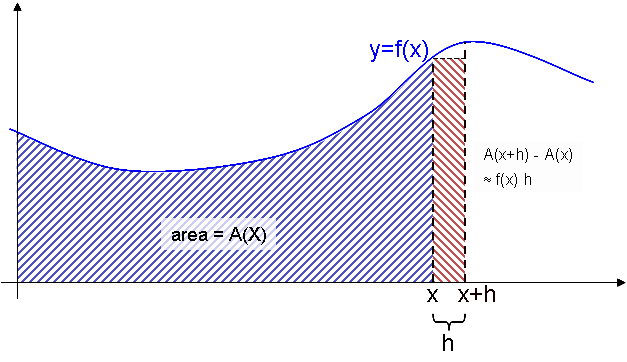
This theorem is the bedrock of calculus. It confirms that differentiation and integration are inverse operations, two sides of the same coin. One measures the rate of change, and the other measures the total accumulation of that change.
If differentiation is the process of finding a function's rate of change, what is integration?
Why is the constant of integration, + C, added when finding an indefinite integral?
You now have the foundational tools to understand what integrals are and how they relate to the derivatives you've already mastered.