Mastering Exploratory Data Analysis
Introduction to EDA
Getting to Know Your Data
Before you can build a house, you need to survey the land. You walk the property, check the soil, and note the slopes. Data analysis is similar. Before you build complex models or draw firm conclusions, you need to understand the landscape of your data. This initial exploration is a crucial process called Exploratory Data Analysis, or EDA.
Exploratory Data Analysis (EDA) is used by data scientists to examine and visualize data to understand its main characteristics, identify patterns, spot anomalies, and test hypotheses.
Think of EDA as the first conversation you have with a dataset. It’s less about getting specific answers and more about asking good questions. What are the main features here? Are there any strange or unexpected values? How do different parts of the data relate to each other? The goal is to get a feel for the data's structure, quirks, and potential before you commit to a specific analytical path.
anomaly
noun
A data point that deviates significantly from other observations.
This approach is fundamentally about flexibility and curiosity. It's about letting the data guide you, rather than forcing it to fit preconceived ideas.
EDA vs. Classical Analysis
So, how is EDA different from what people might think of as traditional statistics or classical data analysis? The main difference lies in the mindset and the order of operations.
Classical analysis is often confirmatory. It starts with a specific question or hypothesis and uses data to confirm or reject it. For example, a classical approach might be: "Does our new website design increase user sign-ups?" You would then collect data specifically to answer that yes-or-no question.
EDA, on the other hand, is exploratory. It starts with the data and asks, "What interesting things can we find here?" You might not have a specific hypothesis. Instead, you're looking for patterns that could help you formulate a hypothesis. You might notice that users from mobile devices are dropping off at a certain page, a pattern you weren't looking for but which EDA helped you discover.
| Feature | Exploratory Data Analysis (EDA) | Classical Data Analysis |
|---|---|---|
| Goal | Generate questions and hypotheses | Test and confirm hypotheses |
| Approach | Open-ended, flexible | Structured, predefined |
| Starting Point | The dataset | A specific question |
| Primary Tools | Visualizations, summaries | Formal statistical tests |
| Outcome | Insights and ideas for further study | A statistical conclusion (e.g., a p-value) |
Neither approach is better; they're simply different tools for different stages of an investigation. In fact, they work best together. EDA finds the promising trails, and classical analysis follows them to see where they lead.
The Role of EDA in a Project
EDA isn't just a preliminary step; it's a foundational part of the entire data analysis workflow. It's the bridge between raw, messy data and meaningful insights.
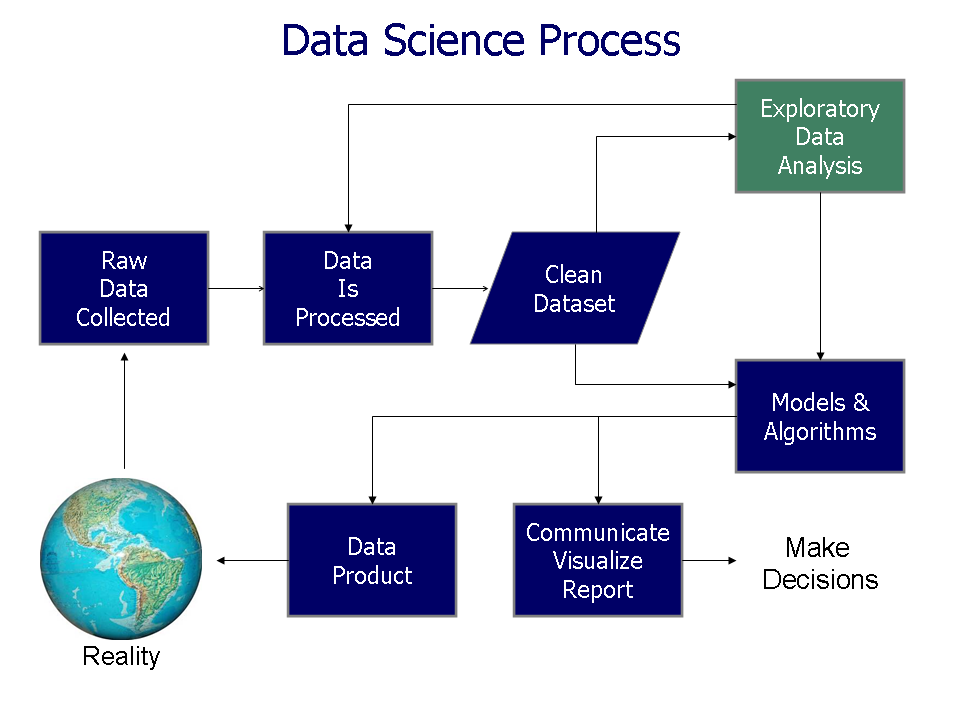
The key objectives of EDA are to:
- Understand the Data's Structure: What variables are included? What are their types (numeric, categorical)? How many rows and columns are there?
- Identify Anomalies and Errors: Look for outliers, missing values, or data entry mistakes. Finding a zip code entered as "New York" is better done early.
- Uncover Underlying Patterns: Discover relationships between variables. For example, you might find that as temperature increases, ice cream sales go up. This is a pattern.
- Inform Feature Engineering: The insights from EDA can help you create new, more useful variables from the existing ones, which can dramatically improve model performance later.
- Test Assumptions: Many statistical models rely on assumptions (like a variable being normally distributed). EDA helps you check if these assumptions hold true for your dataset.
By investing time in EDA, you avoid building complex models on flawed data. It's a classic case of "measure twice, cut once." A thorough exploration phase saves a massive amount of time and prevents you from drawing incorrect conclusions down the line.
Essentially, EDA provides the context needed to make informed decisions throughout the rest of your analysis.
Now, let's test your understanding of these core concepts.
What is the primary goal of Exploratory Data Analysis (EDA)?
Classical data analysis is primarily __________, while EDA is primarily __________.
Next, you'll learn about some of the specific tools and techniques used to perform Exploratory Data Analysis.