Mastering Cricket Strategy and Tactics
Bowling Physics and Variations
The Unseen Forces of Swing
When a cricket ball travels through the air, it's not just a simple projectile. It's interacting with a fluid, the air, and that interaction creates forces that can make the ball deviate sideways. This is called swing. The key lies in managing the flow of air over the ball's surface.
On a new, polished cricket ball, the seam acts as a tripwire for the air. When a bowler delivers the ball with the seam angled, one side of the ball is smooth while the other side is interrupted by the stitched seam. Air flowing over the smooth side separates from the surface early. This is called laminar flow. On the seam side, the stitches create turbulence, causing the air to cling to the ball for longer before separating. This turbulent flow results in a lower pressure zone on the seam side. The ball is then pushed from the high-pressure (smooth) side to the low-pressure (seam) side, causing it to curve in the air.
As the game progresses, the ball's surface gets scuffed and worn. One side is deliberately kept polished by the fielding team, while the other becomes rough. This is where reverse swing comes into play. When the ball reaches a high enough speed, the roles of the smooth and rough sides flip. The rough side now creates more turbulence than the seam, causing air to cling to it longer, while the polished side experiences earlier separation. The pressure differential is reversed, and the ball swings away from the rough side, contrary to conventional swing. This effect is most pronounced with an old ball on a dry, abrasive pitch.
Seam, Pitch, and Deception
A bowler's control over the seam is paramount. For swing, the ideal is a perfectly upright seam, presented like a rudder to the air. But there's another technique: the wobble seam delivery. Here, the bowler deliberately scrambles the seam, causing it to tumble and rotate unpredictably on its way to the batsman.
Why do this? A wobble seam delivery sacrifices aerodynamic swing for unpredictability off the pitch. With the seam's orientation constantly changing, neither the bowler nor the batsman knows exactly how it will hit the surface. It might straighten, nip in, or move away, making it incredibly difficult to play. This technique is especially effective on pitches that offer some assistance, where even a slight touch of the seam on the turf can cause a significant deviation.
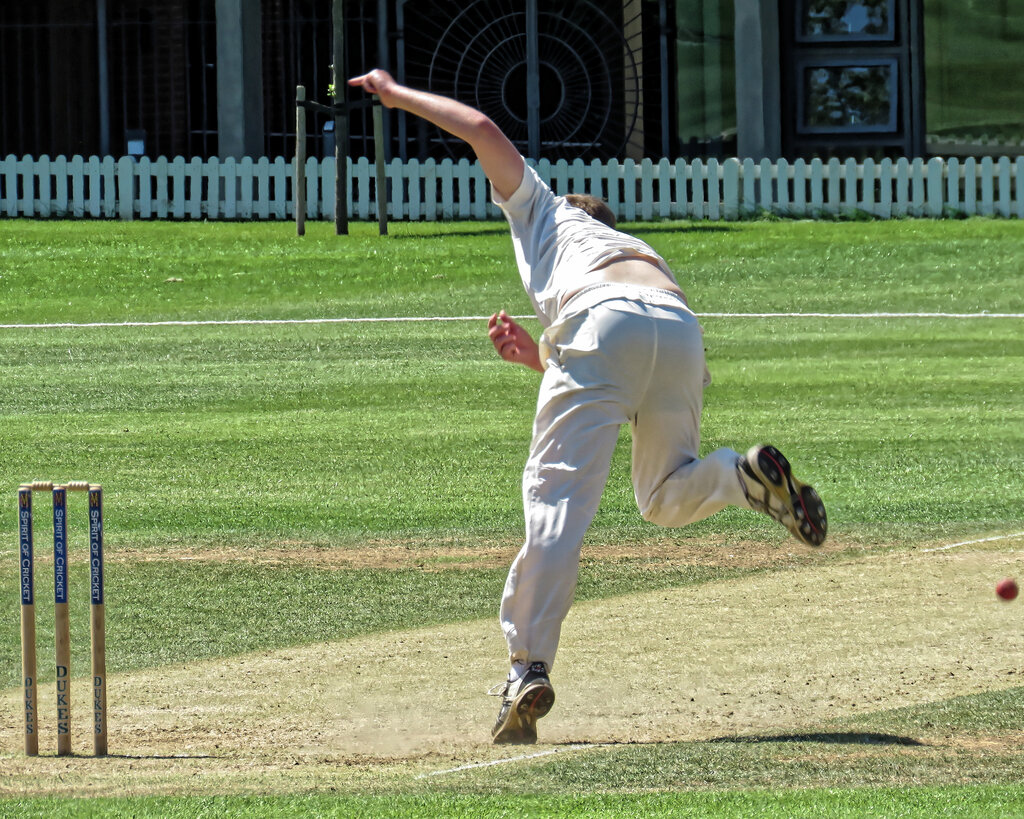
The Physics of Spin
Spin bowling operates on a different aerodynamic principle: the s. By imparting a large number of revolutions on the ball at release, the bowler creates a pressure difference due to the interaction between the spinning ball and the air. As the ball spins, it drags a layer of air around with it. On one side, this layer of air moves in the same direction as the oncoming airflow, resulting in higher velocity and lower pressure. On the other side, it moves against the airflow, slowing it down and creating a zone of higher pressure. The ball is pushed from high pressure to low, causing it to curve or 'drift' in the air.
This drift is a key weapon. A leg-spinner spinning the ball from right to left (from the bowler's perspective) will cause it to drift to the right in the air before it even pitches. The revolutions also affect the ball's bounce. A ball delivered with over-spin (like a topspin forehand in tennis) will dip sharply and bounce higher and faster than expected. A ball with side-spin will turn more sharply after hitting the pitch.
By combining drift and dip, a skilled spinner fools the batsman's perception of the ball's trajectory, making them play at where they think the ball will be, not where it actually ends up.
What is the primary aerodynamic principle that causes a spinning cricket ball to drift in the air?
In conventional swing, the ball curves towards the seam side. Why does this happen?
Understanding these aerodynamic and rotational forces is the key to appreciating the subtle craft of high-level bowling. It's a constant battle of physics, skill, and deception.