Mastering Backgammon
Backgammon Basics
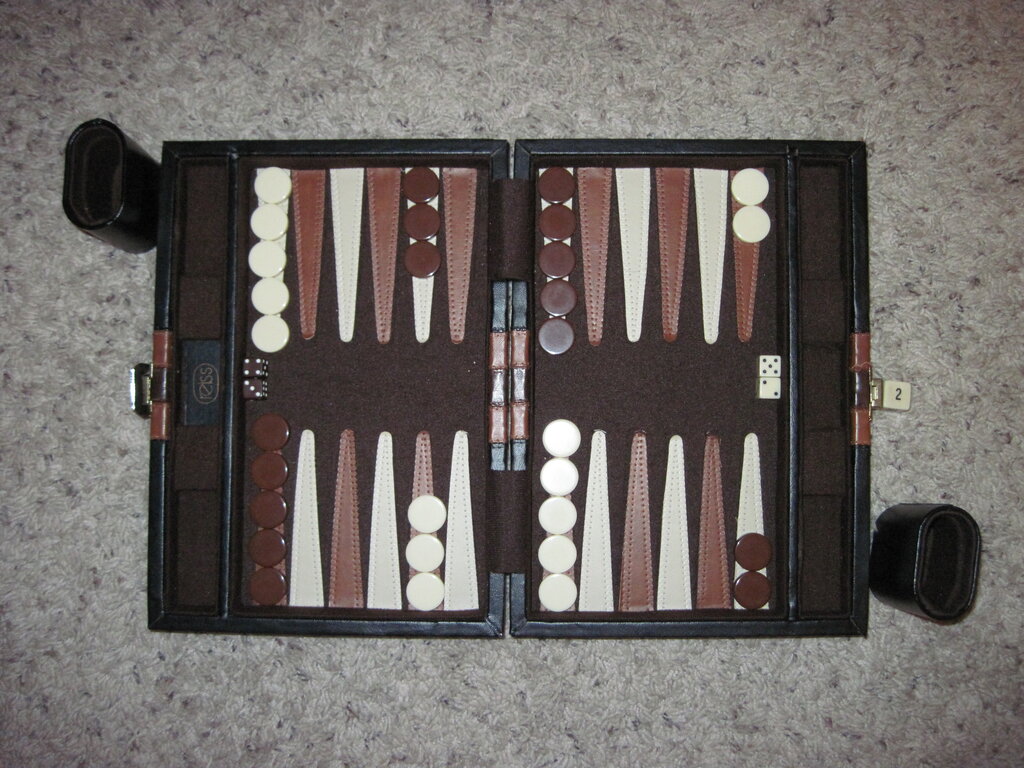
The Board and Pieces
Backgammon is played on a board with 24 narrow triangles called points. The points are grouped into four quadrants of six points each. For you, the points are numbered 1 through 24, starting from your home board and moving counter-clockwise. Your opponent's points are numbered in the opposite direction.
Each player has 15 checkers, which are like small discs. One player uses the light-colored checkers, and the other uses the dark ones. You also have a pair of dice. The board is divided down the middle by a ridge called the bar. This is where checkers go if they get hit.
Objective of the Game
The goal is simple: be the first player to move all 15 of your checkers into your home board and then remove them from the board. The area containing points 1 through 6 is your home board. Your opponent's home board is directly opposite, containing points 19 through 24.
Your objective is a race to get all your checkers home and then off the board before your opponent does.
How to Move
To start your turn, you roll two dice. The numbers you roll are separate moves. For example, if you roll a 5 and a 3, you can move one checker 5 spaces and another checker 3 spaces. Or, you can move a single checker a total of 8 spaces, but you must do it in two steps (a 3 then a 5, or a 5 then a 3), landing on an intermediate point. You must move to an open point, which is any point not occupied by two or more of your opponent's checkers.
A key rule: If a point is occupied by only one of your opponent's checkers (called a 'blot'), you can land on that point. This 'hits' the opponent's checker and sends it to the bar. That player must then use their dice rolls to move that checker from the bar back onto the board before moving any other pieces.
If you roll doubles, you get to play each die twice. For instance, if you roll double 4s, you have four moves of 4 spaces each. You can use these moves on any combination of checkers. If you are unable to make a legal move with the numbers you rolled, you forfeit your turn.
Bearing Off
Once all 15 of your checkers are in your home board, you can start removing them. This is called bearing off. You roll the dice and can remove a checker from the point corresponding to the number on a die. For example, if you roll a 6 and a 4, you can remove one checker from the 6-point and one from the 4-point.
If you roll a number for a point where you have no checkers, you must move a checker from a higher-numbered point. If all your remaining checkers are on points lower than the number you rolled, you can remove a checker from the highest point you occupy. For instance, if you roll a 5 but have no checkers on the 5-point (and your highest occupied point is the 4-point), you can remove a checker from the 4-point.
Let's check your understanding of these core rules.
What is the primary objective in a game of Backgammon?
You roll double 3s. How many moves do you get?
That covers the essentials. Now you know how to set up the board, move your checkers, and win the game. The next step is learning the strategy that turns this game of chance into a game of skill.