Machine Learning Fundamentals
Introduction to Machine Learning
What Is Machine Learning?
Machine learning gives computers the ability to learn from data without being explicitly programmed. Instead of writing step-by-step instructions for every possible scenario, we create algorithms that allow the computer to find patterns and make decisions on its own.
Think of it like this: you wouldn't teach a child to recognize a cat by describing its features in code. You'd show them pictures of cats. After seeing enough examples, the child learns to identify a cat on their own. Machine learning works in a similar way, using data as its examples.
This ability to learn from experience is incredibly powerful. It allows us to tackle problems that are too complex or large-scale for a human to solve manually. From recommending your next favorite song to helping doctors diagnose diseases, machine learning is quietly working behind the scenes in many aspects of modern life.
Learning in the Wild
You probably use machine learning every day without realizing it. It's the engine that powers many of the services you rely on.
- Spam Filters: Your email service learns to distinguish between legitimate messages and junk mail by analyzing millions of emails.
- Recommendation Engines: Services like Netflix and Spotify learn your preferences from what you watch and listen to, then suggest new content you might like.
- Navigation Apps: Google Maps and Waze use machine learning to predict traffic and estimate your arrival time by analyzing real-time data from other drivers.
- Voice Assistants: Siri, Alexa, and Google Assistant use machine learning to understand your spoken commands and respond appropriately.
The Main Flavors of Learning
Machine learning isn't a single technique but a broad field with several distinct approaches. The best approach depends on the type of problem you're trying to solve and the kind of data you have. The four main types are supervised, unsupervised, semi-supervised, and reinforcement learning.
Supervised Learning
noun
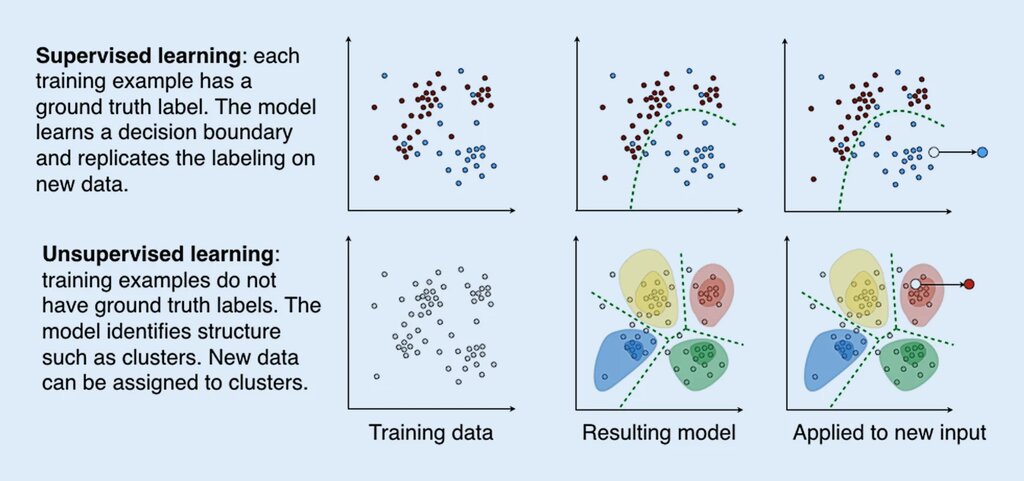
The algorithm learns from a dataset that has been labeled with the correct answers. The goal is to learn a mapping function that can predict the output for new, unseen data.
In supervised learning, the computer is like a student with a set of flashcards. Each card has a question (the input data) and the correct answer (the output label). By studying these examples, the algorithm learns to predict the answer for questions it has never seen before.
Unsupervised Learning
noun
The algorithm learns from an unlabeled dataset, trying to find hidden patterns or structures on its own without any pre-existing answers to guide it.
With unsupervised learning, the computer is given a big box of jumbled items and asked to sort them. It doesn't know what the categories are, but it can group similar items together based on their features, like color, size, or shape. This is useful for discovering natural groupings in data.
Two other important types build on these ideas.
Semi-Supervised Learning is a hybrid approach. It uses a small amount of labeled data along with a large amount of unlabeled data. The labeled data provides a starting point, helping the algorithm make sense of the larger, unlabeled dataset.
Reinforcement Learning involves an 'agent' that learns to make decisions by performing actions and receiving feedback in the form of rewards or punishments. It's all about trial and error. The agent's goal is to maximize its total reward over time. This is the approach used to train AIs to play complex games like chess or Go.
Understanding these different approaches is the first step in seeing how machine learning can be applied to solve a vast range of problems.
What is the fundamental concept behind machine learning?
A streaming service analyzes your viewing history to suggest new movies you might enjoy. This is an example of a recommendation engine.