linear algebra so i can understand qm
Welcome! It's fantastic to have you here. Quantum mechanics is one of the most beautiful and counterintuitive areas of physics, and your professor was absolutely right: its mathematical heart is pure linear algebra. To make sure we build a rock-solid foundation that fits you perfectly, let's start with a quick check-in about your background.
To help me tailor our sessions, could you tell me a little about your current background? Are you comfortable with basic matrix operations and systems of equations, or should we start from absolute scratch?
I know a bit of linear algebra but could use a quick, high-level review.
That makes perfect sense! Since you already have the basics down, we can skip the tedious matrix multiplication drills and focus on the conceptual bridge between linear algebra and quantum mechanics. To get started, let's take a look at our roadmap for this session:

Let's continue to learning about Kets as state vectors.
Show me a diagram comparing kets and classical vectors
You've got it! A visual comparison is a fantastic way to bridge what you already know about classical arrows with how we think about kets in quantum mechanics. Let's look at a side-by-side comparison.

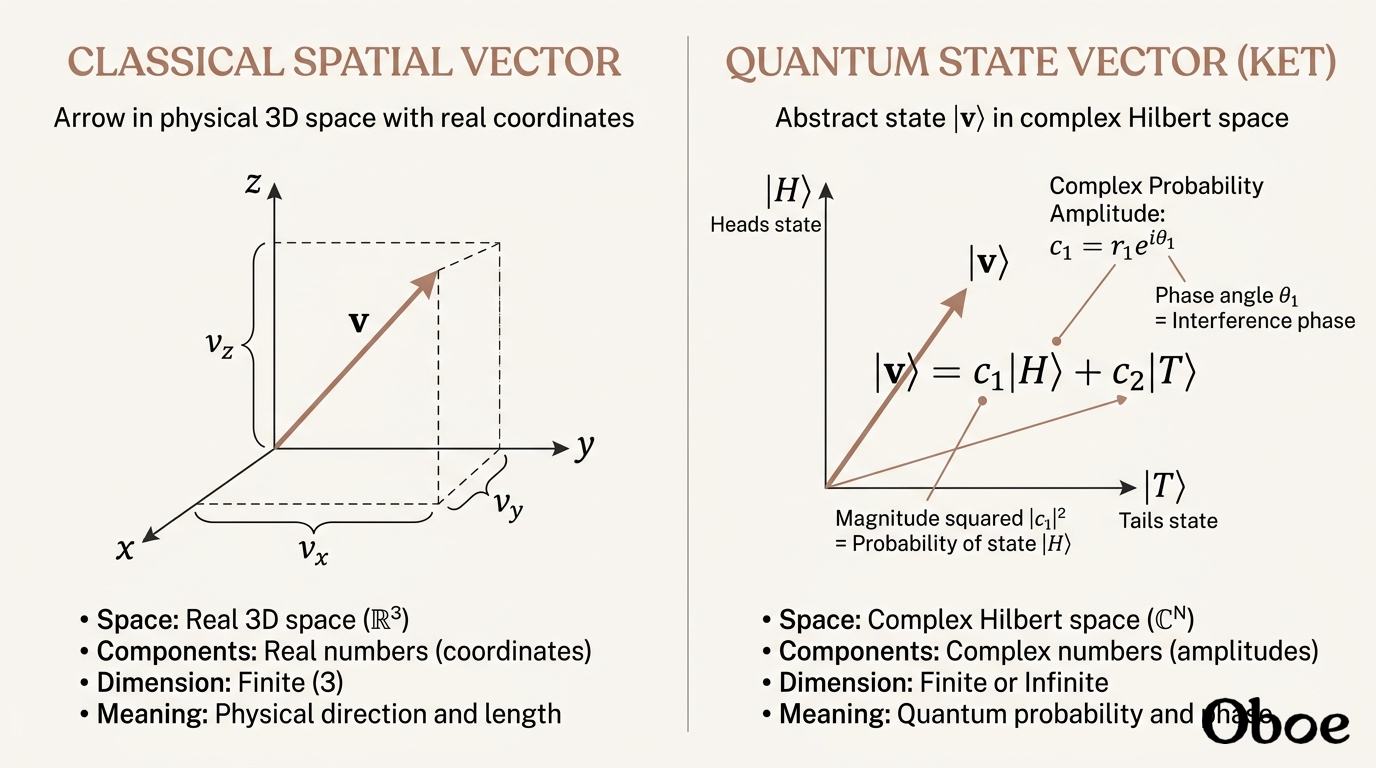
As the diagram shows, while a classical is tied directly to physical directions in our familiar three-dimensional space, a quantum ket lives in an abstract mathematical realm where the "directions" represent different physical states of a system.
Explain how complex numbers act as the components of a ket.
To understand how complex numbers act as the components of a ket, we have to look closely at what these numbers are actually representing: probabilities and phase.
Probability Amplitudes
When we write down a quantum state as a ket, we typically express it as a linear combination of baseline states (our coordinate axes). For example, a coin that can be heads or tails can exist in a superposition:
Here, the components and are not physical distances like the components of a classical 3D vector. Instead, they are called probability amplitudes. These numbers contain two critical pieces of information: the likelihood of finding the system in that state, and its quantum phase.
Magnitude and Phase
Every complex component can be written in polar form as:
Let's break down exactly what these two parts tell us:
-
The Magnitude (): The absolute value squared, , gives the actual physical probability of observing that state during a measurement. If , the probability of flipping heads is , or 50%.
-
The Phase (): The angle is the . While phase doesn't change the individual probability of a state on its own, it is responsible for how different states interfere when they are added together, creating the wave-like constructive and destructive interference we observe in the real world.