
g major chord on guitar
Welcome! I'd love to help you get this essential chord under your fingers.
Before we dive in, could you share a bit about your guitar journey so far? Are you picking up the instrument for the very first time, or have you played around with a few chords already?
I've been playing for a while
Awesome, since you already have some playing under your belt, we can jump right into the structure rather than starting from absolute scratch.

The G Major Triad
Continue to why G major is so common in music
You bet! G major pops up everywhere because it sits right at the center of how the guitar is naturally tuned.
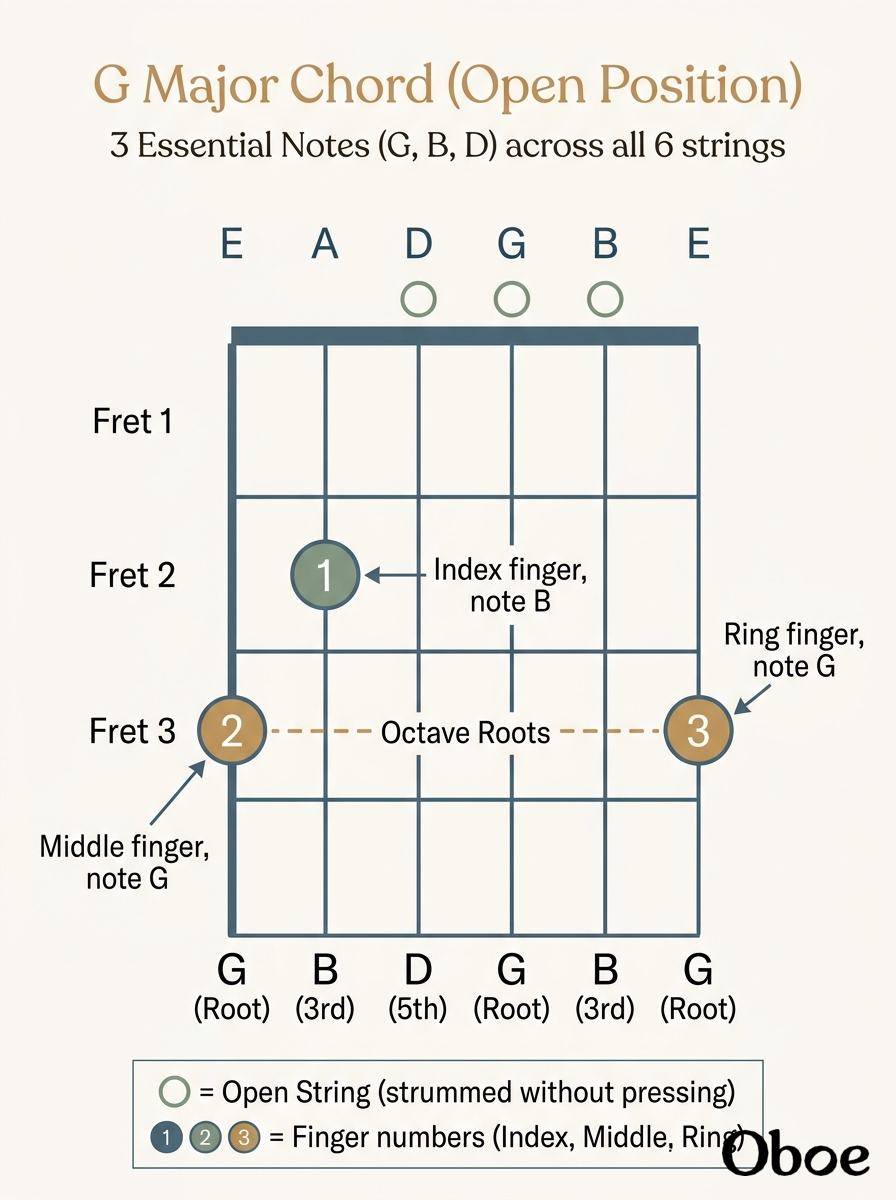
Make me a diagram of the standard G major chord shape
Here is a diagram showing the standard first-position G major chord shape on the guitar fretboard.

Continue to chord transitions and tips
When switching between chords, the secret to smooth transitions is finding anchor points—fingers that stay on the same string or keep a fixed shape.
Take the common progression from G major to or . In many modern acoustic styles, players leave their ring and pinky fingers anchored on the 3rd frets of the high B and E strings. This lets your index and middle fingers pivot smoothly between chords without taking your entire hand off the neck.