Kubernetes Essentials
Introduction to Kubernetes
What is Kubernetes?
Kubernetes is a system for managing groups of containers. Think of it as the conductor of an orchestra. Each musician (a container) plays a part, but the conductor ensures they all work together to create a beautiful symphony (your application).
Often shortened to "K8s" (because there are eight letters between the 'K' and 's'), it automates the deployment, scaling, and operation of applications. It was originally designed by Google and is now maintained by a massive open-source community.
Kubernetes (K8s) is an open-source platform for automating the deployment, scaling, and management of containerized applications.
From Servers to Containers
To understand why Kubernetes is so important, let's look at how things used to be done.
Traditional Deployment: In the past, applications were often run on physical servers. If you ran multiple applications on one server, they could interfere with each other. If you gave each application its own server, you wasted resources and money. Scaling up meant buying and setting up more physical hardware, which was slow and expensive.
Virtualization: The next step was virtual machines (VMs). A single physical server could host multiple VMs, each with its own operating system, acting as a separate computer. This was better for resource use, but each VM still carried the weight of a full OS, making them bulky.
Containerization: Containers are the modern solution. A container packages an application and all its dependencies into a single, isolated unit. Unlike a VM, it doesn't need its own operating system. It shares the OS of its host machine, making it incredibly lightweight and fast to start. This solves the problem of packaging and isolating applications.
But a new problem emerged: how do you manage hundreds or even thousands of these containers at scale? That's where Kubernetes comes in.
Key Benefits
Using Kubernetes provides some powerful advantages for running modern applications.
First, it offers automated scaling. Imagine your e-commerce website on Black Friday. Traffic spikes, and you need more power. Kubernetes can automatically add more containers to handle the load and then scale back down when traffic returns to normal. This saves money and ensures a smooth user experience.
Second, it provides self-healing. If a container crashes or a machine fails, Kubernetes detects it. It automatically restarts the failed container or moves it to a healthy machine, all without manual intervention. This makes applications highly reliable.
Finally, Kubernetes allows for seamless updates. You can roll out a new version of your application with zero downtime. Kubernetes gradually replaces old containers with new ones, ensuring the application is always available to users during the update.
The Basic Building Blocks
To get started with Kubernetes, you need to know three basic concepts that form its core structure.
Cluster
noun
The highest-level component. A cluster is a set of machines, called nodes, that run containerized applications. It's the entire Kubernetes environment.
A cluster contains at least one control plane (the brains) and one or more worker machines, known as nodes.
Node
noun
A single machine within a cluster. It can be a physical server or a virtual machine. Its job is to run the application containers.
Think of nodes as the worker bees of the cluster. They do the actual work of running your applications. On these nodes, you'll find pods.
Pod
noun
The smallest and simplest unit in the Kubernetes object model that you create or deploy. A pod represents a single instance of a running process in a cluster and holds one or more containers.
A pod is like a wrapper for your containers. While a pod can contain multiple containers, it's most common for a pod to have just one. Pods are the components that get scaled up or down and are restarted when they fail.
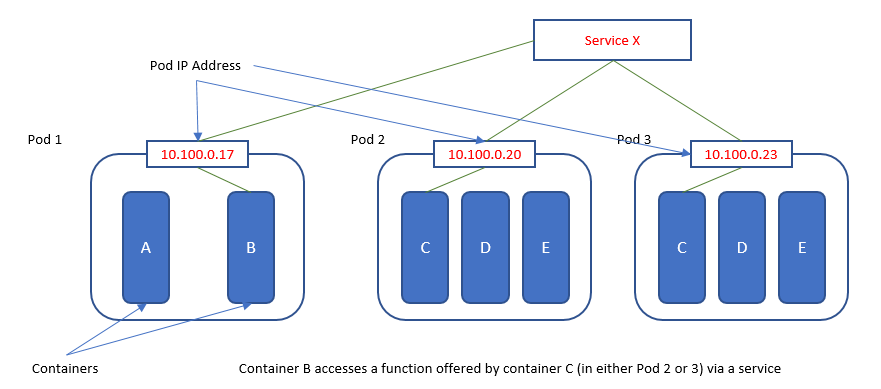
These three concepts—clusters, nodes, and pods—form the foundation of Kubernetes architecture. Understanding their relationship is the first step to mastering container orchestration.
What is the primary function of Kubernetes?
In the context of Kubernetes benefits, what does 'self-healing' refer to?