Kubernetes Essentials for Cloud-Native Apps
Kubernetes Overview
What Is Kubernetes?
Imagine you're conducting a massive orchestra. Each musician is an application component, and they all need to play in perfect harmony. If one musician stops, you need to replace them instantly. If the music gets louder, you need more violins. Managing this manually would be a nightmare.
That's where Kubernetes comes in. It's the conductor for your applications.
Kubernetes (K8s) is an open-source platform for automating the deployment, scaling, and management of containerized applications.
In simpler terms, Kubernetes groups your applications into logical units, making them easy to manage and discover. It was originally designed by Google and is now maintained by the Cloud Native Computing Foundation. Because of its origins at Google, it's built on over fifteen years of experience running production workloads at scale.
From Servers to Containers
To understand why Kubernetes is so important, let's look at how we used to deploy applications. In the beginning, organizations ran applications on physical servers. There was no way to define resource boundaries, which led to resource allocation issues. For example, if multiple applications ran on one physical server, one application could take up most of the resources, causing the others to underperform.
A solution was virtualization. It allows you to run multiple Virtual Machines (VMs) on a single physical server's CPU. Virtualization allows applications to be isolated between VMs and provides a level of security as the information of one application is not freely accessible by another application.
Then came containers. Containers are similar to VMs, but they have relaxed isolation properties to share the Operating System (OS) among the applications. Therefore, containers are considered lightweight. Like a VM, a container has its own filesystem, CPU, memory, process space, and more. Because they are decoupled from the underlying infrastructure, they are portable across clouds and OS distributions.
Containers are a great way to bundle and run your applications. In a production environment, you need to manage the containers that run the applications and ensure that there is no downtime. For example, if a container goes down, another container needs to start. Wouldn't it be easier if this behavior was handled by a system? That’s how Kubernetes comes to the rescue! It provides you with a framework to run distributed systems resiliently.
Key Benefits
Kubernetes offers several key advantages for managing containerized applications. It handles the heavy lifting, so you can focus on building features.
| Benefit | Description |
|---|---|
| Self-healing | If a container fails, Kubernetes automatically restarts it. It also replaces and reschedules containers when nodes die and kills containers that don't respond to health checks. |
| Automatic Scaling | Automatically scale your application up and down based on CPU usage or other custom metrics. |
| Service Discovery & Load Balancing | Kubernetes gives containers their own IP addresses and a single DNS name for a set of containers, and can load-balance across them. |
| Automated Rollouts & Rollbacks | You can describe the desired state for your deployed containers, and Kubernetes will change the actual state to the desired state at a controlled rate. For example, you can automate Kubernetes to create new containers for your deployment, remove existing containers and adopt all their resources to the new container. |
These features make it a powerful tool for managing complex applications, ensuring they are always available and running efficiently.
Kubernetes and Docker
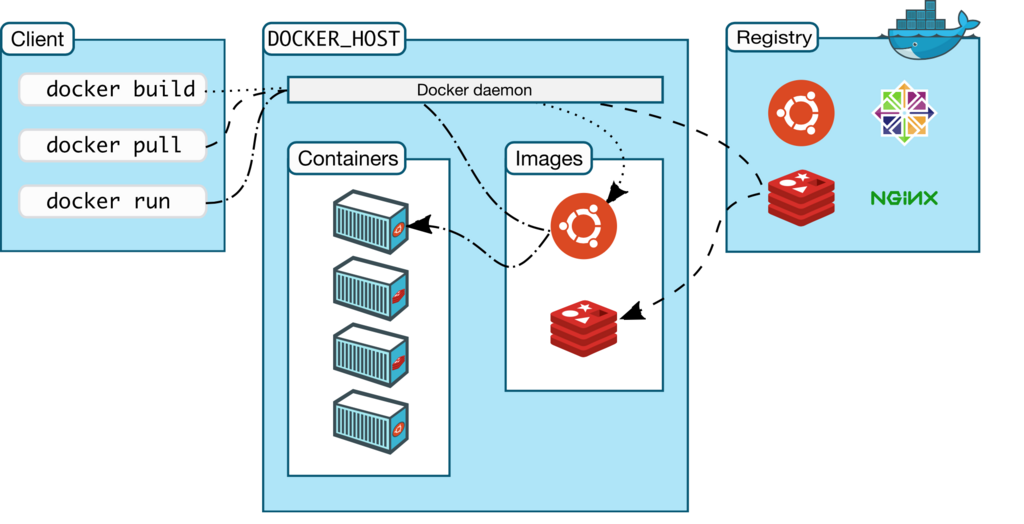
People often mention Kubernetes and Docker together. It's important to understand how they relate. Docker is a platform for creating and running containers. Kubernetes is a system for orchestrating, or managing, those containers.
Think of it this way: Docker provides the shipping containers, and Kubernetes is the port and shipping fleet that manages where the containers go, how many are needed, and what happens if one gets lost at sea. Kubernetes works with Docker, but it can also work with any container runtime that adheres to the Open Container Initiative (OCI) standards.
Now that you have a high-level view of what Kubernetes is and the problems it solves, let's test your knowledge.
What is the primary role of Kubernetes?
Which analogy best describes the relationship between Docker and Kubernetes?
This covers the fundamentals of Kubernetes. In the next section, we'll dive deeper into the components that make up the Kubernetes architecture.