Korean Language Fundamentals
Hangul Basics
A King's Gift
Before the 15th century, writing in Korean was a challenge. Most people used classical Chinese characters, which were complex and took years to master. This meant literacy was a privilege reserved for the elite. King Sejong the Great wanted to change that. He believed everyone deserved the ability to read and write.
So, in 1443, he and a team of scholars created a new writing system. They called it Hunminjeongeum, which means "The Proper Sounds for the Instruction of the People." Today, we call it Hangul (한글). It was designed to be so simple and logical that anyone could learn it quickly. Some even said a wise person could learn it in a morning, and anyone else in ten days.
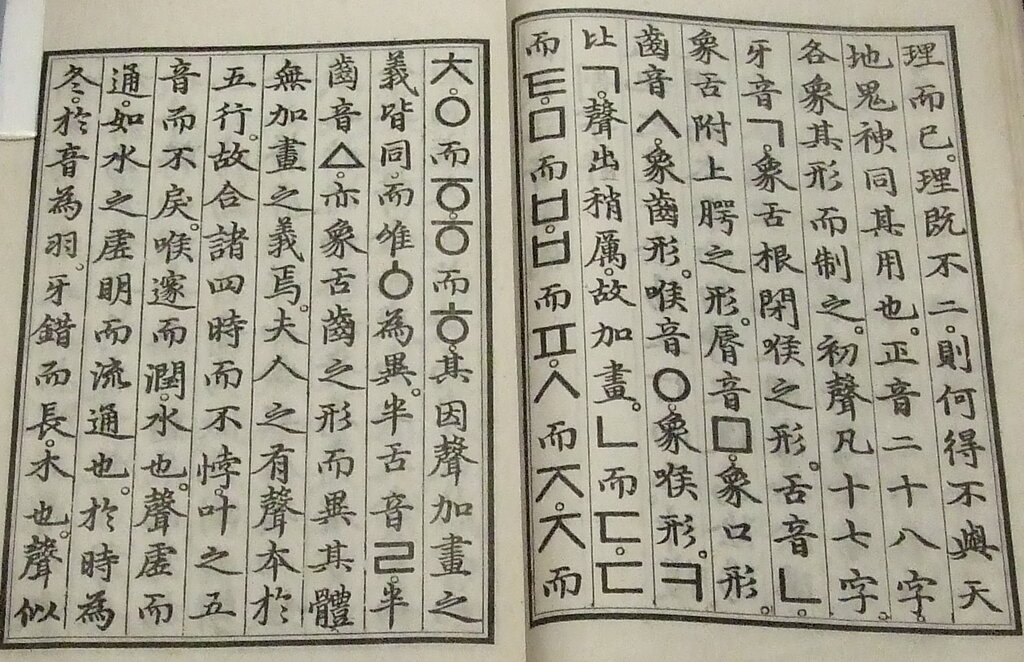
The Basic Components
Hangul is an alphabet, just like the one used for English. Each character represents a sound. There are two types of characters: consonants and vowels. Let's start with the vowels, which are built from just three simple shapes.
These three shapes combine to form all the basic vowels. The dot evolved into a short stroke over time. Notice how adding a short stroke to the basic lines creates the core vowels you'll use every day.
| Vowel | Sound | How it's formed |
|---|---|---|
| ㅏ | 'a' as in father | Human (ㅣ) + Heaven (•) on the right |
| ㅓ | 'eo' like uh in duh | Human (ㅣ) + Heaven (•) on the left |
| ㅗ | 'o' as in boat | Earth (ㅡ) + Heaven (•) above |
| ㅜ | 'u' like oo in moo | Earth (ㅡ) + Heaven (•) below |
| ㅡ | 'eu' like u in put | Just the Earth line |
| ㅣ | 'i' like ee in see | Just the Human line |
Next are the consonants. The genius of Hangul is that the basic consonant shapes are designed to look like the shape your mouth or tongue makes when you produce the sound. For example, ㄱ mimics the shape of the back of the tongue raised to the roof of the mouth.
| Consonant | Name | Sound (at start of syllable) |
|---|---|---|
| ㄱ | giyeok | g |
| ㄴ | nieun | n |
| ㄷ | digeut | d |
| ㄹ | rieul | r/l |
| ㅁ | mieum | m |
| ㅂ | bieup | b |
| ㅅ | siot | s |
| ㅇ | ieung | silent |
| ㅈ | jieut | j |
A quick note on ㅇ (ieung): When it comes before a vowel at the beginning of a syllable, it's just a silent placeholder. When it comes at the end, it makes an "ng" sound, like in "sing."
Building Syllable Blocks
Unlike English, where letters are written in a straight line, Hangul groups letters into syllable blocks. Every block must have at least one consonant and one vowel. The golden rule is that every syllable starts with a consonant.
The simplicity of Hangul can be attributed to its format of syllabic blocks: rather than written linearly, vowels and consonants are grouped into syllables that consist of letters arranged in a square block.
If a syllable starts with a vowel sound, we use the silent consonant ㅇ as a placeholder. The letters are arranged within a square block based on the shape of the vowel.
Let's try building a few words. The word for "child" is 아이 (ai). It has two syllables: "a" and "i".
- The first syllable is the vowel sound "a" (ㅏ). Since it starts a syllable, we need the silent consonant ㅇ. The vowel ㅏ is vertical, so we place the consonant to its left: 아.
- The second syllable is the vowel sound "i" (ㅣ). Again, we need the placeholder ㅇ. The vowel ㅣ is also vertical, so we place ㅇ to its left: 이.
Put them together, and you get 아이.
How about the word for "cucumber," which is 오이 (oi)?
- The first syllable is "o" (ㅗ). We add the silent ㅇ. Because ㅗ is a horizontal vowel, the consonant goes on top: 오.
- The second syllable is "i" (ㅣ), which we already know is 이.
Together, they form 오이.
Let's try one with a final consonant. The word for "bear" is 곰 (gom). This is just one syllable.
- It starts with the consonant ㄱ (g).
- The vowel is ㅗ (o).
- It ends with the consonant ㅁ (m).
Since the vowel ㅗ is horizontal, ㄱ goes on top. The final consonant ㅁ, called the batchim (받침), always goes at the bottom of the block. This gives us 곰.
What was the original name for the Hangul alphabet when it was created in 1443?
What was the primary motivation for King Sejong the Great to create a new writing system for Korean?
With these basic building blocks, you can already start to read and write simple Korean words. It's a system designed for clarity and ease of learning, just as King Sejong intended.