Korean Language Fundamentals
Hangul Alphabet
The Genius of Hangul
Before the 15th century, writing in Korean was a challenge. Koreans used classical Chinese characters, which were complex and didn't fit the spoken language well. This meant literacy was mostly for the elite. King Sejong the Great wanted to change that. He believed everyone should be able to read and write.
So, in 1443, he and a group of scholars created a new writing system: Hangul (한글). It was designed to be simple, logical, and scientific. The goal was for an ordinary person to learn it in just a few days. The system was originally published in a document called Hunminjeongeum, which means "The Correct Sounds for the Instruction of the People."
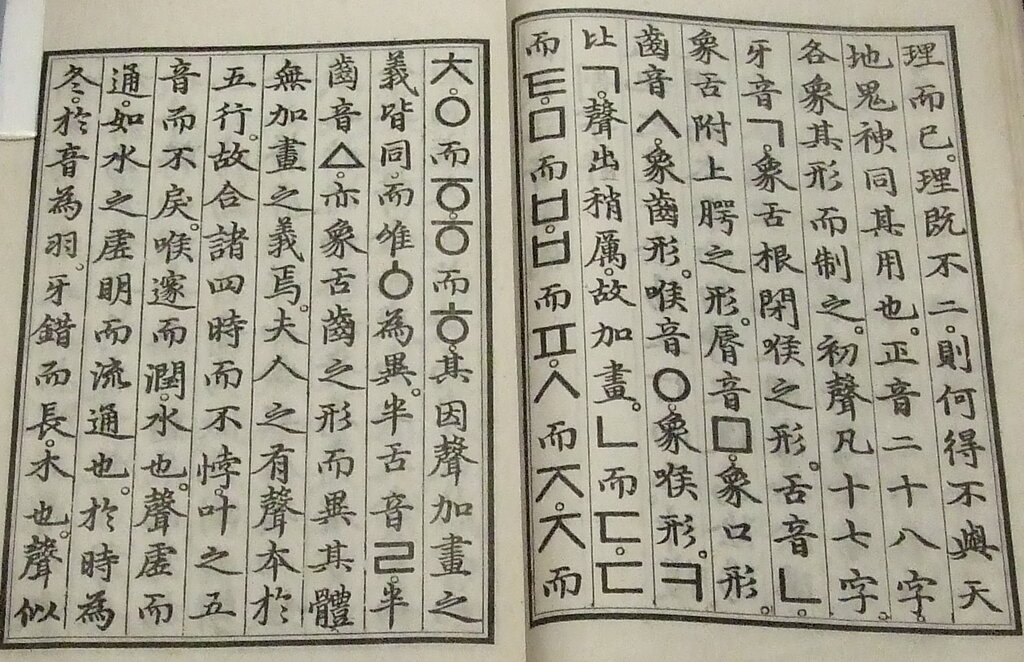
Hangul, the Korean alphabet, is a unique and scientific writing system that was invented in the 15th century by King Sejong the Great and his scholars.
Letters in Blocks
Unlike English, where letters are written one after another in a line, Hangul letters are grouped into syllabic blocks. Think of it like assembling LEGOs. Each block represents one syllable and is made up of at least one consonant and one vowel. These blocks are then read from left to right, top to bottom.
A syllable block always starts with an initial consonant, followed by a vowel, and sometimes ends with a final consonant. Even if a syllable starts with a vowel sound, it uses a special silent consonant, ㅇ, as a placeholder.
The Consonants
Hangul has 14 basic consonants. What's amazing is that their shapes are not random. They were designed to mimic the shape of your mouth, tongue, and throat when you make their sounds. This makes them incredibly intuitive to learn.
For example, the consonant ㄱ (g/k) represents the back of the tongue raised to touch the soft palate. The square-like ㅁ (m) represents the shape of closed lips.
| Character | Name | Sound |
|---|---|---|
| ㄱ | giyeok (기역) | g / k |
| ㄴ | nieun (니은) | n |
| ㄷ | digeut (디귿) | d / t |
| ㄹ | rieul (리을) | r / l |
| ㅁ | mieum (미음) | m |
| ㅂ | bieup (비읍) | b / p |
| ㅅ | siot (시옷) | s / sh |
| ㅇ | ieung (이응) | ng / silent |
| ㅈ | jieut (지읒) | j |
| ㅊ | chieut (치읓) | ch |
| ㅋ | kieuk (키읔) | k |
| ㅌ | tieut (티읕) | t |
| ㅍ | pieup (피읖) | p |
| ㅎ | hieut (히읗) | h |
Notice that some letters have two sounds listed. The sound often changes depending on whether the consonant is at the beginning or end of a syllable. For now, just familiarize yourself with their basic shapes and sounds. We'll explore the nuances later.
The Vowels
There are 10 basic vowels in Hangul, and they were created with a philosophical concept in mind, representing the three pillars of the universe.
All other basic vowels are formed by combining these three elements. For example, adding a 'Heaven' dot to the right of 'Humanity' creates ㅏ (a). Adding it to the left creates ㅓ (eo).
| Character | Sound (approximate) |
|---|---|
| ㅏ | a (like in "father") |
| ㅑ | ya (like in "yacht") |
| ㅓ | eo (like 'u' in "uh-oh") |
| ㅕ | yeo (like 'yo' in "yonder") |
| ㅗ | o (like in "go") |
| ㅛ | yo (like in "yo-yo") |
| ㅜ | u (like 'oo' in "moon") |
| ㅠ | yu (like in "you") |
| ㅡ | eu (like 'u' in "put") |
| ㅣ | i (like 'ee' in "see") |
Now you have the basic building blocks. Let's try combining them.
Making Syllables
Let's form some simple words. Remember, it's just a consonant plus a vowel. To write the word for "child," ai, we can't just write the vowel ㅏ. We need a placeholder initial consonant. We use ㅇ, which is silent in that position.
child
Here, the first block is ㅇ (silent) + ㅏ (a) = 아 (a). The second is ㅇ (silent) + ㅣ (i) = 이 (i). Together, they make 아이 (ai). How about the word for "cucumber"?
cucumber
That's ㅇ (silent) + ㅗ (o) = 오 (o), and ㅇ (silent) + ㅣ (i) = 이 (i). Let's try one with an audible consonant.
furniture
This is ㄱ (g) + ㅏ (a) = 가 (ga), and ㄱ (g) + ㅜ (u) = 구 (gu).
Practice these combinations. Try writing them out. You'll be surprised how quickly you start recognizing the patterns and reading simple Korean words.
Who is credited with commissioning the creation of the Hangul alphabet to improve literacy among common people?
Unlike English letters which are written sequentially, how are Hangul letters arranged?
You've just taken your first step into reading and writing Korean. By mastering these foundational letters, you've unlocked the door to a rich and beautiful language.