JavaScript vs Python
Introduction to Programming Languages
The Language of the Web
In the early days of the internet, websites were static pages of text and images. They were like digital brochures. If you wanted to make them interactive—to have things happen without loading a whole new page—you were out of luck. That changed in 1995.
A programmer at Netscape named Brendan Eich was tasked with creating a simple scripting language for the Netscape Navigator browser. He reportedly built the first version in just ten days. Initially called Mocha, then LiveScript, it was eventually renamed JavaScript in a marketing move to capitalize on the popularity of another language, Java. Despite the similar names, the two languages are completely different.
JavaScript’s purpose was to bring life to web pages. It allowed developers to create pop-up alerts, validate forms before sending them to a server, and create simple animations. For years, this was its domain: running inside a user's web browser to manage front-end interactivity.
But the language evolved. Browsers became more powerful, and JavaScript's capabilities grew. A major turning point came in 2009 with the creation of Node.js. This allowed JavaScript to run outside of the browser, on servers. Suddenly, developers could use the same language to build both the user-facing part of a website (the front end) and the server-side logic (the back end).
Today, JavaScript is the undisputed language of web development. It powers the interactive features of nearly every modern website, from social media feeds that update automatically to complex, in-browser applications like Google Docs.
The Generalist's Tool
Around the same time JavaScript was being born, a Dutch programmer named Guido van Rossum was creating a different kind of language. He wanted to build a language that was easy to read and write, with a clean, uncluttered syntax. He named it Python, inspired by the British comedy group Monty Python.
Python’s philosophy is centered on simplicity and readability. The idea is that code is read far more often than it is written, so it should be clear and easy to understand. This design choice made it popular in academia and scientific computing, but its reach quickly expanded.
Unlike JavaScript, which was built for a very specific purpose, Python was designed as a general-purpose language. It's like a versatile multitool. You can use it for almost anything.
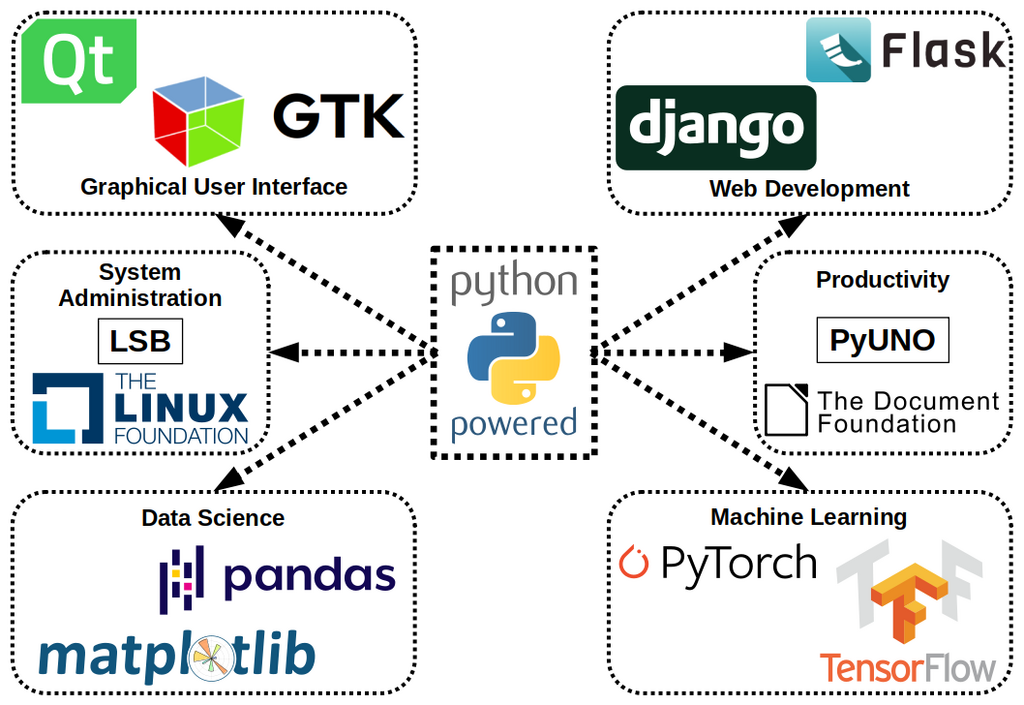
Python's primary applications are incredibly diverse. On the web, it's used for back-end development with frameworks like Django and Flask, powering sites like Instagram and Spotify. It's a dominant force in data science and machine learning, thanks to powerful libraries like pandas, NumPy, and TensorFlow. Programmers also use it for scripting and automation, writing small programs to automate repetitive tasks, from organizing files to managing systems.
Its straightforward syntax makes it a popular first language for new programmers, but its power and flexibility make it a favorite of seasoned experts as well.
What was the original name of the language we now know as JavaScript?
What is a fundamental difference between the initial design philosophies of Python and JavaScript?
While both languages can build web applications, they started from very different places and excel in different areas. JavaScript was born in the browser, while Python was designed for general-purpose programming.