Java Programming Fundamentals
Introduction to Programming
What Is Programming?
At its heart, programming is simply telling a computer what to do. Think of a computer as an incredibly powerful but very literal assistant. It can perform billions of calculations per second, but it won’t do anything without specific, step-by-step instructions. Programming is the art of writing those instructions.
Programming
noun
The process of designing and writing a set of instructions that a computer can follow to perform a specific task.
These instructions, collectively called a program or code, can do everything from displaying a button on your phone screen to guiding a spacecraft to Mars. Every app you use, every website you visit, and every video game you play is powered by code written by programmers.
Speaking the Computer's Language
You can't just tell a computer, “Show me a picture of a cat.” Computers don’t understand English, Spanish, or any other human language. They understand machine code, which is a stream of ones and zeros. Writing directly in machine code is incredibly tedious and difficult for humans.
This is where programming languages come in. They act as a bridge, allowing us to write instructions in a way that is readable for humans but can be translated into machine code for the computer.
There are hundreds of programming languages, each with its own syntax (grammar rules) and strengths. Think of them like different tools in a toolbox. You might use a hammer for a nail and a wrench for a bolt. Similarly, a programmer might choose Python for data analysis, JavaScript for a website, or C++ for a high-performance video game. Despite their differences, they all share the same fundamental purpose: turning human logic into instructions a computer can execute.
From Code to Action
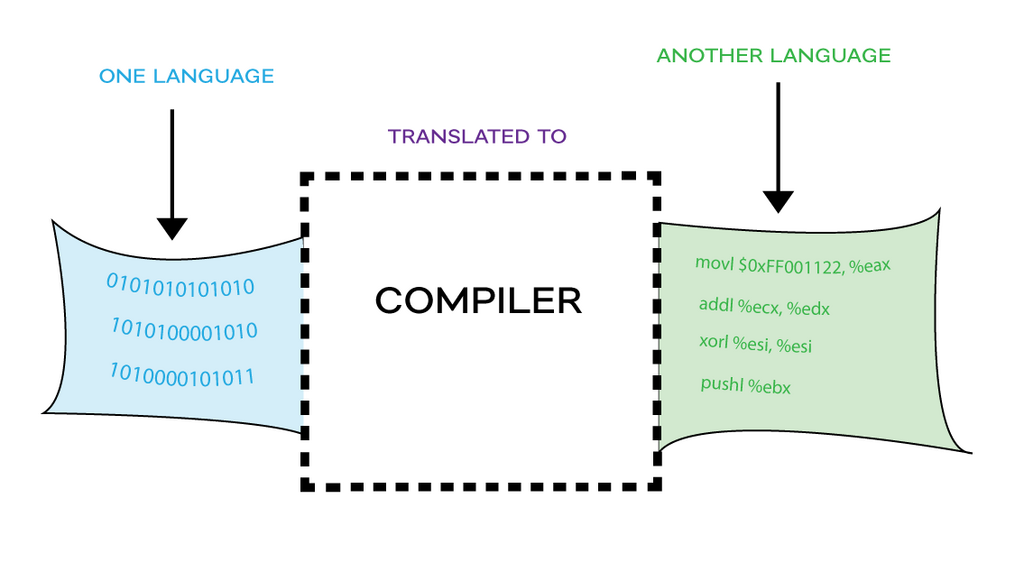
So you've written your instructions in a programming language. How does the computer actually run them? The source code you write must be converted into the ones and zeros of machine code that the computer's central processing unit (CPU) can understand. This translation is done by special programs called compilers or interpreters.
| Translator | How it Works | Analogy |
|---|---|---|
| Compiler | Translates the entire program at once, creating a separate executable file. | A book translator who translates an entire novel from French to English before you read it. |
| Interpreter | Translates and executes the program line by line. | A live interpreter who translates a speech sentence by sentence as it's spoken. |
Regardless of the method, the end goal is the same: to turn your human-readable code into machine-executable instructions. Once translated, the CPU can carry out these instructions, performing the calculations, manipulating data, and ultimately accomplishing the task you programmed it to do.
The Heart of Programming: Algorithms
Before you can write a single line of code, you need a plan. In programming, that plan is called an algorithm. It sounds like a complex term, but it's something you use every day.
Algorithm
noun
A finite sequence of well-defined, computer-implementable instructions, typically to solve a class of problems or to perform a computation.
A recipe for baking a cake is an algorithm. The directions your GPS gives you are an algorithm. It’s simply a clear, step-by-step set of rules for accomplishing a task. A good algorithm must be unambiguous and have a clear stopping point.
Algorithm for Making Toast
- Take one slice of bread from the bag.
- Place the bread in a toaster slot.
- Push the lever down.
- Wait until the toast pops up.
- Remove the toast from the toaster.
Programming is the process of first designing this logical sequence of steps (the algorithm) and then translating it into a programming language that the computer can execute. Strong logical thinking and problem-solving skills are the true foundation of being a great programmer. The language is just the tool you use to express that logic.
What is the primary role of a program, or code?
A recipe for baking a cake is a good analogy for a(n) ____.
With these fundamentals in place, you're ready to explore how these concepts are applied in a specific language like Java.