Java Arrays Explained
Introduction to Arrays
What Is an Array?
Think of an egg carton. It's a container designed to hold a specific number of eggs, all neatly arranged in separate slots. An array in programming works in a very similar way. It's a fundamental data structure that acts as a container, holding multiple items, or elements, in a single place.
An array is a collection of items of the same type stored in a single, contiguous block of memory.
The key idea is that all items in an array must be of the same data type. Just as you'd only put eggs in an egg carton, an array in Java might hold a collection of integers, or a collection of strings, but never a mix of both. This uniformity is what makes arrays predictable and efficient.
Key Characteristics
Every array, regardless of the programming language, shares a few core traits. Understanding them is key to using arrays effectively.
First, an array has a fixed size. When you create an array, you decide how many slots it will have. If you make an array to hold 10 numbers, it will always have exactly 10 slots. You can't add an 11th slot later on, just like you can't magically add another cup to a 12-egg carton.
Second, arrays store homogeneous data. As we mentioned, every element in the array must be of the same type. This consistency allows the computer to manage the data much more efficiently.
Third, every element in an array has a unique identifier called an index. Think of it as a house number on a street. The first element is at index 0, the second is at index 1, and so on. This numbering system makes it easy to find any specific element.
Finally, the elements in an array are stored in contiguous memory. This means they're placed right next to each other in the computer's memory, like a row of connected townhouses. This physical arrangement is one of the reasons arrays are so fast.
| Characteristic | Description |
|---|---|
| Fixed Size | The number of elements cannot be changed after creation. |
| Homogeneous Data | All elements must be of the same data type. |
| Indexed | Each element has a unique numerical index, starting from 0. |
| Contiguous Memory | Elements are stored side-by-side in memory. |
Why Use Arrays?
So, why are arrays so common in programming? They offer a few significant advantages.
Their biggest strength is efficiency. Because all elements are the same size and stored contiguously, the computer can calculate the exact memory location of any element based on its index. This makes retrieving an element incredibly fast, no matter how large the array is. It's like instantly knowing where the fifth book on a shelf is without having to scan the first four.
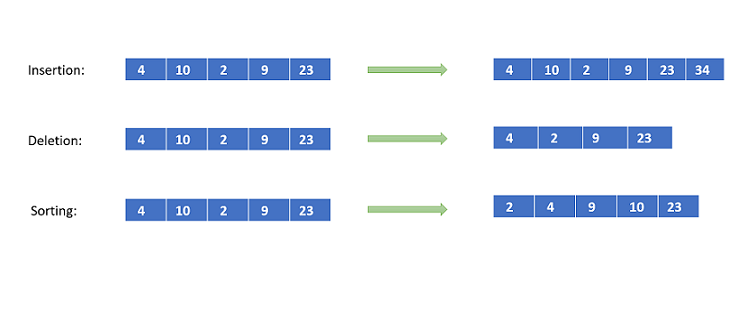
Arrays also improve code organization. Instead of creating separate variables for related pieces of data, like score1, score2, and score3, you can group them into a single array called scores. This makes your code cleaner, more readable, and easier to manage, especially when dealing with large amounts of data.
By grouping data, arrays provide a simple and powerful way to handle collections of similar items, from a list of user names to the pixel data for an image.