Java AI Agent Development
Introduction to AI Agents
What Is an AI Agent?
Think of an agent as someone or something that acts on your behalf. A travel agent books your flights, and a real estate agent helps you find a house. An AI agent is a software program that does something similar. It perceives its environment, makes decisions, and takes actions to achieve a specific goal, all without direct human command for every step.
An AI agent is an autonomous program that senses its environment and acts upon it to achieve its goals.
To get a better feel for what makes an agent, let's look at its key characteristics. A true AI agent isn't just a simple script; it has a few distinct qualities that make it intelligent.
AI agents are defined by four main traits:
- Autonomy: They operate independently without constant human supervision. You give them a goal, and they figure out the steps to get there.
- Reactivity: They are aware of their surroundings and can react to changes. If an unexpected obstacle appears, a reactive agent can adapt its plan.
- Pro-activeness: They don't just react; they take initiative. A proactive agent might identify a potential problem and solve it before it happens.
- Social Ability: They can communicate and cooperate with other agents and humans to achieve their objectives. This is crucial for tasks that require teamwork.
Types of Agents
Not all agents are created equal. They range from simple programs that follow basic rules to complex systems that can reason and learn. We can group them into a few main categories.
Simple Reflex Agents These are the most basic type. They make decisions based only on the current situation, following a simple "if-then" rule. They have no memory of the past. A thermostat is a good real-world parallel: if the room is cold, turn on the heat. It doesn't remember that it was hot an hour ago.
Model-Based Reflex Agents These agents are a step up. They maintain an internal 'model' or representation of the world around them. This allows them to handle situations where they can't see everything at once. For example, a self-driving car's agent needs a model of the road to know that a car that just went behind a pillar still exists.
Goal-Based Agents (Deliberative) These agents have explicit goals to achieve. Instead of just reacting, they can plan a sequence of actions to reach a desired state. If you ask a travel agent to book the cheapest flight to Paris, it will search, compare, and execute a series of steps to fulfill that specific goal.
Utility-Based Agents These are more advanced goal-based agents. They don't just try to achieve a goal; they try to achieve it in the best way possible. They weigh the pros and cons of different outcomes to maximize their 'utility' or happiness. For our travel agent, this might mean finding a flight that's not just cheap but also has a short layover and good reviews.
Learning Agents Learning agents can improve their own performance over time. They start with some initial knowledge and learn from their experiences, much like humans do. A spam filter is a classic example. It learns what you consider junk mail based on the emails you mark as spam, getting better at its job with each interaction.
Where We See AI Agents
AI agents aren't just theoretical concepts; they're already at work in many fields, often behind the scenes.
| Domain | Example Application |
|---|---|
| E-commerce | Chatbots that act as virtual customer service agents, answering questions and resolving issues. |
| Healthcare | Systems that monitor patient data to predict health risks or recommend personalized treatment plans. |
| Finance | Automated trading agents that analyze market data to buy or sell stocks based on predefined strategies. |
| Robotics | Autonomous robots in warehouses that navigate aisles, locate items, and transport them for shipping. |
| Gaming | Non-player characters (NPCs) in video games that react intelligently to the player's actions, creating a more immersive experience. |
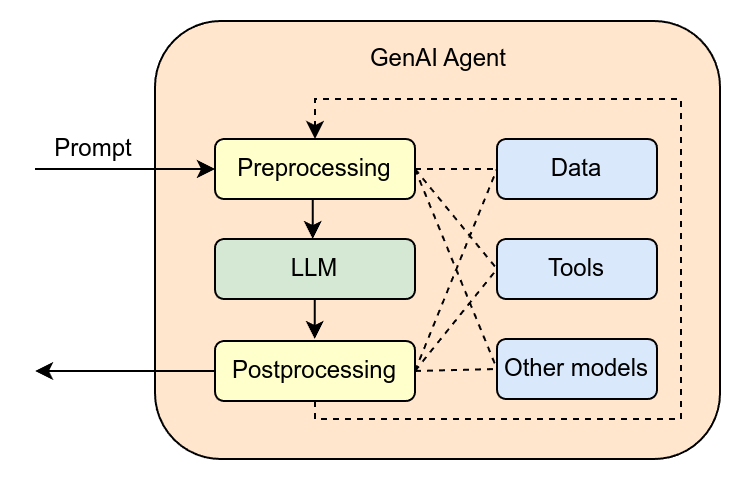
The rise of Large Language Models (LLMs) has supercharged what agents can do. Modern agents can understand complex requests, break them down into smaller tasks, use various software tools (like calendars or search engines), and execute plans to accomplish sophisticated goals.
Benefits and Challenges
Using AI agents offers clear advantages. They can automate repetitive and complex tasks, freeing up human time for more creative work. They operate 24/7 without fatigue, process vast amounts of data much faster than humans, and can make decisions with high precision and consistency.
However, building and deploying them comes with challenges. Creating an agent that can reason and act reliably in a complex, unpredictable world is difficult. There are also important ethical considerations, such as ensuring agents make fair decisions and holding them accountable when they make mistakes. As agents become more autonomous, questions of security and control become increasingly critical.
Let's check your understanding of these core concepts.
Which of the following best describes the fundamental role of an AI agent?
An AI agent for a home security system detects a potential intruder and, without waiting for a command, locks all doors and alerts the authorities. Which key trait is it primarily demonstrating?
Understanding these foundational ideas about what AI agents are, the different types that exist, and where they fit into the world is the first step toward building them.