IT System Development Methodologies
Software Development Methodologies
Choosing a Path
Building software is like constructing a building. You can't just start laying bricks and hope for the best. You need a plan, a blueprint, a methodology. A software development methodology is a framework that structures how a team designs, builds, and maintains software. Choosing the right one can be the difference between a sleek skyscraper and a pile of rubble.
Various SDLC models, such as Waterfall, V-shaped, Iterative, Spiral, and Agile, provide distinct frameworks for task organization and efficient management of the software development process.
Think of it as the set of rules and roles for the project. Who does what? When do they do it? How does everyone stay in sync? The methodology answers these questions. Let's look at some of the most common blueprints used in the industry.
The Waterfall Method
The Waterfall methodology is the oldest and most straightforward approach. It's a linear, sequential process where you complete one full phase before moving on to the next. Imagine building a house, one floor at a time. You must finish the foundation before you can frame the walls, and you must finish the walls before you can put on the roof. There's no going back to pour more concrete after the roof is on.
Each phase has a distinct goal and delivers a specific outcome, like a requirements document or test results. This method's strength lies in its simplicity and emphasis on thorough documentation. It works best for projects where the requirements are crystal clear from the start and are not expected to change. For example, building a simple inventory management system for a warehouse with fixed, unchangeable processes is a good fit for Waterfall.
In Waterfall, progress flows in one direction, downwards through the phases, much like a waterfall.
The Agile Approach
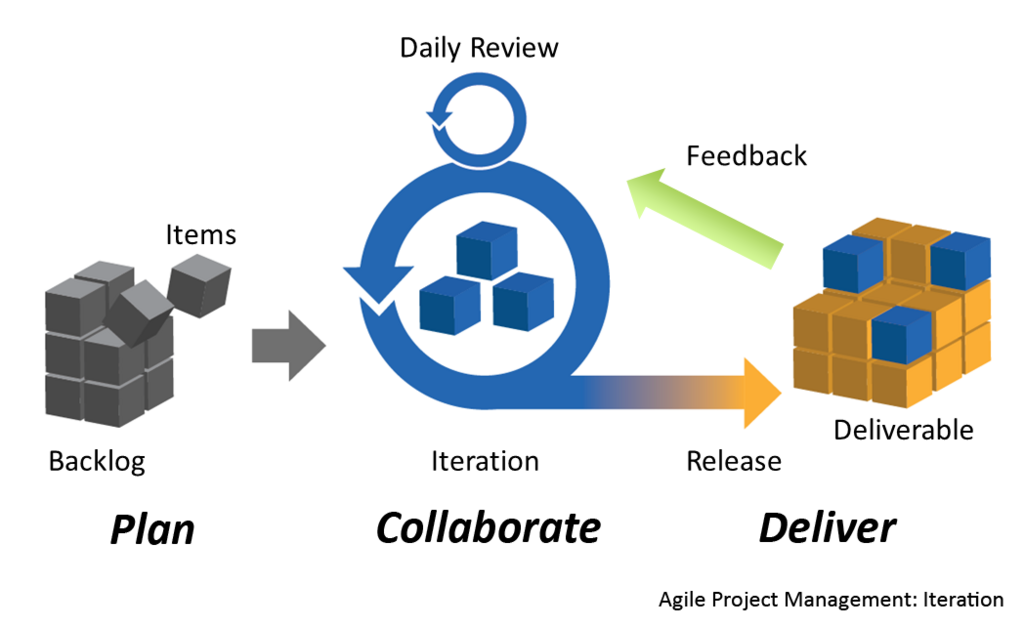
If Waterfall is like building a pre-designed house, Agile is like sculpting a block of marble. You start with a general idea of what you want to create, but the final form emerges through a series of small, incremental changes. You chip away, step back, assess your work, and then chip away some more.
Agile
adjective
A project management approach that uses an iterative process of planning and execution. Work is done in small increments, allowing teams to adapt to changes quickly.
Agile methodologies break a project into small, manageable cycles called sprints or iterations. Each sprint typically lasts a few weeks and results in a working piece of the software. This allows the team to get feedback from the customer early and often, making it easy to adapt to changing requirements. Agile values customer collaboration, individual interactions, and responding to change over rigid plans and processes. It’s ideal for complex projects where the requirements are likely to evolve, such as developing a new mobile app in a competitive market.
Comparing the Models
The choice between Waterfall and Agile depends entirely on the project's nature. Neither is universally better, but one is often a better fit. A project with a fixed budget, clear goals, and a stable environment might thrive with Waterfall. A project exploring new territory with a high degree of uncertainty is better suited for Agile.
| Feature | Waterfall | Agile |
|---|---|---|
| Project Flow | Linear, sequential | Iterative, cyclical |
| Flexibility | Rigid, changes are costly | Highly flexible, changes are welcome |
| Customer Involvement | Low, mainly at start and end | High, continuous collaboration |
| Documentation | Extensive and comprehensive | Minimal, just enough |
| Risk Management | Handled at the end | Addressed in each iteration |
Beyond the Big Two
While Waterfall and Agile are the most well-known, several other methodologies and variations exist, each offering a different flavor of project management.
The V-Model, also known as the Verification and Validation model, is an extension of the Waterfall model. For every development phase, there is a corresponding testing phase. This emphasis on testing helps ensure that defects are found early.
The Spiral Model is a more risk-averse approach. It combines elements of both iterative development (like Agile) and systematic control (like Waterfall). The project passes through four phases in a spiral fashion: planning, risk analysis, engineering, and evaluation. This model is well-suited for large, expensive, and complicated projects where risk management is paramount.
Finally, Adaptive Software Development (ASD) is a methodology that grew out of the idea that continuous adaptation is the normal state of a project. It has a three-phase cycle: Speculate, Collaborate, and Learn. 'Speculate' replaces the rigid planning of other models, acknowledging that you can't plan everything perfectly. 'Collaborate' focuses on teamwork and communication to solve complex problems. 'Learn' emphasizes that the team must continuously learn from mistakes and successes to improve.
Ready to check your understanding? Let's see how well you've grasped these concepts.
Which of the following best describes the Waterfall methodology?
A startup is creating a novel social media application. The market is new, and the final feature set is uncertain. The plan is to release a basic version quickly and then add features based on user feedback. Which methodology is most suitable?
Understanding these different blueprints is the first step for any aspiring software engineer or project manager. The key is to match the project's needs with the methodology's strengths.