Introduction to Synthetic Intelligence
Introduction to Artificial Intelligence
What Is Artificial Intelligence?
Artificial Intelligence, or AI, is about making computers smart. Think of it like this: you teach a person how to do a new task by showing them examples. AI works in a similar way, but with machines. We feed them huge amounts of information, and they learn to recognize patterns, make decisions, and solve problems.
Artificial Intelligence
noun
The theory and development of computer systems able to perform tasks that normally require human intelligence, such as visual perception, speech recognition, decision-making, and translation between languages.
Sometimes you'll hear the term Synthetic Intelligence (SI) used as well. It means the same thing. At its core, AI is a broad field of computer science dedicated to simulating intelligent behavior in computers.
This introduction to this special issue discusses artificial intelligence (AI), commonly defined as “a system’s ability to interpret external data correctly, to learn from such data, and to use those learnings to achieve specific goals and tasks through flexible adaptation.”
A Quick Trip Through Time
The idea of intelligent machines has been around for centuries, but the actual field of AI research was born in the summer of 1956 at a workshop at Dartmouth College. That's where the name "artificial intelligence" was coined.
The journey since then has been a rollercoaster. There were periods of great excitement and funding, followed by "AI winters" when progress stalled and interest faded. In the last couple of decades, though, things have taken off. The explosion of available data and massive increases in computing power have fueled breakthroughs that were once just science fiction.

Two Kinds of AI
When people talk about AI, they are usually talking about one of two different types: Narrow AI or General AI. Understanding the difference is key.
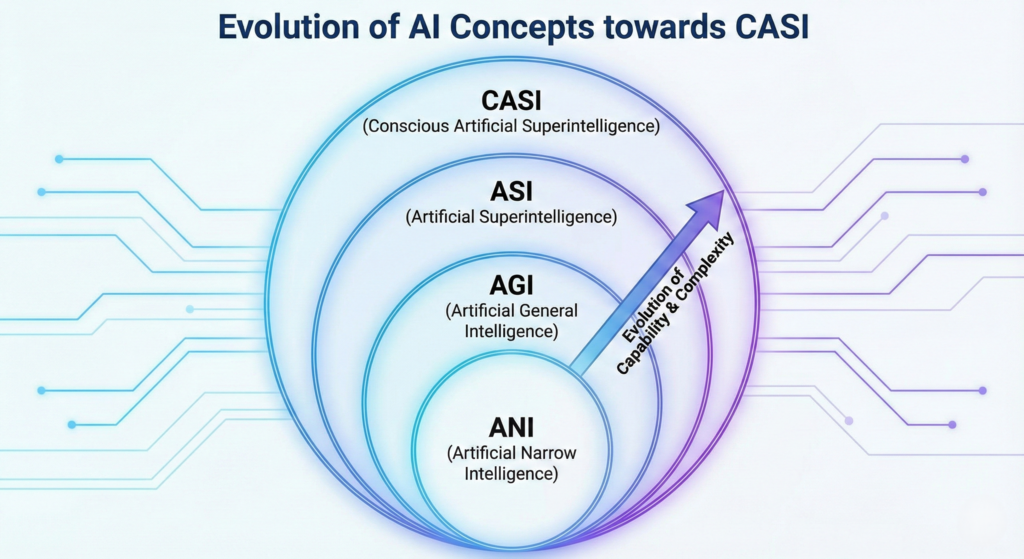
Artificial Narrow Intelligence (ANI), sometimes called Weak AI, is what we have today. It's an AI that is designed and trained for one specific task. Your phone's voice assistant, the spam filter in your email, and the recommendation engine on a streaming service are all examples of narrow AI. They are incredibly good at what they do, but they can't operate outside of their defined purpose. You can't ask your spam filter to drive a car.
Artificial General Intelligence (AGI), or Strong AI, is different. This is the type of AI you see in movies. It's a machine with the ability to understand, learn, and apply its intelligence to solve any problem, much like a human being. It could switch from writing a poem to composing music to solving a complex physics equation. AGI doesn't exist yet; it's still a theoretical goal for researchers.
| Feature | Narrow AI (ANI) | General AI (AGI) |
|---|---|---|
| Scope | Performs a specific task | Can handle any intellectual task |
| Examples | Siri, Alexa, Self-driving cars | Data (Star Trek), HAL 9000 (2001) |
| Current Status | Exists today and is widely used | Theoretical, does not exist yet |
| Capability | Superhuman at its one task | Human-like, adaptable intelligence |
Why AI Matters
AI is more than just a buzzword; it's a technology that is fundamentally changing our world. It's helping doctors diagnose diseases earlier, enabling farmers to grow more food with fewer resources, and personalizing education for students. AI powers the tools we use every day, from navigation apps to online shopping.
The future impact could be even more profound. As AI becomes more capable, it could help us tackle some of humanity's biggest challenges, like climate change, disease, and poverty. Of course, this also brings up important questions about ethics, job displacement, and safety that we need to address as the technology develops.
Now, let's review the main ideas we've covered.
Ready to test your knowledge?
What is the core concept behind Artificial Intelligence (AI)?
A voice assistant on your phone that can answer questions and set timers is a real-world example of what?
From its early days as a theoretical concept to its current role as a transformative technology, AI has come a long way. Understanding its basic principles is the first step to navigating the future it's helping to create.