Introduction to Recurrent Neural Networks
Introduction to Neural Networks
The Artificial Neuron
Neural networks are inspired by the human brain. The brain's basic building block is a cell called a neuron. It receives signals, processes them, and passes them on. Artificial neural networks use a simplified model of this process.
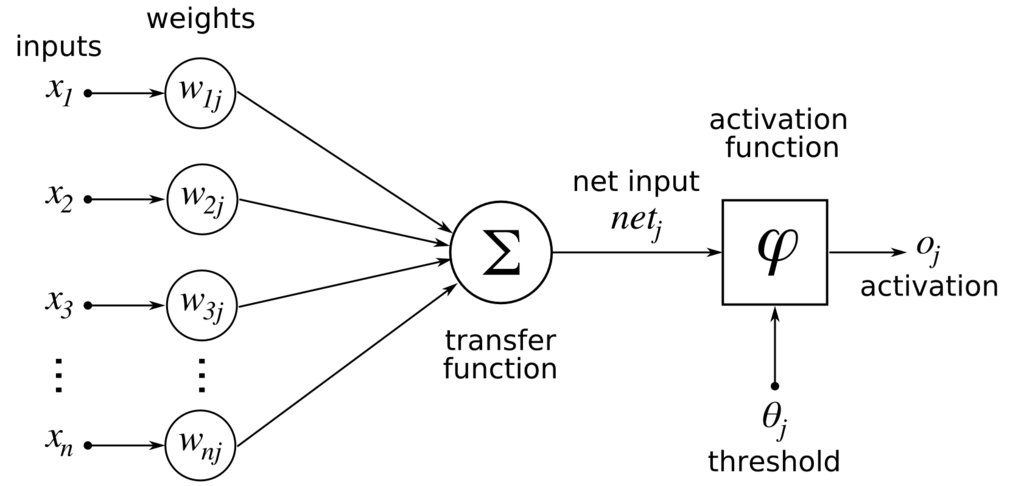
The artificial neuron, or perceptron, is the fundamental unit of a neural network. It works in a few simple steps:
- It receives inputs. Each input is a piece of data, like a pixel from an image or a word from a sentence.
- Each input has a weight. The weight is a number that represents the importance of that input. A higher weight means the network considers that input more significant. Initially, these weights are set to random values.
- It calculates a weighted sum. The neuron multiplies each input value by its corresponding weight and adds them all up. It also adds a special value called a bias, which helps adjust the output.
- It applies an activation function. The weighted sum is passed through an activation function. This function acts like a gatekeeper, deciding whether the neuron should "fire" (pass on a signal) and what that signal should be. This step is crucial because it allows the network to learn complex patterns, not just simple linear relationships.
Think of weights as knobs you can turn. The network's goal is to learn the perfect setting for each knob to solve a specific problem.
Building a Network
A single neuron isn't very powerful. The real magic happens when we connect many of them together into a network. The simplest type is a feedforward neural network.
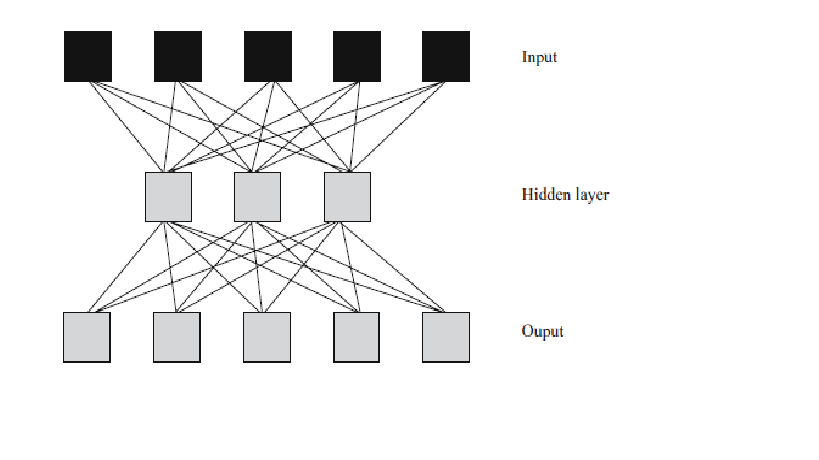
In this architecture, neurons are organized into layers. Information flows in one direction, from the first layer to the last, without looping back. That's why it's called "feedforward."
-
Input Layer: This is the network's front door. It receives the initial data. For example, if you're analyzing a 28x28 pixel image, this layer might have 784 neurons, one for each pixel.
-
Hidden Layers: These are the layers between the input and output. They perform most of the computation. Each neuron in a hidden layer receives outputs from the previous layer, applies its own weights and activation function, and passes the result forward. The more hidden layers a network has, the more complex the patterns it can learn.
-
Output Layer: This is the final layer. It produces the network's prediction. The number of neurons here depends on the task. For a simple yes/no question, it might be just one neuron. For classifying an image into one of ten categories, it would have ten neurons.
How a Network Learns
A brand new network with random weights is like a student on their first day of class, it doesn't know anything. It learns by practicing. We give it a problem, it makes a guess, we tell it how wrong it was, and it adjusts its thinking to do better next time. This process involves two key ideas: backpropagation and gradient descent.
Backpropagation
noun
An algorithm for calculating how much each weight and bias in the network contributed to the final error.
After the network makes a prediction, we compare it to the correct answer. The difference is the error. Backpropagation is the process of working backward from this error. It starts at the output layer and moves back through the hidden layers, figuring out which connections were most responsible for the mistake. It's like a manager tracing a mistake back down the chain of command to see who needs more training.
Once the network knows which weights to blame, it needs to know how to adjust them. That's where gradient descent comes in.