Introduction to Quantum Computing
Introduction to Quantum Computing
Beyond Bits and Bytes
Classical computers, from your smartphone to the most powerful supercomputers, think in a very straightforward way. They use bits, which are like tiny light switches. A bit can be either on or off, representing a 1 or a 0. All the amazing things classical computers do boil down to manipulating billions of these simple on-or-off switches.
Quantum computers operate on a completely different principle, drawn from the strange rules of quantum mechanics. Instead of bits, they use quantum bits, or qubits.
qubit
noun
The basic unit of quantum information. It is the quantum analogue of the classical bit.
A qubit isn't just a 0 or a 1. It can be a 0, a 1, or a blend of both at the same time. This property is called superposition. Think of a spinning coin. While it's in the air, it's neither heads nor tails, but a combination of both possibilities. Only when it lands (when we measure it) does it settle into a definite state. A qubit is like that spinning coin.
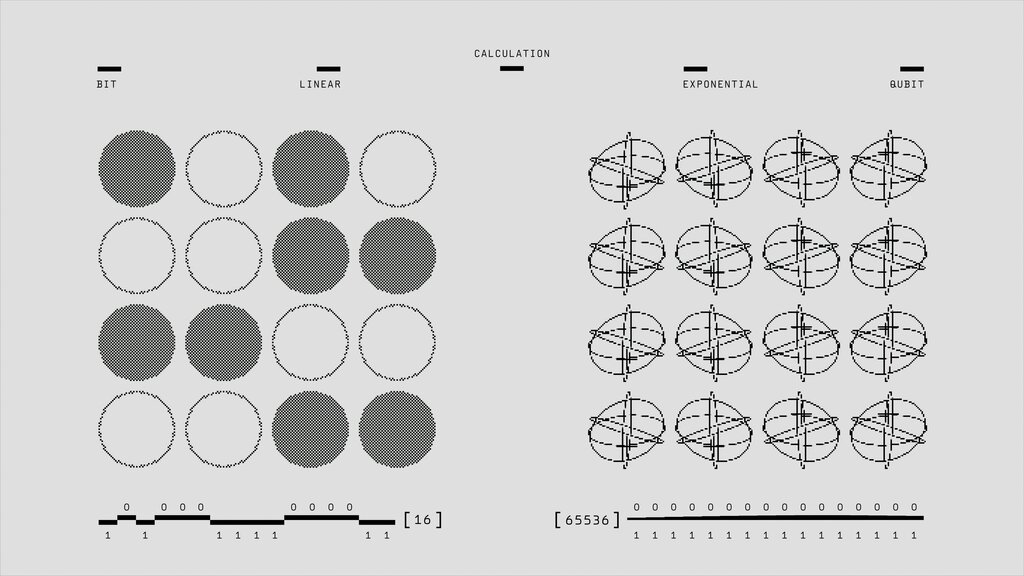
This ability to exist in multiple states at once is the first key difference. A classical computer with 2 bits can be in one of four possible states (00, 01, 10, or 11) at any given time. A quantum computer with 2 qubits can be in all four of those states simultaneously.
Quantum Parallelism
Because qubits can hold multiple values at once, a quantum computer can perform many calculations in parallel. With just a few hundred entangled qubits, a quantum computer could represent more numbers than there are atoms in the known universe. This allows it to explore a vast number of possibilities simultaneously.
Imagine trying to find the right key to unlock a door from a pile of billions of keys. A classical computer would try each key one by one. A quantum computer, leveraging superposition and another quantum property called interference, can essentially test all the keys at once, dramatically speeding up the search.
This is quantum parallelism. It's not about doing one thing faster; it's about doing countless things at the same time.
This doesn't mean quantum computers will replace the device you're reading this on. They won't make your email send faster or your games run smoother. Classical computers are excellent at everyday tasks.
Quantum computers are specialized machines designed to tackle problems that are currently impossible for even the fastest supercomputers. These problems often involve simulating complex systems, like designing new molecules for medicine, creating novel materials, or breaking complex cryptographic codes.
Why It Matters
Understanding the difference between classical and quantum computing is about recognizing a fundamental shift in how we process information. We are moving from a world of definite 0s and 1s to a world of probabilities and superpositions. This opens up new frontiers for computation, allowing us to solve problems that were once thought to be permanently out of reach.
What is the fundamental property of a qubit that distinguishes it from a classical bit?
A classical computer with 4 bits can be in one of how many possible states (e.g., 0000, 0001, etc.) at any single moment?
This new paradigm of computing is still in its early stages, much like classical computing was in the 1950s. But its foundation rests on these core principles: using qubits and leveraging their quantum properties to achieve unprecedented computational power.