Introduction to Quantum Computing
Introduction to Quantum Computing
Beyond Bits and Bytes
Classical computers, from your smartphone to the most powerful supercomputers, think in a very straightforward way. They use bits, which are like tiny light switches. A bit can either be off, represented by a 0, or on, represented by a 1. Every app you use, photo you see, and message you send is ultimately just a massive sequence of these 0s and 1s.
This binary system is incredibly effective, but it has limits. For certain complex problems, a classical computer would need more time than the age of the universe to check every possible answer. Quantum computing takes a completely different approach. It works with the strange and wonderful rules of quantum mechanics to process information in a new way.
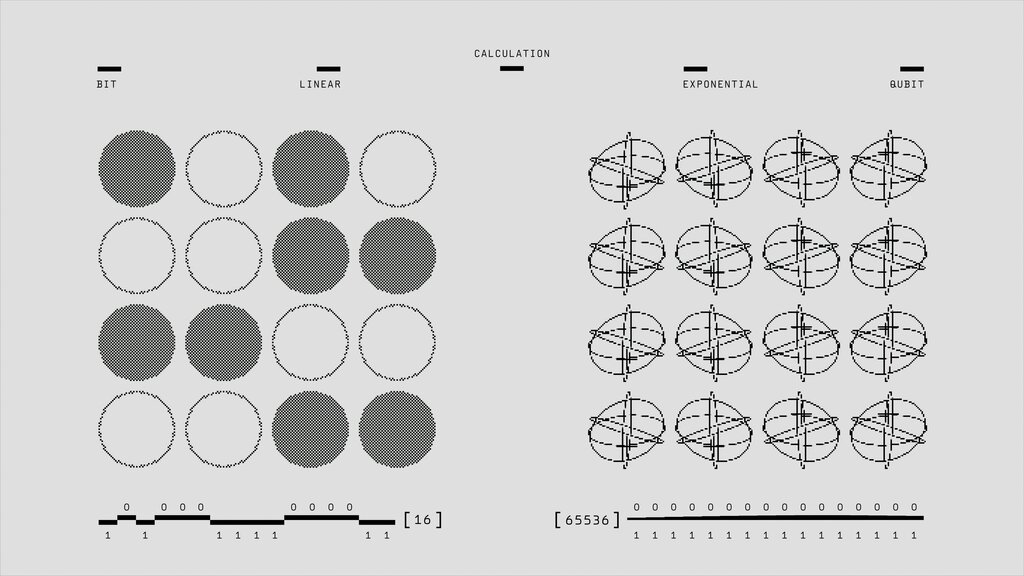
The fundamental building block of a quantum computer is the qubit, short for "quantum bit." Like a classical bit, a qubit can be a 0 or a 1. But it can also be something else entirely.
Superposition and Entanglement
Imagine a spinning coin. While it's in the air, it's neither heads nor tails. It's in a state that's a combination of both possibilities. Only when it lands does it settle into a definite state. A qubit behaves in a similar way thanks to a principle called superposition.
A qubit can exist in a combination of both 0 and 1 at the same time. It's only when we measure it that it "chooses" a state, collapsing into either a definite 0 or a 1. This ability to exist in multiple states at once allows quantum computers to explore a vast number of possibilities simultaneously.
superposition
noun
A fundamental principle of quantum mechanics where a quantum system, like a qubit, can exist in a combination of multiple states at the same time.
A single qubit holds more information than a classical bit. A group of them can hold an exponentially larger amount.
The other key principle is entanglement. This is a special connection between two or more qubits. When qubits are entangled, their fates are linked, no matter how far apart they are. If you measure one entangled qubit and find it's a 0, you instantly know its partner is a 1, and vice versa.
Albert Einstein famously called this "spooky action at a distance." Think of it like having two magic coins. If you flip them and send one to the other side of the world, the moment you see yours landed on heads, you know for a fact the other one landed on tails, without ever looking at it.
entanglement
noun
A quantum mechanical phenomenon in which the quantum states of two or more objects have to be described with reference to each other, even though the individual objects may be spatially separated.
A New Way of Computing
By harnessing superposition and entanglement, quantum computers aren't just faster versions of the computers we have today. They are a completely different kind of tool. They don't process information step-by-step. Instead, they navigate a complex landscape of probabilities to find solutions.
This makes them uniquely suited for solving certain types of problems that are intractable for classical computers, like designing new molecules for medicine, creating novel materials, and breaking complex codes. It's a shift from counting on switches to conducting an orchestra of possibilities.
Two concepts in quantum physics that are the building blocks of quantum computing are superposition and entanglement.
These concepts are the foundation of everything that makes quantum computing so powerful. Let's review what we've covered.
What is the fundamental unit of information in a classical computer?
The principle that allows a qubit to exist in a combination of both 0 and 1 at the same time is known as ________.
Understanding these core principles is the first step into the revolutionary world of quantum computing.