Introduction to Python Programming
Python Basics
What is Python?
Python is a programming language known for being powerful yet easy to read. It was created in the late 1980s by Guido van Rossum, who wanted a language that was simple and intuitive. The name doesn't come from a snake, but from the British comedy group Monty Python's Flying Circus.
Python's design philosophy emphasizes readability. The idea is that code is read more often than it is written, so it should be clean and easy to understand. This is summed up in a collection of 20 principles known as "The Zen of Python," which includes guiding ideas like "Beautiful is better than ugly" and "Simple is better than complex."
At its core, Python is built for humans first and computers second. Its straightforward syntax allows you to focus on what you want to do, not how to say it.
This simplicity makes Python incredibly versatile. It's used for building websites, analyzing data, creating artificial intelligence models, and automating everyday tasks. From small scripts to massive applications at companies like Google and Netflix, Python is everywhere.
Getting Set Up
To start writing Python, you need an interpreter. An interpreter is a program that reads your Python code and executes the commands. The good news is that it's free and easy to install.
Head over to the official Python website, python.org, and download the latest version for your operating system (Windows, macOS, or Linux). The installer will guide you through the process. During installation on Windows, make sure to check the box that says "Add Python to PATH." This will make it easier to run Python from your command line.
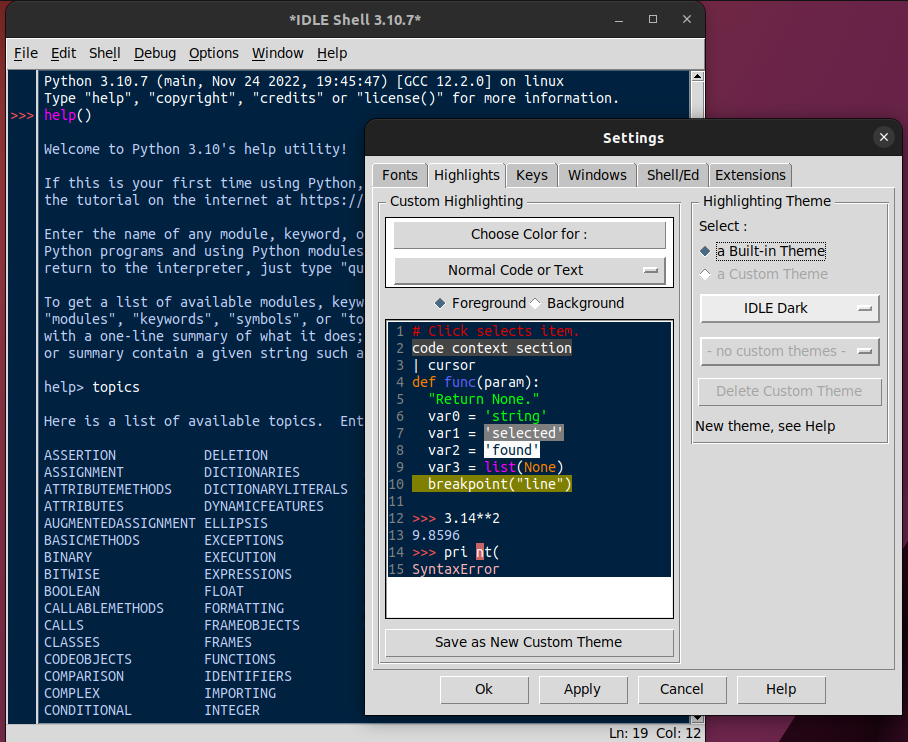
When you install Python, you also get a simple program called IDLE (Integrated Development and Learning Environment). IDLE includes a text editor for writing your code and a shell for running it. It's all you need to get started.
Your First Program
It's a tradition in programming to start by making the computer say "Hello, World!". Let's do that in Python.
Open IDLE. You'll see a window with a >>> prompt. This is the shell, where you can type commands one at a time. To print a message, you use the print() function. A function is a named block of code that performs a specific task. In this case, print() displays text on the screen.
print("Hello, World!")
Type that line into the shell and press Enter. Python will immediately execute the command and display the output:
Hello, World!
Congratulations, you've just written and run your first piece of Python code! The text inside the quotation marks is called a string, which is just a sequence of characters. The parentheses () are used to pass the string to the print() function.
Writing a Script
Typing commands one by one is fine for quick tests, but for anything more complex, you'll want to save your code in a file. This is called a script.
In IDLE, go to File > New File. This will open a new, blank text editor window. Here, you can write multiple lines of code. Let's try a slightly more advanced script.
# This is a comment. Python ignores it.

# Assign the string "Alice" to a variable named user_name.
user_name = "Alice"

# Print a greeting that includes the value of the variable.
print("Hello, " + user_name + "!")
Let's break this down:
- Comments: Any line starting with
#is a comment. The interpreter ignores it. Comments are for humans to explain what the code does. - Variables:
user_name = "Alice"creates a variable. A variable is like a labeled box where you can store information. Here, we're storing the string"Alice"in a variable nameduser_name. - Concatenation: The
+sign joins strings together. This is called concatenation. We're combining"Hello, ", the value ofuser_name, and"!"into a single string to be printed.
Now, save the file. Go to File > Save and name it something like greeting.py. The .py extension is important—it tells your computer this is a Python file.
To run the script, press F5 on your keyboard (or go to Run > Run Module). The output will appear back in the IDLE shell window:
Hello, Alice!
You've now written a script that uses variables to make its output dynamic. This is a fundamental building block of programming.
Where does the name for the Python programming language come from?
What is the primary role of a Python interpreter?
That covers the absolute basics of getting started with Python. You've learned what Python is, how to set it up, and how to write and run your first few lines of code. From here, you can start exploring what makes this language so powerful.