Introduction to Python Programming
Python Basics
Getting Started with Python
Python is a popular programming language known for its clear and readable syntax. It's often recommended for beginners because it reads a bit like plain English, which lets you focus on learning programming concepts without getting bogged down by complicated rules.
Let's dive into the first steps: setting up your environment, understanding Python's structure, and learning how to work with data.
Your Coding Workspace
To start writing Python code, you need two main things: the Python interpreter and a place to write your code, like a text editor or an Integrated Development Environment (IDE).
The interpreter is a program that reads your Python code and translates it into instructions the computer can understand and execute. You can download it for free from the official Python website, python.org.
An IDE is software that combines a text editor with other helpful tools for programmers, like a debugger and an interpreter console, all in one place. For beginners, Python's built-in IDLE is a great starting point.
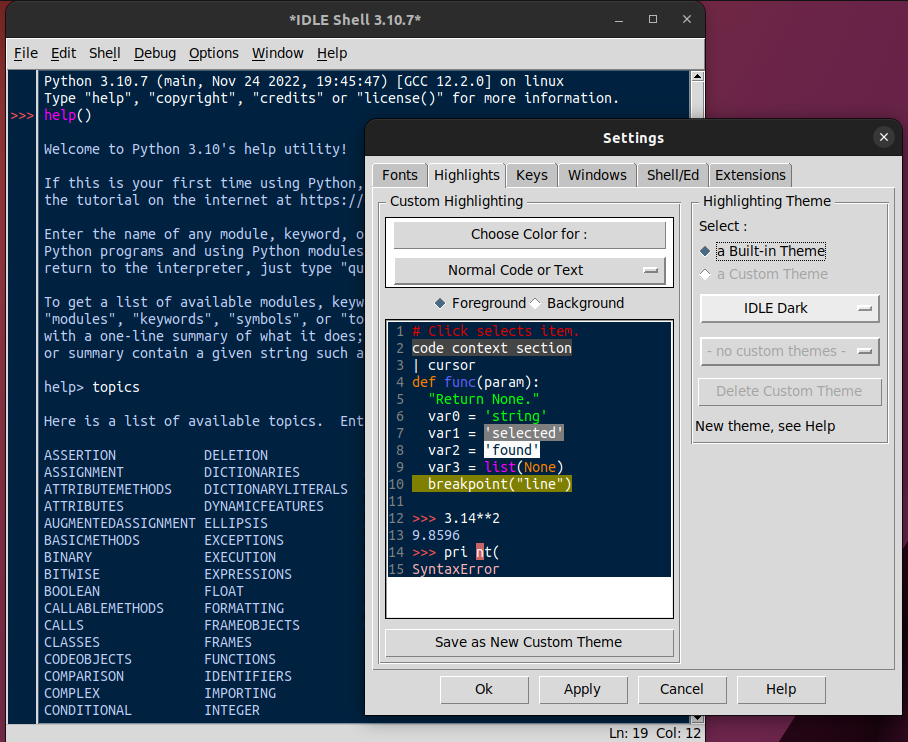
Once you're set up, you can write your first program. It's a tradition in programming to start by making the computer say "Hello, World!".
print("Hello, World!")
When you run this line of code, the text Hello, World! will appear on your screen. The print() function is how you display output.
Syntax and Indentation
Python's syntax is clean and straightforward. Unlike many other languages that use brackets or keywords to define blocks of code, Python uses indentation—the spaces at the beginning of a line.
In Python, whitespace is not just for readability; it's a rule. Consistent indentation is required for your code to run correctly.
While this might seem strange at first, it forces you to write clean, organized code that is easy for you and others to read. The standard convention is to use four spaces for each level of indentation. Most code editors can be configured to insert four spaces when you press the Tab key.
Storing and Using Data
In programming, we need a way to store information that we can use and change. We do this with variables. A variable is like a labeled container where you can keep a piece of data.
# Assigning a value to a variable
user_name = "Alex"
user_age = 30
Here, user_name and user_age are variables. We used the equals sign (=) to assign values to them. The text "Alex" is a string, and the number 30 is an integer. These are called data types.
Python has several built-in data types. Here are a few common ones:
| Data Type | Description | Example |
|---|---|---|
String (str) | A sequence of characters. | "Hello", 'Python' |
Integer (int) | A whole number. | 10, -5, 1024 |
Float (float) | A number with a decimal point. | 3.14, -0.5, 2.0 |
Boolean (bool) | Represents truth values. | True, False |
Python automatically detects the data type when you assign a value to a variable. You can use the print() function to see the value stored in a variable.
planet = "Earth"
moons = 1

print(planet)
print(moons)
This code will output:
Earth
1
Input and Output
We've already seen how to output information using print(). But what if you want to get information from the user? For that, Python provides the input() function.
The
input()function pauses your program and waits for the user to type something and press Enter.
Whatever the user types is returned as a string. You can store this string in a variable to use it later.
# Ask the user for their name
name = input("What is your name? ")

# Greet the user
print("Hello, " + name + "!")
If you run this code, it will first display "What is your name? ". After you type your name and press Enter, it will greet you personally. The plus sign (+) is used here to combine strings, a process called concatenation.
A quick heads-up: input() always gives you a string, even if the user types a number. If you need to treat the input as a number, you have to convert it first. You can do this with functions like int() or float().
age_string = input("How old are you? ")
age_number = int(age_string)

years_until_100 = 100 - age_number

print("You will be 100 in", years_until_100, "years.")
In this example, we convert the user's input into an integer so we can perform a math calculation with it.
What is the primary role of the Python interpreter?
In Python, indentation is not just for style; it is required to define blocks of code.
With these basics, you have the building blocks to start writing simple but useful Python programs.