Introduction to Python Programming
Introduction to Python
What is Python?
Python is a high-level, general-purpose programming language. Think of it as a versatile tool, like a multi-tool pocket knife for coders. You can use it to build websites, analyze data, automate repetitive tasks, or even create games. Its popularity comes from a simple design philosophy: make code easy to read and write.
Python is a versatile, high-level programming language known for its readability and simplicity.
Unlike some languages that are strict and complex, Python is designed to be more intuitive. This makes it a great language for beginners, but it's also powerful enough for experts at major companies like Google, Netflix, and NASA.
Readability First
Python's core philosophy is often summarized in a collection of 20 guiding principles called "The Zen of Python." One of the key ideas is that "Readability counts." The language is built on the idea that code is read far more often than it is written, so it should be clean, clear, and beautiful.
This philosophy has a direct impact on how you write Python code. The most noticeable feature is its use of indentation. Instead of using brackets or keywords to group lines of code, Python uses whitespace. This forces developers to write code that is visually organized and easy to follow.
In Python, the structure of your code is determined by how it's indented. A block of code is simply a group of lines indented at the same level.
For example, here is a simple function. The print() statements are part of the greet function because they are indented underneath it.
def greet(name):
    # This block of code is inside the function
    print("Hello, " + name + "!")
    print("Welcome to Python.")

# This line is not indented, so it's outside the function
greet("Alex")
A Flexible Approach
Python isn't rigid about how you solve problems. It supports several different ways of thinking about and structuring your code, known as programming paradigms. This flexibility is one of its greatest strengths.
The three main paradigms you'll encounter are:
- Procedural Programming: This is like writing a recipe. You provide a series of steps in order, and the computer follows them one by one.
- Object-Oriented Programming (OOP): This approach involves creating "objects" that represent concepts or things. An object can hold data (its attributes) and perform actions (its methods). For example, you could model a
Carobject with attributes likecolorandspeed, and a method likedrive(). - Functional Programming: This style treats computation as the evaluation of mathematical functions. It avoids changing data and focuses on creating reliable, predictable code by minimizing side effects.
You don't have to choose just one. Python allows you to mix and match these approaches to best fit the problem you're trying to solve.
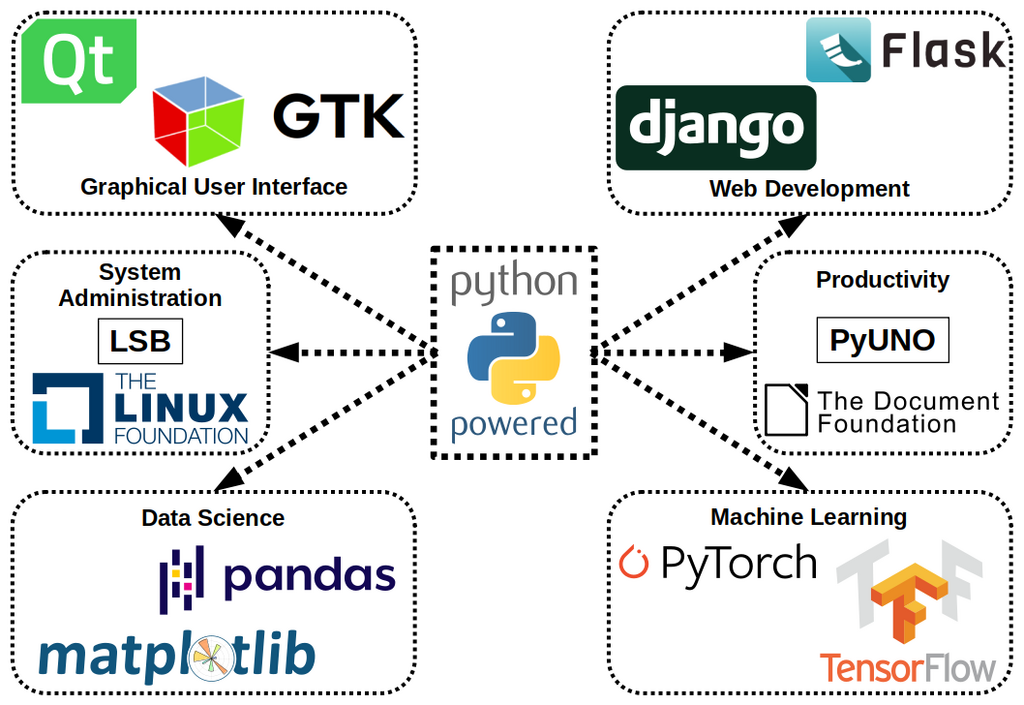
Smart Features
Python also includes features that let you focus on your logic rather than on tedious, low-level details. Two of the most important are dynamic typing and automatic memory management.
Dynamic Typing
other
The practice of determining a variable's data type (like a number or text) at runtime, rather than explicitly declaring it in the code.
In some languages, you have to tell the computer exactly what kind of data a variable will hold. In Python, you don't. The interpreter figures it out automatically when the code runs. You can create a variable and assign it a number, and later assign it a string of text without any issue.
# The variable 'data' is first an integer
data = 100
print(data)

# Now it's a string, and Python handles the change automatically
data = "Hello, world!"
print(data)
Finally, Python handles automatic memory management, often called garbage collection. When you create variables and objects, they take up space in your computer's memory. Python automatically detects when an object is no longer in use and frees up that memory. You don't have to worry about cleaning up after yourself, which prevents a common source of bugs in other languages.
These features work together to create a language that is powerful, flexible, and beginner-friendly, providing a solid foundation for any programming journey.