Introduction to Python Programming
Python Basics
Meet Python
Python is a powerful, versatile programming language used for everything from web development to artificial intelligence. It was created by Guido van Rossum and first released in 1991. Van Rossum wanted to make a language that was easy to read and write, even for beginners.
His goal was to let programmers write clear, logical code for projects big and small. Unlike some languages that require a lot of boilerplate code just to get started, Python lets you express concepts in fewer lines. This simplicity is a core part of its identity.
The Zen of Python
Python's design isn't accidental. It's guided by a set of principles known as "The Zen of Python." This collection of 20 aphorisms, written by Tim Peters, captures the language's core philosophy. It prioritizes simplicity, readability, and beauty over complexity.
Beautiful is better than ugly. Explicit is better than implicit. Simple is better than complex. Readability counts.
This philosophy means that code written in Python often looks a lot like plain English. When you read someone else's Python code, you can usually understand the logic without needing extensive comments or documentation. This makes it easier for teams to collaborate and for individuals to maintain their own projects over time.
Key Features
A few key features make Python stand out. One of the most important is its use of dynamic typing. In many languages, you have to declare what type of data a variable will hold, like an integer or a string. In Python, you don't. The language figures it out automatically when the program runs.
# Python infers the type of the variable.
x = 10          # x is an integer
print(x)

# You can even reassign it to a different type.
x = "Hello!"    # Now, x is a string
print(x)
Python also handles automatic memory management. Programmers don't have to worry about manually allocating and freeing up memory, a task that is a common source of bugs in other languages like C++. Python's built-in garbage collector takes care of this, letting you focus on solving the actual problem.
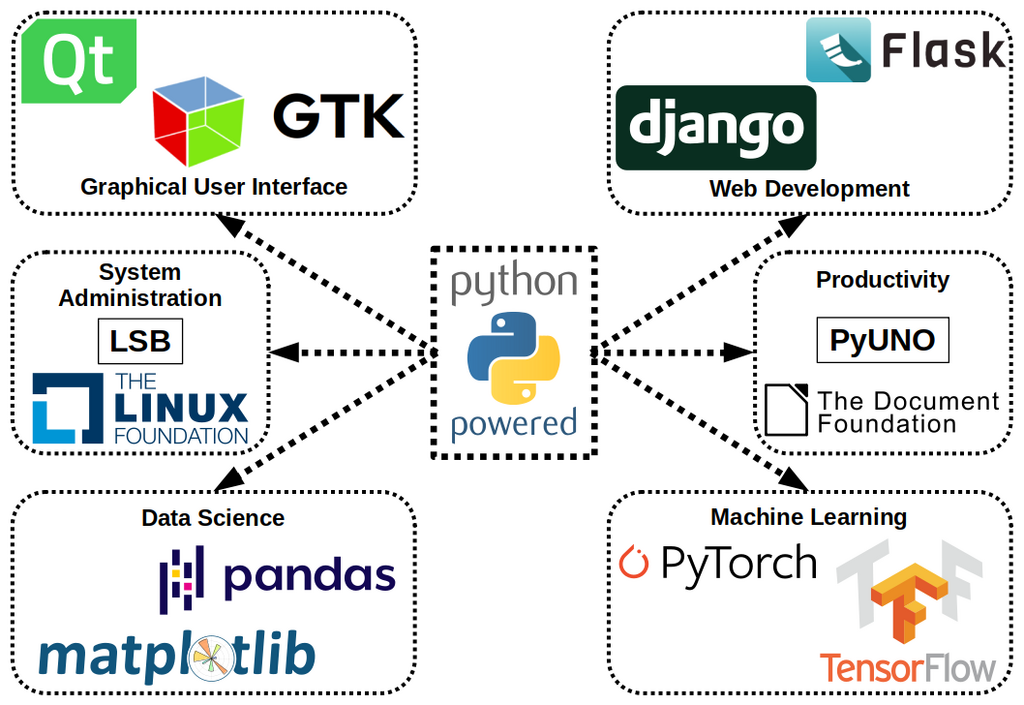
Finally, Python is a multi-paradigm language. This means it supports different programming styles. You can write code in a straightforward, step-by-step way (procedural), organize it around objects and data (object-oriented), or treat computation as the evaluation of mathematical functions (functional). This flexibility makes it a powerful tool for a huge variety of tasks.
Now, let's review what we've learned about Python's fundamentals.
Who is the creator of the Python programming language?
What is "The Zen of Python"?
This foundation gives you a sense of not just what Python is, but why it was designed the way it was.