psychology
Welcome! I'm so excited to dive into the fascinating world of the human mind with you.
Before we build our roadmap, I'd love to know what brings you here. Are you looking for a general overview, or is there a specific mystery of human behavior you're eager to unlock?
Just a general overview to start
A general overview is the perfect way to start! To kick things off, let's look at our game plan for this introductory course.

Defining Psychology
Continue to the history of psychology
Let's travel back to the late 19th century, where psychology first broke away from philosophy to become its own scientific discipline.
The Birth of a New Science
How did introspection work?
It was actually a highly structured—and surprisingly tedious—process!
Inside Wundt's Laboratory
For instance, if a researcher struck a metronome, you wouldn't say, "I hear a pleasant rhythmic sound." That would be interpreting the sound.
Instead, you had to break the experience down into its absolute atomic units. You might report a precise sequence of isolated auditory sensations, the exact perceived pitch, and the subtle feelings of tension or relaxation that occurred between the clicks.
By collecting these detailed, inward-looking reports, structuralists hoped to map out a complete periodic table of human consciousness.
A structuralist diagram representing Wilhelm Wundt's introspection experiment with a metronome and an observer.
Continue to the other major schools like functionalism and behaviorism
Let's move away from Wundt's laboratory in Germany and cross the Atlantic to see how the next major school of thought emerged.
Functionalism: The Purpose of the Mind
Make me a diagram comparing structuralism vs functionalism
I'd be glad to help visualize this major shift in how early thinkers approached the mind.

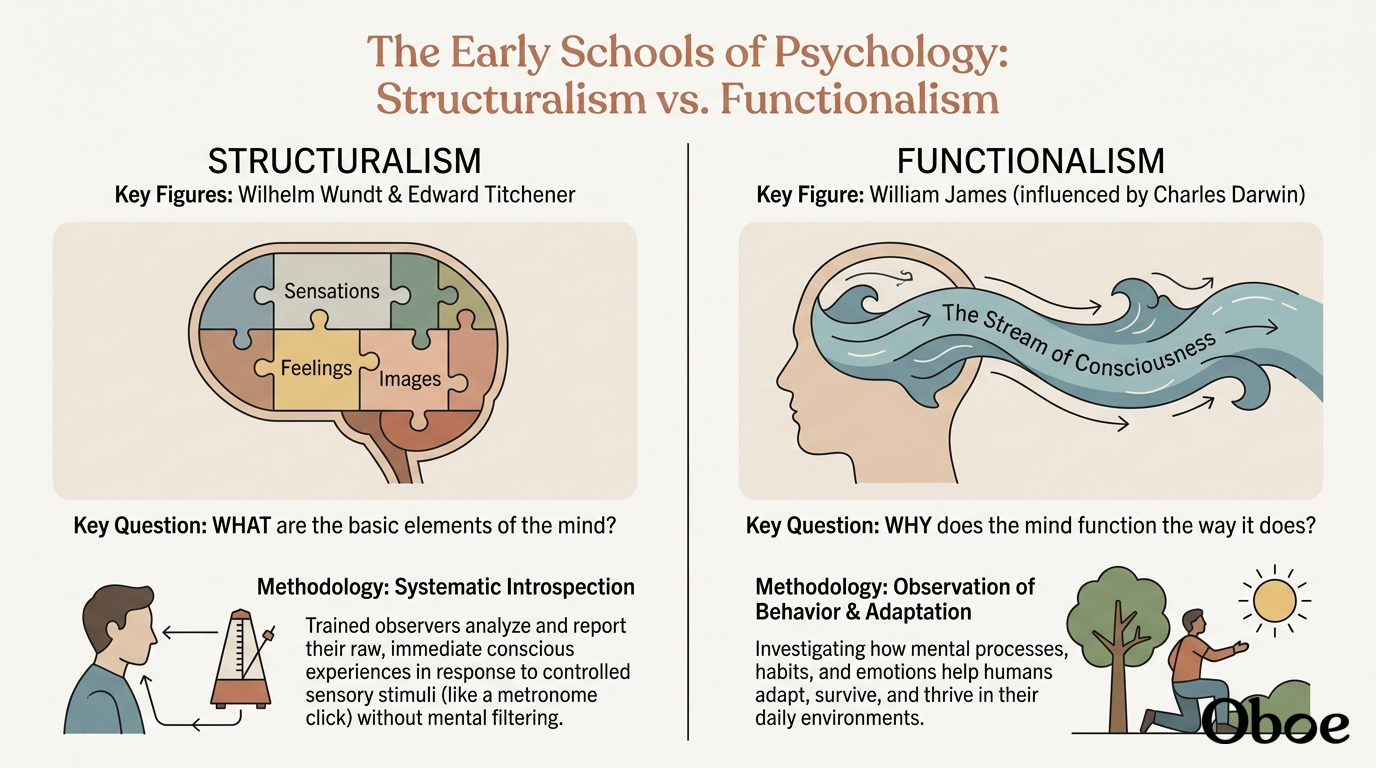
I have set up a diagram comparing these two competing philosophies so you can see their core models side-by-side.
While structuralists tried to freeze the mind's activity to catalog its parts, functionalists looked at how the entire system flowed dynamically to help an organism survive.
But as functionalism and structuralism debated back and forth, a group of scientists grew increasingly frustrated. They argued that trying to measure any kind of internal consciousness—whether as static structures or a flowing stream—was unscientific because nobody else could see inside your head. This frustration led directly to the rise of behaviorism.
Behaviorism: Rejecting the Invisible Mind
Continue to Sigmund Freud and psychoanalysis
While behaviorists were busy studying external actions, a highly controversial theory was brewing in Vienna that looked in the exact opposite direction—deep into the parts of our mind we cannot even see.
Psychoanalysis: The Power of the Unconscious
At the turn of the 20th century, an Austrian neurologist named introduced a revolutionary and radical theory known as psychoanalysis. Freud argued that our conscious thoughts, choices, and behaviors are actually driven by powerful, hidden forces within our unconscious mind—a vast reservoir of feelings, thoughts, urges, and memories that exist outside of our awareness.
Freud famously compared the human mind to an iceberg. The tip of the iceberg visible above the water represents our conscious awareness. The massive, hidden portion submerged beneath the surface is our unconscious, packed with deep-seated desires, fears, and unresolved childhood conflicts that we locked away because they were too disruptive to face directly.
Unlike the behaviorists, who ignored internal states, Freud believed these hidden forces constantly leak out, shaping our adult personalities, anxiety, and habits. To access this hidden realm, he developed therapeutic techniques like free association and dream analysis, forever changing how we think about mental health and therapy.
A single, towering psychological iceberg, showing the conscious tip above water, the preconscious slice at the waterline, and the massive unconscious base submerged deep below the surface.
I've started generating an interactive diagram of Freud's famous iceberg metaphor to help you visualize how these different layers of awareness stack up against each other.
By showing how much of our mental life is submerged, this model helps explain why Freud believed we are often mysteries to ourselves.
With this perspective in mind, we've wrapped up our look at the foundational history and early schools of psychology. Let's see if you feel ready to move forward to the next part of our path.
How did other scientists react to Freud?
It is safe to say that Freud's ideas hit the scientific community like a lightning bolt, sparking intense fascination but also massive skepticism.
The Backlash Against the Unconscious
While the public was captivated by the scandalous and dramatic nature of Freud's theories, many mainstream scientists and academic psychologists were deeply concerned. Their primary criticism was simple: Freud's methods were not scientifically .
To be considered truly scientific, a theory must make specific, testable predictions that can be proven wrong through experimentation. Freud's ideas, however, were so flexible that they could explain any possible behavior after the fact, making them impossible to test or disprove in a controlled laboratory setting.
Furthermore, other scientists pointed out that Freud based his entire global theory of human nature on a very narrow, unrepresentative group: wealthy, anxious adult patients in Vienna.
Rather than conducting empirical experiments with diverse groups of people, Freud relied heavily on his own subjective interpretations of these clinical case studies. This led to a major divide in early psychology, driving empirical researchers to double down on observable, measurable data while clinicians continued to explore the deep mysteries of the therapeutic relationship.
Now that we have explored the dramatic early battles of psychology—from structuralism to behaviorism and psychoanalysis—we are ready to wrap up our first major milestone on the learning path.
Let's continue to the next subtopic: Core Research Methods
It is wonderful to see your enthusiasm! We are officially stepping into our second major milestone: Core Research Methods.
The Backbone of Psychology: The Scientific Method
- Observation: A researcher notices a pattern in everyday life. For example, they might observe that students who study in quiet rooms seem to perform better on tests than those who study with music playing.
- Hypothesis: The researcher forms a testable prediction. This isn't just a guess; it's a specific, concrete statement. For example: "Students who study in a quiet environment will score higher on a memory test than students who study with background music."
- Experimentation: The researcher sets up a controlled test. They might bring two groups of students into a lab, have one study in silence and the other study with music, and then give them the exact same test.
- Analysis & Conclusion: The researcher analyzes the results using math and statistics. If the quiet group scored significantly higher, the hypothesis is supported! If there was no difference, the researcher must go back and modify their ideas.
Make me a diagram of the scientific method loop
I've started building a visual map of the scientific method loop so you can see exactly how a fleeting observation transforms into structured, tested scientific knowledge.
A four-step circular flowchart of the scientific method showing Observation, Hypothesis, Experimentation, and Analysis connected in a clockwise loop.
This loop is the standard that keeps psychological research rigorous. By moving from a physical observation to a structured test, researchers ensure they aren't just projecting their own biases onto human behavior.
Now that we have the ultimate blueprint of how psychological science works, we are ready to explore the specific toolkits researchers use to gather their data. In psychology, there is no single "perfect" tool—different questions require different approaches, such as experiments, case studies, or surveys.
Tell me about psychological experiments
Experiments are the crown jewels of psychological research because they are the only tool that can definitively prove cause and effect.
The Anatomy of an Experiment
To design an experiment, a researcher must manipulate one specific factor to see if it causes a change in another, keeping everything else exactly the same. The factor that the researcher actively changes or manipulates is called the , while the factor that is measured for any change is the dependent variable.
To make sure the independent variable is actually causing the change (and not just luck or some outside factor), researchers split their participants into two distinct groups:
-
The experimental group: This group receives the active treatment or manipulation (like studying in a room with background music playing).
-
The control group: This group does not receive the treatment (they study in a quiet room). This serves as a baseline so researchers can compare the results and see if the music made any real difference.
An experimental setup illustrating random assignment of participants into an experimental group with music and a control group with silence, leading to a final test phase.
I've sketched a visual representation of how participants flow through this setup to help you picture how researchers isolate the variables.
To prevent biases from ruining the results, researchers rely on random assignment, ensuring that every participant has an equal chance of ending up in either group. This balances out individual differences like natural intelligence, sleep levels, or memory skills so they don't skew the final data.
Make me flashcards on experimental design
You've got it! Flashcards are a fantastic way to lock in these critical research concepts before we move on to other study designs. I have put together a deck for you.

Flash Cards
Completed
0 completed • 11 remaining
Independent Variable
See Answer
0 completed • 11 remaining
Dependent Variable
See Answer
0 completed • 11 remaining
Experimental Group
See Answer
0 completed • 11 remaining
Control Group
See Answer
0 completed • 11 remaining
Random Assignment
See Answer
0 completed • 11 remaining
Confounding Variable
See Answer
0 completed • 11 remaining
Double-Blind Study
See Answer
0 completed • 11 remaining
Placebo Effect
See Answer
0 completed • 11 remaining
Operational Definition
See Answer
0 completed • 11 remaining
Replication
See Answer
0 completed • 11 remaining
Internal Validity
See Answer
Now that you have those core terms down, we are ready to look at what psychologists do when they can't run a controlled experiment. Sometimes, manipulating variables is impossible or highly unethical.
When that happens, researchers have to pivot to different investigative tools, starting with the deep-dive approach known as the .
Let's continue to surveys
Let's pivot from looking at single individuals in case studies to looking at entire populations using surveys.
Surveys: Gathering Big Data
However, you can't just hand a survey to any random group of people and assume it represents everyone. To get accurate results, psychologists must carefully select their participants.
They start with the population, which is the entire group they want to draw conclusions about (for example, "all college students in the US"). Because they can't ask millions of students, they pull a smaller sample—a subgroup that actually takes the survey.
To ensure the sample accurately reflects the larger population, researchers must use random sampling, giving every single person in the population an equal chance of being selected. If a researcher only surveyed students at 8:00 AM gym classes, their sample would be biased and wouldn't represent the broader student body.
Continue to the importance of ethics in psychological research
It is impossible to talk about psychological science without talking about the strict moral boundaries that keep human beings safe during research.
Ethics in Psychological Research
- Informed Consent: Participants must be fully told what the study involves, including any potential risks, before they agree to join. They must sign up voluntarily and are free to walk away at any absolute point without penalty.
- Protection from Harm: Researchers must ensure that participants are not subjected to unnecessary physical or psychological pain. If a study might cause mild temporary stress, the benefits to society must heavily outweigh those risks.
- Confidentiality: All personal data gathered during a study must be kept completely private. A participant's identity should never be linked to their public test scores or responses.
- Debriefing: If a study requires temporary deception (like telling a participant they are taking a memory test when the researchers are actually observing social pressure), the researcher must fully explain the true nature of the experiment as soon as it ends.
The four ethical pillars of psychological research—Informed Consent, Protection from Harm, Confidentiality, and Debriefing—arranged as distinct defensive shields surrounding a central participant figure.
I have drafted a layout showing how these four ethical pillars form a protective shield around participants, illustrating the balance between seeking knowledge and respecting human dignity.
By ensuring that research is conducted with respect and safety, psychologists can build a body of science that we can genuinely trust.
What happens if a researcher violates these rules?
When a researcher plays fast and loose with the rules, the consequences can be swift and devastating, both for their career and for the scientific community as a whole.
The Fallout of Ethical Violations
If a psychologist violates ethical guidelines, the most immediate consequence is usually an investigation by their institution's (IRB). The IRB has the power to shut down active studies on the spot. If the violations are severe, the university or research hospital can fire the researcher, and federal agencies can strip away their research funding. Furthermore, academic journals will retract any published papers based on the tainted data, effectively destroying the researcher's professional reputation and making them unemployable in the scientific community.
But the damage goes far deeper than a single career. When unethical studies come to light, they severely damage public trust in science. If people believe that psychologists exploit or harm participants, they will stop volunteering for studies, and governments will stop funding research. Without public participation and funding, the progress of psychological science grinds to a halt, preventing us from discovering new treatments for mental health conditions.
That is why IRBs act as strict gatekeepers. By reviewing and approving every study before it even begins, they make sure that no research is conducted unless the participant's safety and dignity are fully guaranteed.
Continue to the major branches of psychology
Let's turn the page! You have officially conquered the fundamentals of research methods and ethics. Now, we are ready to step into a vibrant new territory on our learning map: the Major Branches of Psychology.
The Colorful Map of the Mind
Because human behavior is incredibly vast, psychology isn't just one single job or topic. It is a massive tree with many distinct branches, each looking at the human experience through a different lens.
Imagine you are watching a person study for an exam. A might look at the electrical signals and neurotransmitters firing in their brain. A would focus on how their memory stores and retrieves the information. Meanwhile, a might ask how their studying habits have changed from childhood to adulthood.
Instead of competing, these different branches work together to give us a complete, multi-dimensional picture of how we function. Let's start exploring these branches to see which ones spark your curiosity the most.
Make me a diagram mapping the branches
I would love to help map this out for you. Let's create a visual guide to show how these different branches focus their lenses on different aspects of human life.
A clean mind map radiating from a central Psychology node to Biological, Cognitive, and Developmental branches.
I have put together a preliminary layout showing how these three major theoretical branches branch off from our central tree.
While biological, cognitive, and developmental psychology form the core scientific foundation of how we study the mind, there are other branches that look at how we behave in groups, or how our individual personalities make us unique.
Are you ready to explore those next, or would you like to dive deeper into one of the branches we just mapped out?
i want to explore all of them one by one
I love that attitude! Taking them one by one is the best way to appreciate how uniquely each branch approaches the human experience. Let's start with our first stop: Biological Psychology.
Biological Psychology: The Hardware of the Mind
How do biological psychologists study the live brain?
It is amazing how far we have come from the days of introspection. Today, biological psychologists do not have to rely on subjective reports; they can peer directly inside a living, thinking brain using advanced technology.
Windows into the Active Brain
To watch the brain in action without harming the patient, researchers rely on three primary tools:
-
EEG (Electroencephalogram): This tool measures the electrical activity sweeping across the surface of your brain. By placing electrodes on the scalp, researchers can record the rapid electrical firing of nerve cells. It is incredibly fast, capturing changes in milliseconds, which makes it perfect for studying sleep stages or sudden reactions to sounds.
-
fMRI (Functional Magnetic Resonance Imaging): While an EEG measures electricity, an fMRI measures blood flow. When a brain region becomes active, it demands more oxygen-rich blood. By tracking where that oxygenated blood flows while you perform a task—like looking at a picture of a loved one—the fMRI creates a detailed, 3D map of which brain structures are working in real time.
-
PET (Positron Emission Tomography) Scans: This method tracks chemical activity. Researchers inject a harmless, radioactive tracer (usually a form of active glucose) into the bloodstream. Because active brain cells consume glucose for energy, the PET scan highlights exactly where the brain is consuming the most fuel. This helps researchers map how neurotransmitters or drugs travel through the nervous system.
| Technique | What It Measures | Best For... | Advantage |
|---|---|---|---|
| EEG | Electrical impulses | Tracking sleep and rapid reactions | Extremely fast (millisecond timing) |
| fMRI | Oxygen-rich blood flow | Mapping precise active structures | Highly detailed 3D spatial images |
| PET Scan | Glucose/chemical consumption | Tracking neurotransmitter/drug pathways | Revealing deep chemical activity |
By combining these tools, scientists can observe the physical brain as it processes emotions, generates thoughts, and commands our muscles to move.
Make me a diagram of these neuroimaging tools
I've put together a visual breakdown of these primary neuroimaging tools so you can see exactly how they compare when peering inside a live, functioning brain.
A three-panel comparative view of EEG, fMRI, and PET neuroimaging scans side by side.
Now that we have looked at how scientists physically observe the active brain, we can take a closer look at what they are actually looking at.
To understand the brain's physical communication network, we have to look at the and the chemical messengers that keep it running. This complex system serves as the physical foundation for every thought, feeling, and movement we experience.
Tell me more about how dopamine works
Dopamine is one of the most famous chemicals in the human body, but it is also one of the most misunderstood.
The Truth About Dopamine
In popular culture, dopamine is often called the "pleasure chemical," but biological psychologists have discovered that its actual job is much more interesting. Dopamine does not actually produce the feeling of pleasure itself; instead, it is the molecule of anticipation, motivation, and drive.
Imagine you are walking down the street and smell fresh donuts. The rush of excitement you feel that makes you want to step inside the bakery is a spike of dopamine. It is the chemical that says, "Hey, pay attention! Something great is about to happen, and you need to go get it."
Once you actually eat the donut, a completely different set of chemicals (like natural ) take over to give you that warm, satisfied feeling of enjoyment. Dopamine's role is simply to motivate you to do the work to get the reward.
This distinction is highly important for understanding habits and addiction. Because dopamine spikes before we get what we want, it creates a powerful neurological loop.
Your brain notes the cue (the smell), releases dopamine to create motivation (the craving), drives you to perform the action (buying the donut), and registers the reward. Over time, this pathway becomes so deeply carved into your neural hardware that just encountering the cue triggers an almost irresistible urge to act.
Now that we have looked at how biological psychologists map behavior directly to physical brain chemistry, we are ready to transition to our next major branch of psychology.
Continue to Cognitive Psychology
Cognitive Psychology: Inside the Information Processor
Now, let's step inside our second major branch: cognitive psychology. While behaviorists viewed the mind as a "black box" that could not be scientifically measured, cognitive psychologists blew that box wide open, choosing to focus entirely on the mental processes going on inside—like perception, memory, thinking, and decision-making.
- Input (Sensory Data): Just as a computer receives data from a keyboard, mouse, or camera, your brain constantly takes in raw input from your physical surroundings through your eyes, ears, and skin.
- Processing (Cognition): Once inside, your mind actively processes this raw data. You pay attention to certain details, interpret what they mean based on past experiences, and decide how to organize them.
- Storage (Memory): Like a computer saving files, your brain has different storage compartments. Your temporary short-term memory acts like RAM, holding onto active data for a few seconds. If information is deemed important, it is moved to long-term memory, which functions like a hard drive.
- Output (Action): Finally, after retrieving and processing this stored data, your brain triggers an output—a physical behavior, a spoken sentence, or a strategic decision.
Explain how cognitive biases affect our decision-making
It is fascinating to see how our internal information-processing systems can sometimes take shortcuts that lead us entirely astray.
The Glitches in Our Mental Software
To keep from being overwhelmed by the millions of sensory inputs hitting us every second, our brains rely on mental shortcuts called heuristics. While these shortcuts are incredibly efficient for daily survival, they also create systematic errors in our thinking known as . These biases act like invisible optical illusions for our judgment, quietly warping how we process information and make choices without us ever realizing it.
Let's explore two of the most common and powerful biases that cognitive psychologists study:
-
Confirmation Bias: This is our strong tendency to search for, favor, and recall information in a way that confirms what we already believe, while completely ignoring or downplaying evidence that contradicts us. If you believe a certain planet is lucky, you will notice every good thing that happens under it and forget all the bad times.
-
The ,: This occurs when we estimate the likelihood of an event based on how easily we can recall similar examples from our memory. Because plane crashes or shark attacks are highly dramatic and widely reported, they are incredibly easy to picture. This trick of memory makes us feel like these rare events are far more common and dangerous than they actually are, while we ignore much higher, quieter risks like driving a car.
By studying these systematic mental hiccups, cognitive psychologists help us understand why smart people can believe provably false things, and how we can train ourselves to make more objective decisions.
With these cognitive bugs uncovered, we have officially finished our deep dive into the inner workings of cognitive psychology. Let's look at our next step on the roadmap.
Continue to Developmental Psychology
Let's cross over to our third major branch: developmental psychology. While biological psychology looks at your physical hardware and cognitive psychology looks at your mental software, developmental psychology looks at how both of those systems change and grow throughout your entire lifespan.
Developmental Psychology: From Womb to Tomb
For a long time, early researchers assumed that once you became an adult, your brain and personality were completely locked in place. Because of this, early focused almost entirely on infants and young children. Modern researchers, however, know that we never truly stop changing. They study human growth from conception, through childhood and adolescence, all the way into adulthood, old age, and the very end of life—a perspective often called "womb to tomb" development.
To map these changes, developmental psychologists look at three major domains that constantly interact with one another:
-
Physical Development: This includes body growth, brain changes, motor skills, and health. For example, a baby learning to crawl or an elderly adult experiencing a decline in reaction times.
-
Cognitive Development: This focuses on memory, language, and problem-solving. This is where we look at how a toddler goes from babbling single words to how an adult develops complex, logical reasoning skills.
-
Social & Emotional Development: This explores how we form relationships, manage emotions, and build our self-esteem and identity.
One of the classic debates in this branch is the famous question of nature versus nurture. Developmental psychologists want to know: how much of who we become is shaped by our genetics (nature) versus our life experiences, parenting, and culture (nurture)? By studying identical twins who were separated at birth, researchers have discovered that while genetics lay down a powerful blueprint for things like intelligence and temperament, our physical and social environments play a massive role in deciding how those traits actually show up in our daily lives.
Continue to Personality Psychology
It is exciting to move on to this next chapter of our journey! Let's explore our fourth major branch: Personality Psychology.
Personality Psychology: What Makes You Unique
- Openness to Experience: Your level of curiosity, creativity, and preference for variety versus routine.
- Conscientiousness: How organized, self-disciplined, responsible, and goal-oriented you are.
- Extraversion: Your level of energy, positive emotion, urgency, and how much you seek stimulation in the company of others.
- Agreeableness: How compassionate, cooperative, trusting, and helpful you are toward people.
- Neuroticism: Your tendency to experience unpleasant emotions easily, such as anger, anxiety, depression, and vulnerability to stress.
By scoring high or low on each of these five channels, psychologists can sketch a remarkably accurate fingerprint of your natural tendencies and predict how you might behave in different situations.
Make me a diagram of the OCEAN personality traits
Ask and you shall receive! I have mapped out the universal dimensions of personality.
A static, neutral visual mapping of the Big Five OCEAN personality traits across five horizontal spectrum sliders.
I've started drafting this interactive slider visual so you can see how personality is scored on a sliding scale rather than putting people into rigid categories.
While our personality traits help explain how we behave as individuals, they don't exist in a vacuum. To understand why we act the way we do, we also have to look at how we are influenced by the people and groups around us. This brings us directly to our fifth major branch: Social Psychology.
Social Psychology: The Power of the Situation
To see this in action, consider the concept of conformity—the tendency to align our attitudes, beliefs, and behaviors with those around us to fit in.
In a famous series of experiments conducted by Solomon Asch in the 1950s, participants were asked to look at a line and choose which of three other lines matched its length. The answer was incredibly obvious. However, when a group of actors hired by the researcher intentionally gave the wrong answer first, over 70% of the real participants went along with the group's incorrect choice at least once. Even when our own eyes tell us the truth, the social pressure to belong can make us deny what we see.
By studying these invisible social currents, social psychologists help us understand peer pressure, crowd behavior, and how we can build more cooperative communities.
can you test my icean
I wait until the night before and rely on stress to get it done.
That is a classic, highly relatable response, and it is actually the perfect real-world example of how these personality dimensions work!
Procrastination and Conscientiousness
In personality psychology, waiting until the final hours and relying on the adrenaline spike of stress is a classic sign of scoring on the lower end of the spectrum. People who score very high in Conscientiousness tend to be natural planners; they organize their calendars, break projects into daily steps, and feel uncomfortable with messy, last-minute rushes.
Conversely, those who score lower on this scale tend to be more spontaneous, flexible, and comfortable with easygoing, unstructured environments. They often rely on external pressure—like an urgent deadline—to kickstart their focus and get things done.
It is vital to understand that personality traits like Conscientiousness are not rigid labels. You are not simply "a procrastinator" or "a planner." Instead, Big Five scores exist on a continuous spectrum, and your position on that spectrum can fluctuate depending on your environment, age, and motivation. Someone might be highly unstructured with chores, but incredibly organized and detail-oriented when working on a hobby they genuinely love.
Now that we have connected your daily habits to the fascinating science of personality, we are ready to move forward to the final branch of our current milestone: Social Psychology, where we look at how group settings and environments warp our behavior.
Give me a worksheet to test my other OCEAN traits
I'd love to help you explore how you score on the other universal personality dimensions! While a clinical assessment requires hundreds of standardized questions, we can use a quick, interactive worksheet to look at your personal habits and see where you might sit on the rest of the .

I have put together a quick, reflective worksheet with scenarios for Openness, Extraversion, Agreeableness, and Neuroticism.
Once you've had a chance to look through those scenarios and share your reactions, we can map out your overall personality style and then continue to our final subtopic, Social Psychology, to see how our situations can completely change how we behave.
Continue to Social Psychology
It is time to dive into our final stop under the major branches: social psychology.
The Invisible Pull of the Group
A split-view diagram comparing the visual weight of responsibility for a single observer versus ten distributed observers.
I've started building a visual representation of this effect to help you see how social responsibility physically dilutes when we are in a crowd.
By understanding how the social environment quietly shapes our choices, we can learn to spot these psychological traps in our daily lives and consciously choose to act differently.
With social psychology covered, we have officially finished exploring all the major branches on our outline! Let's see how you are feeling about everything we have learned so far.