Introduction to Programming Languages
Introduction to Programming Languages
The Language of Machines
Computers are powerful, but at their core, they are surprisingly simple. They only understand one language: machine code. This is a sequence of binary digits, just ones and zeros, that tells the processor exactly what to do. For a human, writing instructions in binary would be incredibly slow and difficult.
Trying to communicate directly with a computer in its native tongue is like trying to build a car by arranging individual atoms.
This is where programming languages come in. They act as a bridge, allowing us to write instructions in a format that is much closer to human language. A programming language provides a set of rules and vocabulary—its syntax—that we can use to express complex ideas and logic. The computer then uses a special program to translate our instructions into the ones and zeros it understands.
Programming languages bridge this gap and provide a medium between human languages and binary code that is essential for writing programs.
From Punch Cards to Python
The first programmers didn't have the luxury of typing code into a text editor. They often worked with machine code directly, flipping switches or punching holes into cards to represent binary instructions. It was a painstaking process where a single mistake could ruin hours of work.
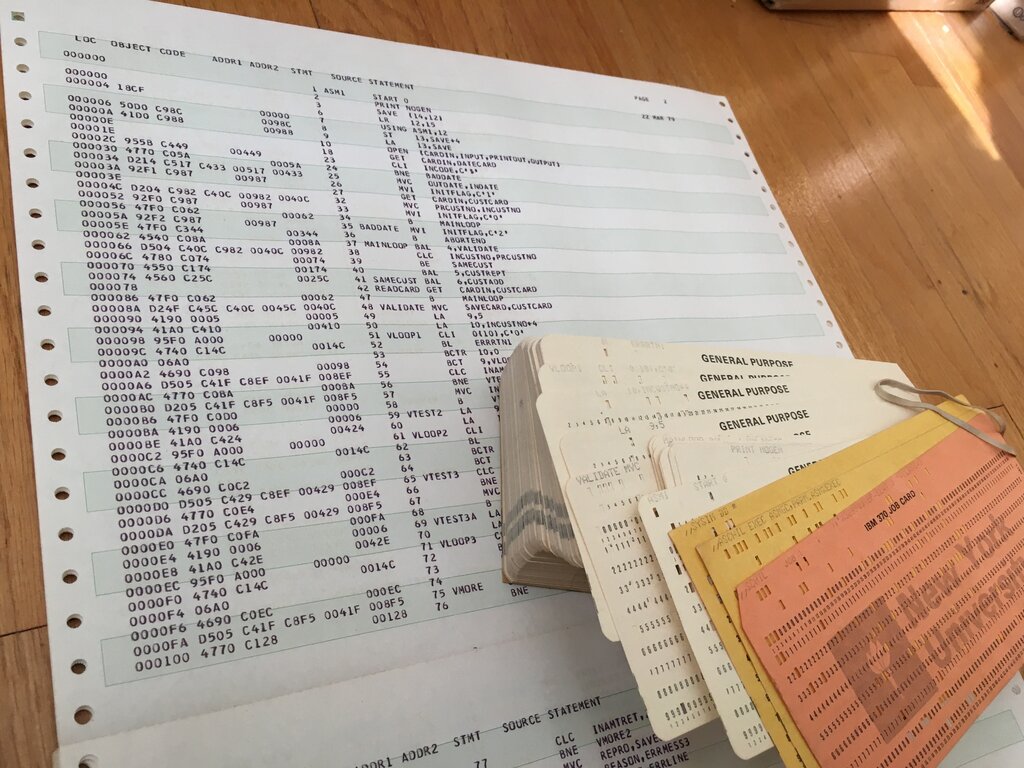
The first major breakthrough was the invention of assembly languages. Instead of raw numbers, programmers could use short, memorable mnemonics like ADD for addition or MOV for moving data. This was a significant improvement, but it was still tied very closely to the specific architecture of a computer.
The late 1950s saw the arrival of the first high-level languages like FORTRAN, COBOL, and LISP. These were revolutionary. They allowed programmers to write code that was more abstract and portable, focusing on the problem to be solved rather than the inner workings of the machine. A line of code in a high-level language could correspond to dozens of machine instructions.
Since then, thousands of programming languages have been created. Some, like C, give programmers low-level control over the computer's memory. Others, like Python and JavaScript, offer higher levels of abstraction that make it faster to build complex applications. Each language was designed to solve a particular set of problems in a better way.
Translating Our Instructions
So how does a computer understand code written in a language like C++ or Python? The translation from a human-readable language to machine code is handled by two types of programs: compilers and interpreters.
Compiler
noun
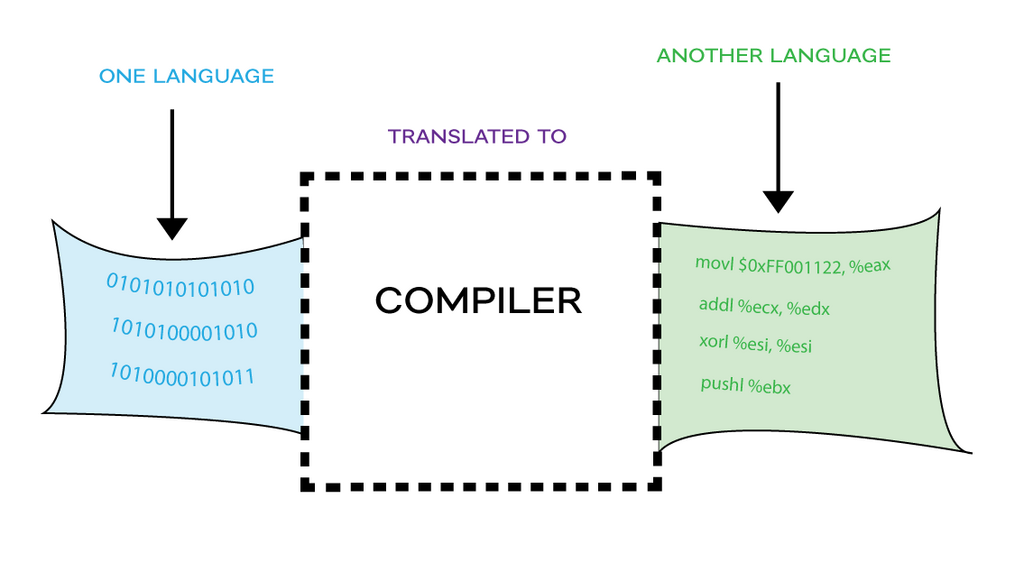
A program that translates an entire source code file into a separate, executable file of machine code before the program is run.
Think of a compiler as translating a whole book from one language to another. It reads your entire program, analyzes it, and generates a new file containing the equivalent machine code. You then run this new file. Languages like C, C++, and Go use compilers. This process often results in faster programs because all the translation work is done upfront.
Interpreter
noun
A program that translates and executes source code one line at a time, without creating a separate executable file.
An interpreter, on the other hand, is like a live human translator for a conversation. It reads one line of your code, translates it to machine code, and the computer executes it immediately. Then it moves to the next line. Python, JavaScript, and Ruby are examples of interpreted languages. This approach makes it easier to test small pieces of code quickly, since you don't have to recompile the entire program after every change.
What is the language that a computer's processor directly understands?
What was the primary advantage of early high-level languages like FORTRAN and LISP over assembly language?
Understanding these core concepts—what a language is for and how it gets translated—is the first step into the world of programming.