Introduction to PLC Programming
Introduction to PLCs
What is a PLC?
At the heart of nearly every modern factory, power plant, or automated warehouse is a small, rugged computer called a Programmable Logic Controller, or PLC. Think of it as the brain of an industrial operation. It takes in information from sensors, makes decisions based on a program, and then sends out commands to make things happen—like starting a motor, opening a valve, or moving a robotic arm.
A Programmable Logic Controller (PLC) is the backbone of factory automation, controlling various machines and processes.
Its job is to automate processes that would otherwise require a person to manually flip switches and monitor gauges. By using a PLC, manufacturers can make their operations faster, more reliable, and more efficient. From bottling plants to car assembly lines, PLCs are the unseen workhorses that keep the industrial world moving.
From Relays to Processors
Before PLCs, industrial control was a tangled mess of wires and electromechanical relays. A relay is essentially a switch that's operated by an electromagnet. To create a control system, engineers would wire hundreds or even thousands of these relays together in massive cabinets. If you wanted to change how a machine operated, you didn't just rewrite some code. You had to physically unwire and rewire the relays. It was time-consuming, expensive, and a nightmare to troubleshoot.
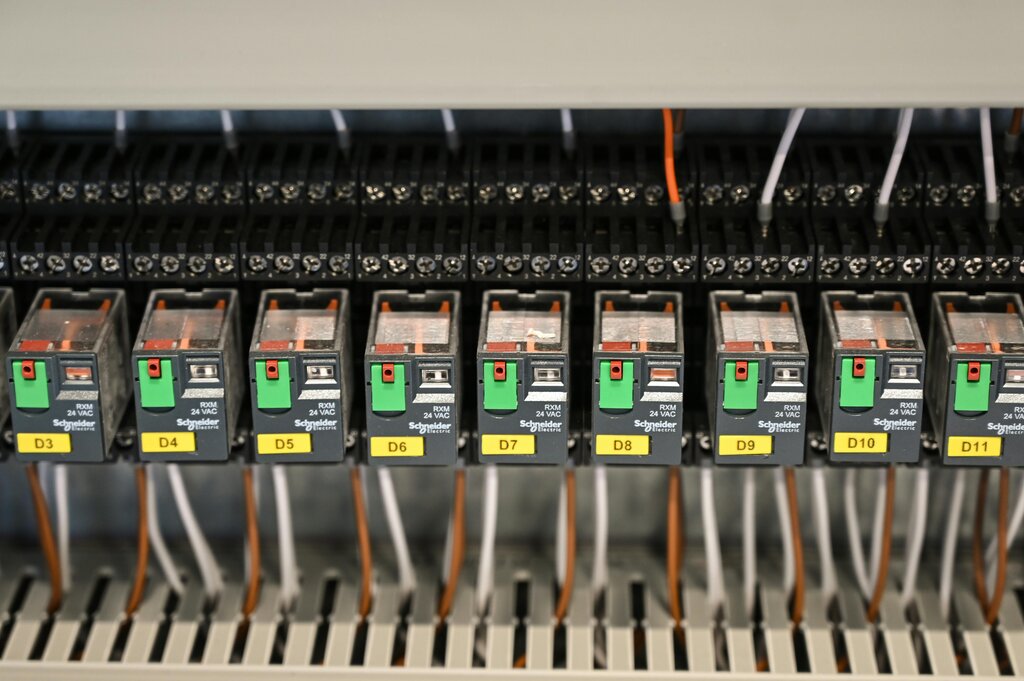
In the late 1960s, the automotive industry was desperate for a better way. They needed a system that was flexible, solid-state, and easy to reprogram. An engineer named Dick Morley and his team answered the call, creating the first PLC. It replaced the physical wiring of relays with a software program. Now, changing a process was as simple as updating the logic in the controller's memory. This invention revolutionized manufacturing.
Inside the Box
A PLC isn't like your desktop computer. It's built to survive harsh industrial environments with extreme temperatures, vibration, and electrical noise. While its components serve similar functions, they are designed for reliability and real-time control. A typical PLC is a modular system with a few key parts.
- CPU (Central Processing Unit): This is the PLC's brain. It executes the control program, performs logic operations, and communicates with the other parts.
- Memory: This is where the PLC's operating system and the user-created program are stored. It also holds the status of all the inputs and outputs.
- Input/Output (I/O) Modules: These modules are the PLC's connection to the outside world. Input modules read signals from devices like buttons, sensors, and switches. Output modules send control signals to devices like motors, lights, and solenoids.
- Power Supply: This component converts the available AC power into the low-voltage DC power that the PLC's internal components need to operate.
In short, inputs tell the CPU what's happening, the CPU decides what to do based on its program, and outputs make it happen.
One of the key advantages of this modular design is flexibility. If you need to monitor more sensors, you just add another input module. If you need to control more motors, you add an output module. This allows a control system to easily grow and adapt to new requirements.
Before you're tested on this material, let's try a quick quiz.
What is the primary function of a Programmable Logic Controller (PLC) in an industrial setting?
Before the invention of PLCs, industrial control systems were primarily built using electromechanical relays. What was the main disadvantage of this technology?
PLCs are fundamental building blocks of modern industry, providing the intelligence and reliability needed for complex automation.