No history yet

Philosophy

Welcome! Philosophy is a massive and exciting world, but it is best approached as a conversation rather than a dry list of facts.

Before we build our roadmap, I would love to know a bit more about what brings you here. Are you looking to tackle life's big questions, or is there a specific thinker who caught your eye?

I want to sharpen my critical thinking and logic skills.

That is a fantastic goal. Critical thinking and logic are not just academic exercises; they are the ultimate cognitive toolkits for navigating everyday life, spotting bad arguments, and making sound decisions. Let's start our journey by looking at our roadmap to see how we will build these skills step-by-step.

Your path
The Foundations of Logic and Argumentation
Applying Critical Thinking to Philosophical Texts
To build a bulletproof logical mind, we first need to understand what philosophy actually is. The word itself comes from the Ancient Greek philosophia, which literally translates to the "". Rather than just accepting things at face value, philosophy is the systematic study of fundamental questions about existence, knowledge, values, reason, mind, and language. It's not about memorizing facts; it's about learning how to think, not what to think.

Can you show me a diagram of how this works?

To show you how philosophy serves as your ultimate critical thinking toolkit, let's visualize how its major branches connect directly to your goal of sharpening your reasoning skills.

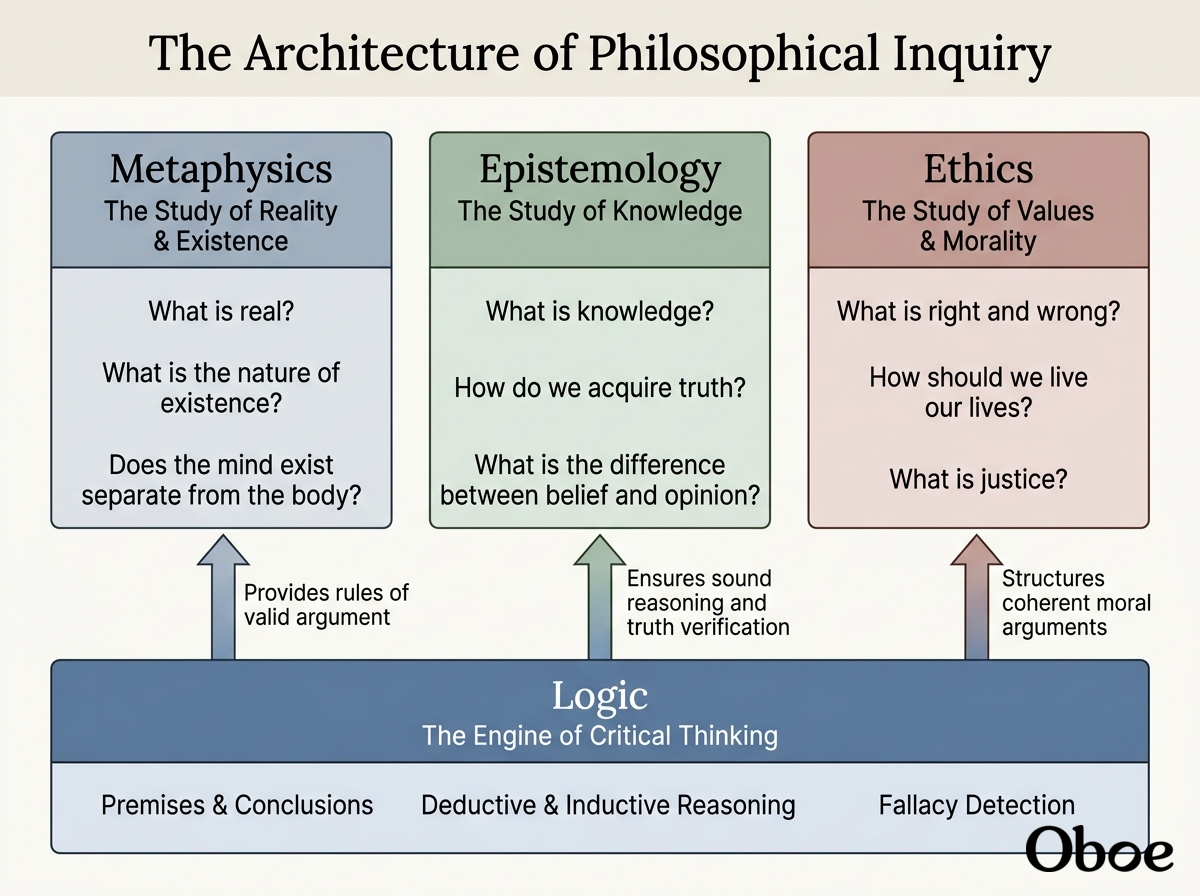
DIAG
Diagram
Generated course diagram
I've started generating a diagram that maps out this framework. While that compiles, let's look at why learning philosophy is the single best way to hone your critical thinking. At its core, philosophy forces you to dissect the underlying assumptions behind every claim. Instead of just asking what is true, it trains you to ask: How do we know it's true? and What makes this a valid conclusion? This disciplined approach is why studying philosophy develops sharp analytical skills. By learning to navigate complex, abstract ideas, you build a mental framework that can evaluate arguments in any field, from science and law to everyday conversations. This foundation is built on four core branches:
  • Metaphysics: The study of reality and existence.
  • Epistemology: The study of knowledge and belief.
  • Ethics: The study of values and moral choices.
  • : The systematic study of valid rules of inference and reasoning.
Because logic is the tool we use to investigate all the other branches, it serves as the absolute foundation for critical thinking.