Introduction to Machine Learning Concepts
Introduction to Machine Learning
What is Machine Learning?
Machine learning is a way for computers to learn from data and make decisions without being explicitly programmed for every single task. It’s about recognizing patterns and improving with experience.
Think about filtering spam emails. With traditional programming, you'd write specific rules: if an email contains the words “free,” “money,” and “now,” mark it as spam. This works, but spammers quickly adapt. You’d be stuck writing new rules forever.
Machine learning takes a different approach. You would show the program thousands of emails that have already been marked as spam or not spam. The machine learning model then learns the patterns and characteristics of spam on its own. It might notice that spam often uses urgent language, has strange formatting, or comes from unusual email addresses. Over time, it gets better at spotting spam, even new types it has never seen before.
Traditional programming uses rules to process data and get answers. Machine learning uses data and answers to figure out the rules.
Why It Matters
Machine learning is all around us. It powers the recommendation engine that suggests what you should watch next on a streaming service. It’s behind the technology that lets your phone recognize your face. It helps doctors diagnose diseases from medical images, and it enables self-driving cars to navigate traffic.
The core idea is to use data to build models that can make predictions or decisions. This allows us to solve complex problems that would be impossible to code by hand.
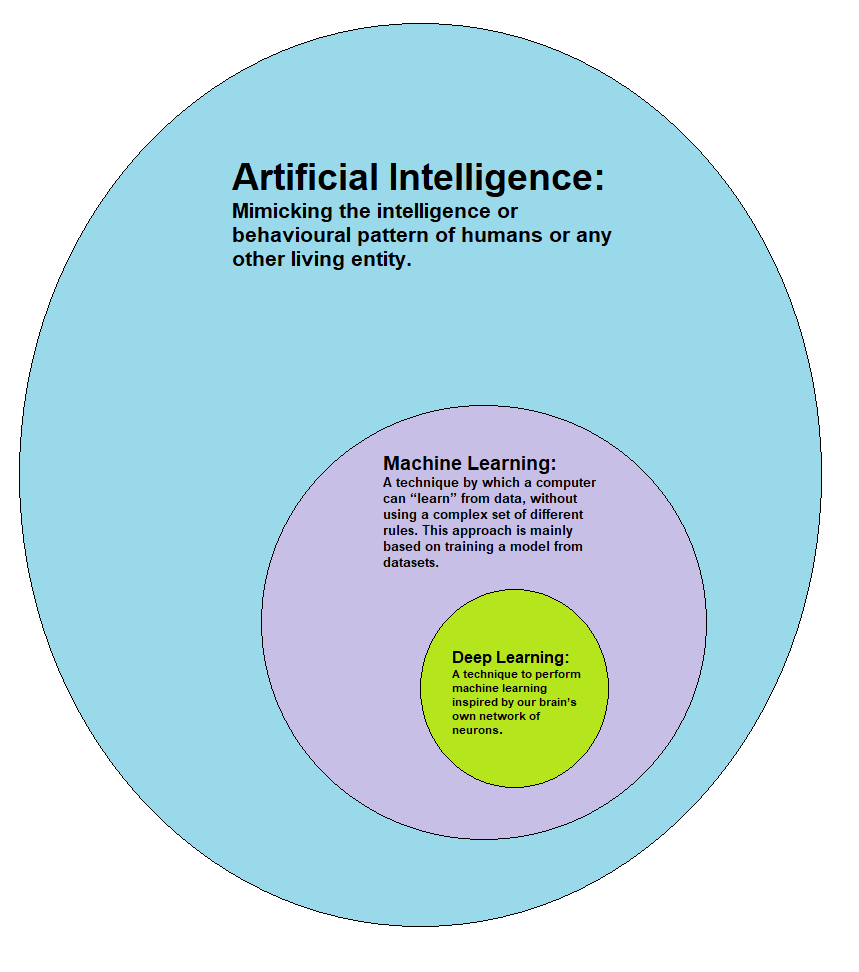
Three Ways to Learn
Not all machine learning is the same. There are three main approaches, each suited for different kinds of problems: supervised learning, unsupervised learning, and reinforcement learning. Think of them as different strategies for teaching a computer a new skill.
Let's look at each one.
Supervised Learning: Learning with a Teacher
Supervised learning is like studying with flashcards. You give the model a dataset where the correct answers are already provided. This is known as labeled data.
For example, to teach a model to identify cats, you’d feed it thousands of pictures, each one labeled “cat” or “not a cat.” The model learns the visual patterns associated with the “cat” label. After training, you can show it a new, unlabeled picture, and it will predict whether or not it's a cat. Predicting house prices based on features like square footage and number of bedrooms is another classic example.
Unsupervised Learning: Finding Patterns on Its Own
Unsupervised learning is what happens when you give the model a dataset without any labels or correct answers. The goal isn't to predict a specific outcome but to discover hidden structures and patterns within the data.
Imagine giving a computer a box of assorted fruits and asking it to sort them. Without knowing the names of the fruits, it might group them by color, size, or shape. This is called clustering. Online retailers use this technique to group customers with similar purchasing habits, allowing for targeted marketing campaigns.
Reinforcement Learning: Learning from Trial and Error
Reinforcement learning is about learning through consequences. An agent (the model) learns to make decisions by performing actions in an environment to achieve a goal. When it takes an action that gets it closer to the goal, it receives a reward. When it takes a wrong action, it gets a penalty.
This is how AI models learn to play complex games like Chess or Go. The agent isn't taught the best moves. Instead, it plays millions of games against itself, learning from trial and error which sequences of actions lead to a win (a reward). This approach is also used in robotics to teach robots how to perform tasks like walking or grasping objects.
| Learning Type | Data Input | Goal | Example |
|---|---|---|---|
| Supervised | Labeled Data | Predict an outcome | Spam detection |
| Unsupervised | Unlabeled Data | Find hidden patterns | Customer segmentation |
| Reinforcement | No initial data | Maximize a reward | Training a game-playing AI |
These three types of learning form the foundation of machine learning. By understanding them, you can start to see how computers are taught to perform a huge range of intelligent tasks.
What is the primary goal of machine learning?
According to the text, how does machine learning approach spam filtering differently from traditional programming?