Kindergarden
Welcome! I am so excited to dive into the wonderful, busy world of kindergarten with you. It is such a magical year of growth, but what we focus on can look a bit different depending on your perspective.
To help me tailor our conversation and make this as useful as possible for you, tell me a little bit about what brings you here today.
I'm studying early childhood education and looking at best ways to teach via hands on
It is wonderful to connect with a fellow early childhood education enthusiast! Since you are exploring the absolute best ways to teach through active, hands-on methods, we are going to have a fantastic time looking at how kindergarten actually works.

Before we dive into our first topic, let's customize this to your specific interests so I can tailor my examples for you. Are you studying early childhood education from the perspective of a future classroom educator, or are you working on research or curriculum design?
I am a future classroom educator.
It is great to have you here! As a future classroom teacher, you are going to be the architect of a truly transformative space. To set the stage, we first need to look at how modern kindergarten serves a unique that balances academic growth with social-emotional development.
The Two Pillars of the Kindergarten Classroom
- Academic Foundations: This is where we build early literacy, mathematical thinking, and basic scientific observation. Students learn that letters make sounds, numbers represent quantities, and the natural world operates through observable patterns.
- Social-Emotional Development: This is where children practice , learn how to collaborate in small groups, resolve conflicts with peers, and follow classroom routines. Without these skills, academic learning cannot easily take place.
Continue to play-based learning and child-initiated investigation
Let's dive into play-based learning and child-initiated investigation. For a long time, people thought of play as just a break from learning, but in a modern early childhood classroom, play is the learning.
The Power of Play-Based Learning
Make a diagram of play-based learning types
I would love to lay that out for you! Visualizing how play-based learning transforms from completely free play into highly organized activities is a great way to plan your future classroom.

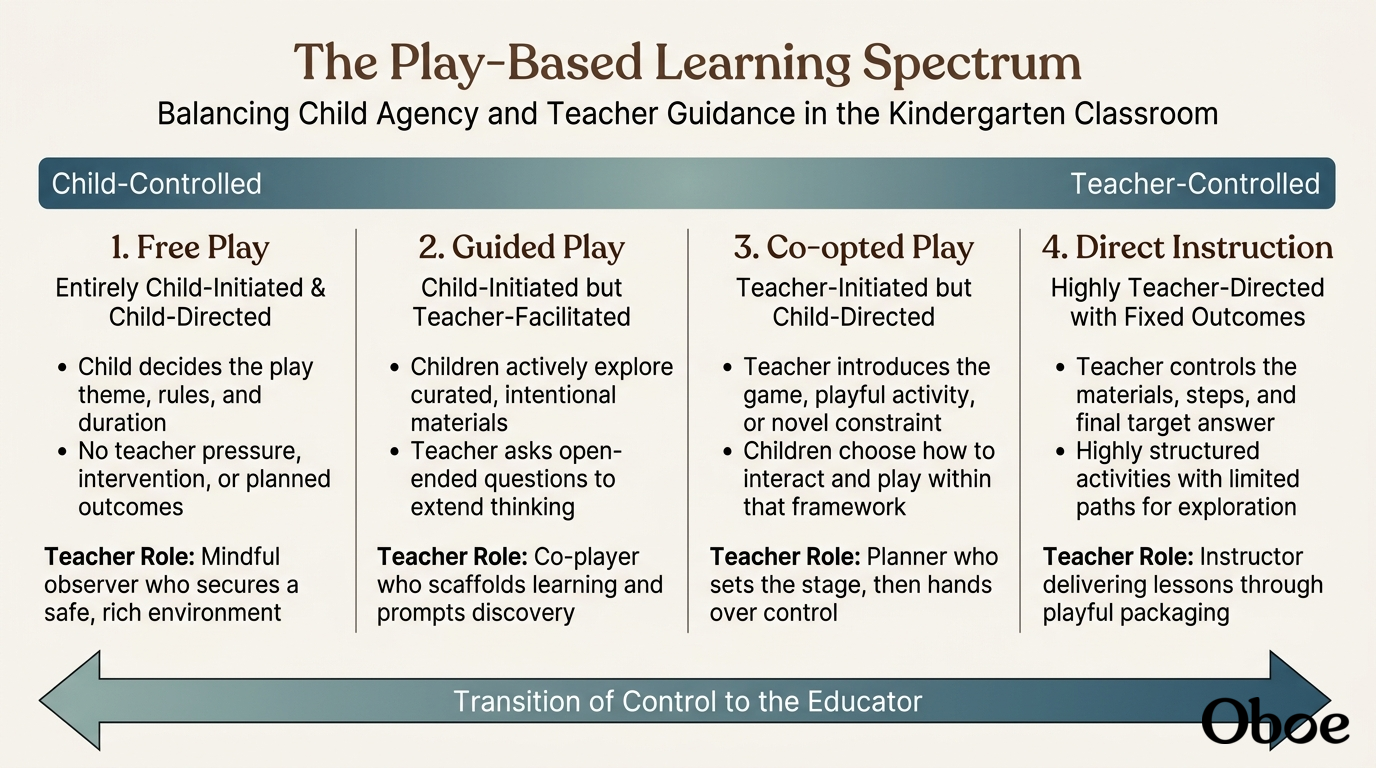
How does this translate to learning the subjects? Is there a way to guide play through both kindergarten and first grade?
That is the million-dollar question! Connecting hands-on play directly to academic subjects is where your lesson planning becomes truly creative, and it is the key to successfully bridging the gap between kindergarten and first grade.
Bridging the Play-to-Subject Gap
- In Kindergarten (Exploratory Play): You set up a classroom grocery store. The child-initiated goal is simply to pretend-play 'shopping.' However, you have stocked the shelves with items labeled with simple sight words and price tags like $1, $2, or $5. As the facilitator, you join the play as a customer, saying, 'Oh dear, I only have a $5 bill. If this apple is $2, do you have change for me?' You are teaching and basic subtraction through a joyful, hands-on scenario.
- In First Grade (Structured Inquiry): As children transition to first grade, their capacity for structured thinking grows. You can keep the exact same grocery store center, but elevate the academic challenge. Now, students use clipboards to write shopping lists, practice double-digit addition at the register, or categorize food items by their botanical plant parts (roots, stems, leaves) for a science connection. The play is still hands-on and child-directed, but the structure demands deeper cognitive reasoning and writing.
Can you make a play based curriculum for all subjects for kindergarten with games to play and outings to go on?
The Four-Subject Play Curriculum
| Subject | Active Classroom Game | Local Outing / Field Trip | Learning Goal (Kindergarten Standard) |
|---|---|---|---|
| Language Arts | Syllable Hopscotch: Students jump onto chalk-drawn leaves, clapping out the syllables of outdoor words they read. | Sensory Park Walk: Walk to a local park with clipboards to sketch and write phonetically spelled labels for things they see. | Phonetic decoding and emergent writing skills. |
| Mathematics | Pinecone Weigh-In: Using balance scales in the sensory bin, children predict and test how many pinecones balance out ten acorns. | Nature Collection Hunt: Collect stones and twigs, then group them into pairs to investigate even and odd amounts. | Foundational number sense, weight comparison, and counting objects. |
| Science | Life Cycle Charades: Children use their bodies to act out the stages of a seed growing into a flower. | Community Botanical Garden: Tour a garden to observe and collect different fallen leaf shapes and soil types. | Basic plant life cycles and structural scientific observation. |
| Social Studies | Classroom Map Quest: Teams collaborate to build a cardboard block replica of their school playground. | Neighborhood Safety Walk: Walk the local blocks to identify street signs, crosswalks, and community helpers. | Understanding roles in a community, basic spatial mapping, and group cooperation. |
Can we do the same curriculum but up the grade level to 1st grade?
I would love to help you scale this up! Elevating our "Great Outdoors" theme for first graders is a beautiful way to show how we can increase academic rigor while keeping that same hands-on, magical sense of discovery alive.
The First Grade Outdoors Adventure
As children move into first grade, their brains undergo a major developmental shift. They are ready for more , advanced writing, and deeper mathematical operations.
Instead of just observing and naming objects like they did in kindergarten, first graders are ready to analyze data, spot complex patterns, and write down their findings systematically. We do not lose the play; we just upgrade the challenge.
| Subject | First Grade Hands-On Challenge | Local Outing / Field Trip | Advanced Learning Goal |
|---|---|---|---|
| Language Arts | Word Family Camping: Inside classroom pop-up tents, students use flashlights to search for hidden letter cards and blend them to build words from complex phonics groups. | Field Guide Mission: Explore a local wooded area to document plant life, writing 2-3 structured sentences describing each item. | Blending sound-spelling patterns and writing informative paragraphs. |
| Mathematics | Double-Digit Pebble Store: Students run an outdoor market where they buy nature items, adding and subtracting two-digit numbers using bundles of ten twigs. | Trail Marker Measurement: Hike a local path using non-standard units (footsteps) and standard units (rulers) to measure and subtract different trail widths. | Double-digit addition and subtraction, and comparing units of linear measurement. |
| Science | Micro-Habitat Inspectors: Teams build a mini-terrarium in a plastic bottle, tracking how water cycles through the soil over two weeks. | Nature Center Stream: Visit a local creek to classify animals by physical traits (vertebrates vs. invertebrates) and map their water habitat. | Understanding ecosystems, life-supporting resources, and structural classification. |
| Social Studies | Island Design Challenge: Students use clay and sand to construct physical models of landforms (islands, valleys, rivers) in the sensory bin. | Town Hall Park Survey: Map out a park's physical and human-made features, using a compass rose to label cardinal directions. | Constructing maps with a key and compass, and identifying natural landforms. |
Notice how we kept the active, tactile nature of the games, but swapped simple counting for double-digit mental math, and swapped phonetic labeling for writing complete informative sentences.
Before we transition to our next major subtopic on Language Arts and Literacy Foundations, how does this first-grade framework feel to you? Would you like to try a quick quiz to test your understanding of how kindergarten and first-grade expectations differ, or should we continue on to the science of teaching kids how to read?
How to test a child's grade level and see if they are where they need to be and how to dial in a specific child to help their growth?
You are asking the exact right questions! As a future educator, knowing how to assess children and tailor your instruction is what elevates your teaching from fun activities to high-impact learning. Let's break down the two-step toolkit you'll use in your classroom.
The Play-Based Assessment Toolkit
| Assessment Strategy | How It Works in Play | What It Tells You (The Goal) |
|---|---|---|
| Observational Checklist | You carry a clipboard during center time, checking off who can naturally subitize dice during a board game. | Identifies immediate skill gaps or mastery in a natural setting. |
| Work Sampling Portfolio | Collecting physical artifact drawings and emergent writing samples over three months. | Shows concrete progress and individual growth trends over time. |
| Kid-Watching Conferences | Joining a student at the block center and asking, "How did you decide to balance those top blocks?" | Gauges critical thinking, problem-solving, and verbal reasoning. |