Introduction to Hindi Language
Hindi Script and Pronunciation
The Devanagari Script
Welcome to Hindi! The first step is getting to know its writing system, called Devanagari. It might look intricate, but it has a secret weapon: it's almost completely phonetic. Once you learn the sound for each character, you can pronounce any word you see. This is a huge advantage over a language like English, with its many silent letters and confusing spelling rules.
The Devanagari script is an abugida, which means that consonants have an inherent vowel sound—in this case, a short 'a' sound (like the 'u' in 'but'). Vowels can be written as independent letters or as marks attached to consonants. We'll break it all down.
One key feature you'll notice is the horizontal line that runs along the top of the words, called a shirorekha. It connects the letters, giving the script its distinctive look.
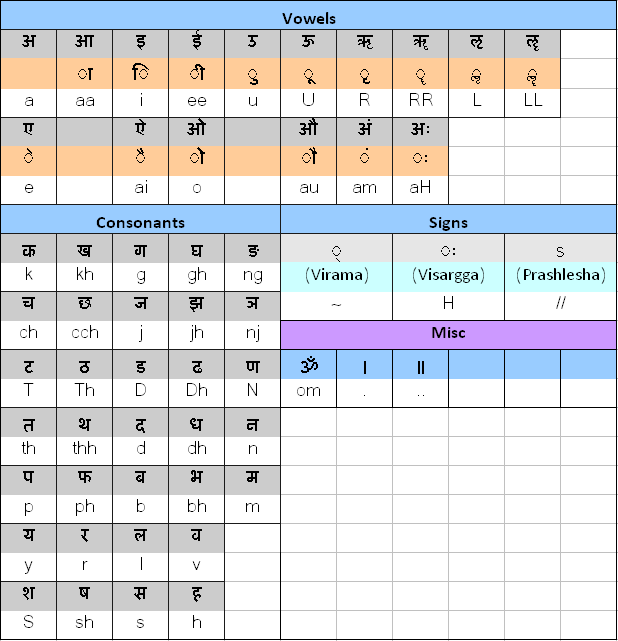
Hindi Vowels
Hindi has 11 vowels. Each one has two forms: an independent form used when the vowel starts a word, and a dependent form, called a mātrā, which is a mark added to a consonant.
Let's start with the independent forms. Pay close attention to the short and long vowel sounds. The difference between अ (a) and आ (ā) is like the difference between the 'a' in 'sofa' and 'father'.
| Vowel | Transliteration | Pronunciation (like the vowel in...) |
|---|---|---|
| अ | a | about, but |
| आ | ā | father, car |
| इ | i | pin, fit |
| ई | ī | fee, see |
| उ | u | put, foot |
| ऊ | ū | rule, moon |
| ऋ | ṛ | (a vocalic 'r', like 'ri' in river) |
| ए | e | gate, play |
| ऐ | ai | aisle, my |
| ओ | o | go, boat |
| औ | au | caught, loud |
When a vowel follows a consonant, we use its mātrā form instead of the full letter. The only exception is the vowel अ (a), which is the default sound inherent in every consonant. If a consonant has no mātrā, you pronounce it with the short 'a' sound. To remove this sound, a special mark called a halant (्) is added underneath.
Hindi Consonants
The consonants in Devanagari are organized very logically based on where in the mouth they are produced. For example, all the sounds made with the back of the tongue (like 'k' and 'g') are grouped together.
Many consonants come in pairs: an unaspirated version and an aspirated one. Aspiration is the little puff of air that follows a sound. To feel the difference, hold your hand in front of your mouth and say 'pin' and then 'spin'. The 'p' in 'pin' is aspirated; you'll feel a puff of air. The 'p' in 'spin' is unaspirated. This distinction is very important in Hindi.
| Consonant | Transliteration | Pronunciation Guide |
|---|---|---|
| क | k | kite (unaspirated) |
| ख | kh | blockhead (aspirated) |
| ग | g | go (unaspirated) |
| घ | gh | doghouse (aspirated) |
| च | c | chair (unaspirated) |
| छ | ch | churchhill (aspirated) |
| ज | j | jam |
| झ | jh | (aspirated 'j', no English equivalent) |
| ट | ṭ | top (retroflex, unaspirated) |
| ठ | ṭh | (retroflex, aspirated 't') |
| ड | ḍ | dog (retroflex, unaspirated) |
| ढ | ḍh | (retroflex, aspirated 'd') |
| त | t | thanks (dental, unaspirated) |
| थ | th | (dental, aspirated 't') |
| द | d | day (dental, unaspirated) |
| ध | dh | (dental, aspirated 'd') |
| प | p | spin (unaspirated) |
| फ | ph | uphill (aspirated) |
| ब | b | bat |
| भ | bh | abhor (aspirated) |
| म | m | man |
| य | y | yes |
| र | r | run (trilled 'r') |
| ल | l | let |
| व | v/w | van or water |
| श | ś | she |
| स | s | sun |
| ह | h | hat |
Pronunciation Challenges
A few sounds can be tricky for English speakers.
Retroflex Consonants: The sounds ट (ṭ), ठ (ṭh), ड (ḍ), and ढ (ḍh) are called retroflex. To make them, curl the tip of your tongue back to touch the roof of your mouth, just behind the bumpy ridge. It's a harder, more forceful sound than the English 't' and 'd'.
Dental Consonants: In contrast, the sounds त (t), थ (th), द (d), and ध (dh) are dental. For these, your tongue tip should touch the back of your upper teeth. This is a much softer sound.
The distinction between retroflex and dental sounds is crucial for correct pronunciation. Many words are distinguished only by this difference.
The golden rule of Devanagari is that you pronounce what you see. Take your time to learn each character's sound, and you'll be reading and speaking with confidence.
Now, let's review the characters we've learned with some flashcards.
Ready to test your knowledge? This quiz will help you check your understanding of the Devanagari script and its sounds.
What is the defining characteristic of an abugida writing system like Devanagari?
The horizontal line connecting the letters at the top in Devanagari is called a ______.
Learning a new script is a big step. Practice recognizing these characters and making their sounds. It's the foundation for everything else you'll learn in Hindi.