Introduction to Generative AI
Introduction to Generative AI
What Is Generative AI?
Artificial intelligence that can create something entirely new is called generative AI. While other types of AI might analyze or categorize information, generative AI acts more like an artist or an inventor. It learns from vast amounts of existing data—like text, images, or music—and then uses that knowledge to produce original content that has similar characteristics.
generative AI
noun
A type of artificial intelligence that can produce various types of new content, including text, imagery, audio, and synthetic data.
Think of it like a musician who listens to thousands of jazz songs. They don't just memorize the solos; they learn the rules, patterns, and spirit of jazz music. Then, they can improvise a brand new solo that sounds authentically like jazz but is completely their own. Generative AI does something similar, but with data. It doesn't just copy and paste; it synthesizes and creates.
The key difference is creation, not just analysis. Generative AI makes new things; other forms of AI describe existing things.
Beyond a Smart Assistant
You're probably familiar with AI that can recognize your voice, tag your friends in photos, or recommend a movie. These systems are incredibly smart, but they operate differently from generative AI. Most of what people used to call AI is better described as analytical or discriminative AI. Its primary job is to classify data or make predictions based on it.
For example, a discriminative AI can look at a photo and determine if it's a cat or a dog. It sorts information into known categories. A generative AI, on the other hand, can create a brand new, realistic image of a cat that has never existed.
| AI Type | Primary Function | Example |
|---|---|---|
| Analytical / Discriminative AI | Classifies or predicts from data | Is this email spam or not? |
| Generative AI | Creates new, original data | Write a new email that sounds like it's from me. |
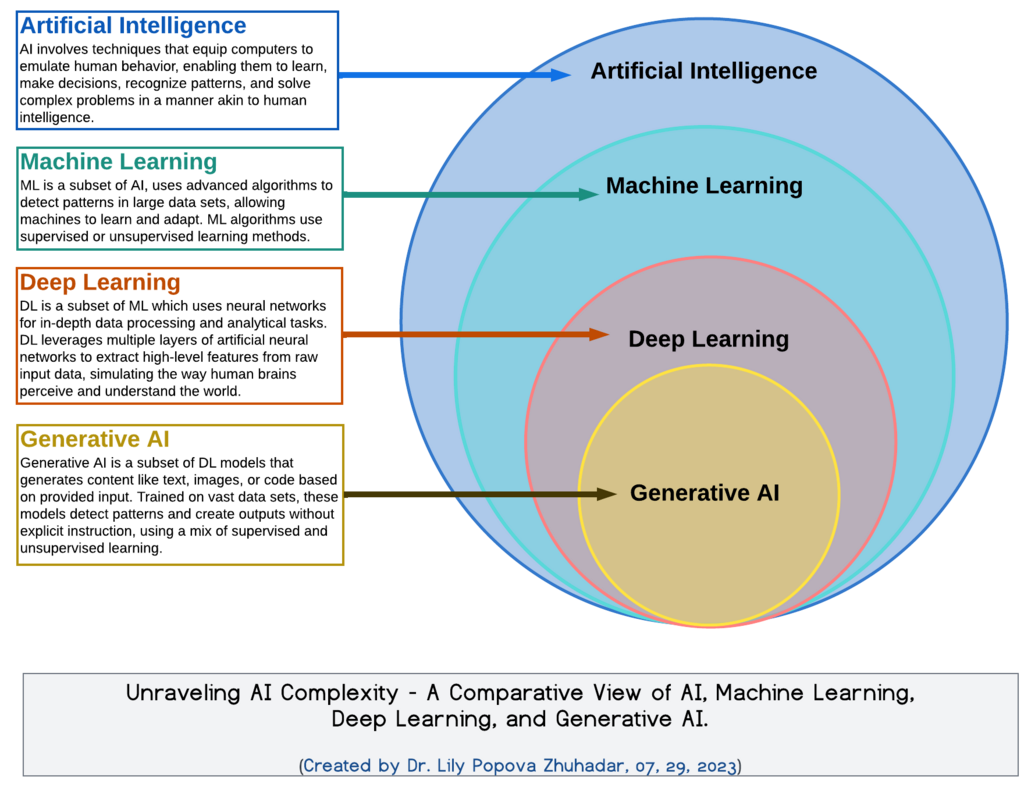
Generative AI is a specialized subset of the broader field of artificial intelligence, often powered by deep learning and neural networks.
A Brief History
Though it seems like it appeared overnight, the concepts behind generative AI have been developing for decades. Early computer programs in the 1950s and 60s, like ELIZA, could simulate conversations but were based on simple rules and pattern matching. They couldn't truly create novel text.
The theoretical groundwork for modern generative models was laid in the following decades with the development of neural networks. But it wasn't until the 2010s that two key factors came together: massive amounts of digital data to learn from and powerful computers that could process it all.
Key breakthroughs, like the introduction of Generative Adversarial Networks (GANs) in 2014 and Transformers in 2017, supercharged the field. GANs taught AI to get better at creating realistic images by having two AIs compete against each other. Transformers made AI much better at understanding the context in long sequences of text. These innovations paved the way for the powerful tools we see today.
Applications and Ethics
Generative AI is already changing how we work and create. In entertainment, it's used to generate special effects, compose music, and even write early drafts of scripts. Healthcare professionals use it to create synthetic patient data for research without compromising privacy, and to design new drugs. In finance, it can generate market simulations to test trading strategies.
But this powerful technology also comes with serious ethical questions. One major concern is bias. If an AI is trained on data that reflects historical biases, it can generate content that reinforces those same stereotypes.
Privacy is another issue. Models trained on public data from the internet might inadvertently reproduce personal information. There's also the question of accountability: if a generative AI produces harmful or false information, who is responsible? The user who prompted it, the company that built it, or someone else?
As generative AI becomes more integrated into our lives, navigating these challenges is just as important as developing the technology itself.
If you choose to allow your students to use generative AI tools, it is your responsibility to clearly communicate your expectations for how they engage with these tools.
Understanding what generative AI is, where it came from, and how it works is the first step toward using it wisely.