No history yet

Basics of Game Theory

Welcome! I'm excited to explore game theory with you. Before we dive into the strategies and math, I'd love to know a bit about what brings you here and your background so I can tailor our conversation perfectly.

I'm a complete beginner looking for a fun introduction.

Welcome! I'm thrilled to have you here. Since you're looking for a fun and easy-to-grasp introduction, we will keep the math light and focus on the intuition.

Your path
Simultaneous vs. Sequential Games
Dominant Strategies and Nash Equilibrium
Real-world Applications
Let's kick things off with a simple definition. At its heart, isn't actually about playing chess or video games. Instead, it is the study of how people make decisions when their success depends on the choices of others.

Continue and learn the core concepts (players, strategies, payoffs)

Let's dive right into the building blocks of any strategic situation. In game theory, we use the word game to describe any situation where people interact, and every single one of these games is built from three essential ingredients: players, strategies, and payoffs.

The Three Pillars of a Game

ElementWhat It Means
PlayersThe decision-makers who are acting in the game.
StrategiesThe complete plan of action available to each player.
PayoffsThe ultimate rewards or consequences based on everyone's choices.
To make this concrete, let's look at an everyday scenario: two rival coffee shops, Brew Haven and Daily Grind, deciding whether to set their coffee price at $3 or $5. In this scenario, the are the two coffee shops. Their available are the choices to charge either $3 or $5. Finally, the are the profits each shop makes once they see what price their rival chose. If both charge $5, they both make great profits. But if Brew Haven charges $3 while Daily Grind charges $5, Brew Haven steals all the customers and gets a massive payoff, leaving Daily Grind with next to nothing.

Now that we have these core ingredients down, we can use them to explore a famous classic example that puts them all together. Would you like to see how this works in a simple coordination game, or should we jump straight to the famous Prisoner's Dilemma?

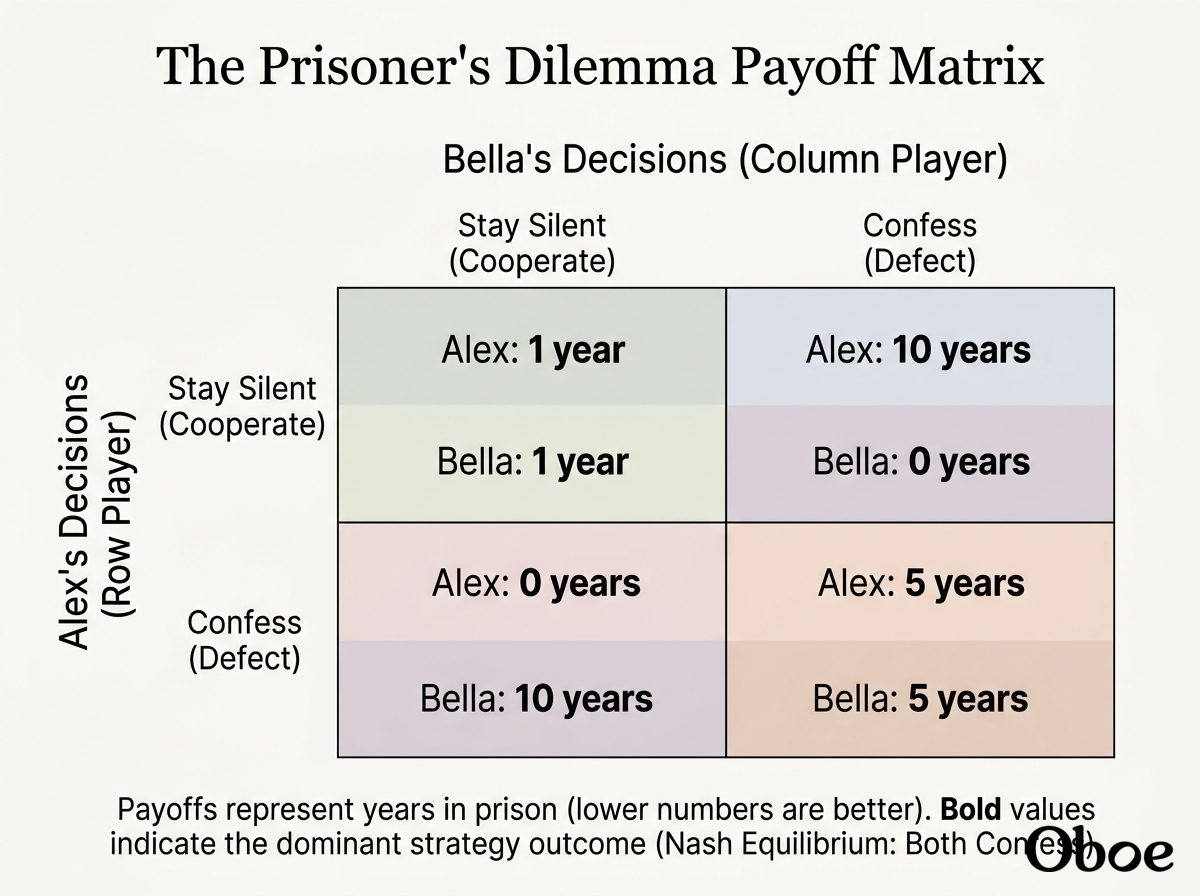
Let's continue to the Prisoner's Dilemma! Plus, I'd love to see a diagram of how this looks.

You got it! The is the perfect way to see how these concepts come to life, and it perfectly illustrates how doing what is best for yourself can sometimes lead to a terrible outcome for everyone.

The Setup of the Dilemma

Imagine two suspects, Alex and Bella, are arrested for a crime. The police put them in separate rooms so they cannot talk. The detective offers each of them the exact same deal:
  • Stay Silent (Cooperate with each other)
  • Confess (Defect on your partner)
Because they cannot communicate, they have to guess what the other will do.
DIAG
Diagram
Generated course diagram
Let's lay out the payoffs in a standard to see how their decisions interact. If both Alex and Bella stay silent, they both get a light sentence of 1 year in prison. If one confesses while the other stays silent, the confessor goes free (0 years) while the silent partner gets hit with a brutal 10 years. Finally, if both confess, they both serve a moderate sentence of 5 years.