french
Welcome! I'm so excited to help you start your French journey. To make sure we customize this to your goals, tell me a bit about what's drawing you to the language and your current background.
I have some basic exposure and want to prep for travel.
I am so thrilled to help you prepare for your travels! Having a bit of background is a fantastic head start, and focusing on practical conversational skills will make your trip infinitely more rewarding.

Starting with French Pronunciation
To kicked off our first subtopic, we need to talk about the sounds of the language. Spoken French has a reputation for being incredibly beautiful and flowing, but for English speakers, it can also feel like a bit of a trick. That is because French is famous for its and , where words are often pronounced very differently than how they look on the page.
As a quick traveler's tip, the most important silent letter rule to memorize is that final consonants (especially -s, -t, -d, and -g) are usually completely quiet. For example, when you want to say "hot" in the masculine form, it is spelled chaud but you only pronounce it as shoh—the "d" is entirely silent!
Let's start by looking at how some of these sounds work in real life. Would you like to see a comparison diagram showing how spelling translates to spoken pronunciation, or would you prefer to jump right into some essential travel phrases?
Show me a pronunciation diagram
I would love to show you! Visualizing how these letters shift from the page to your voice is one of the quickest ways to build speaking confidence.

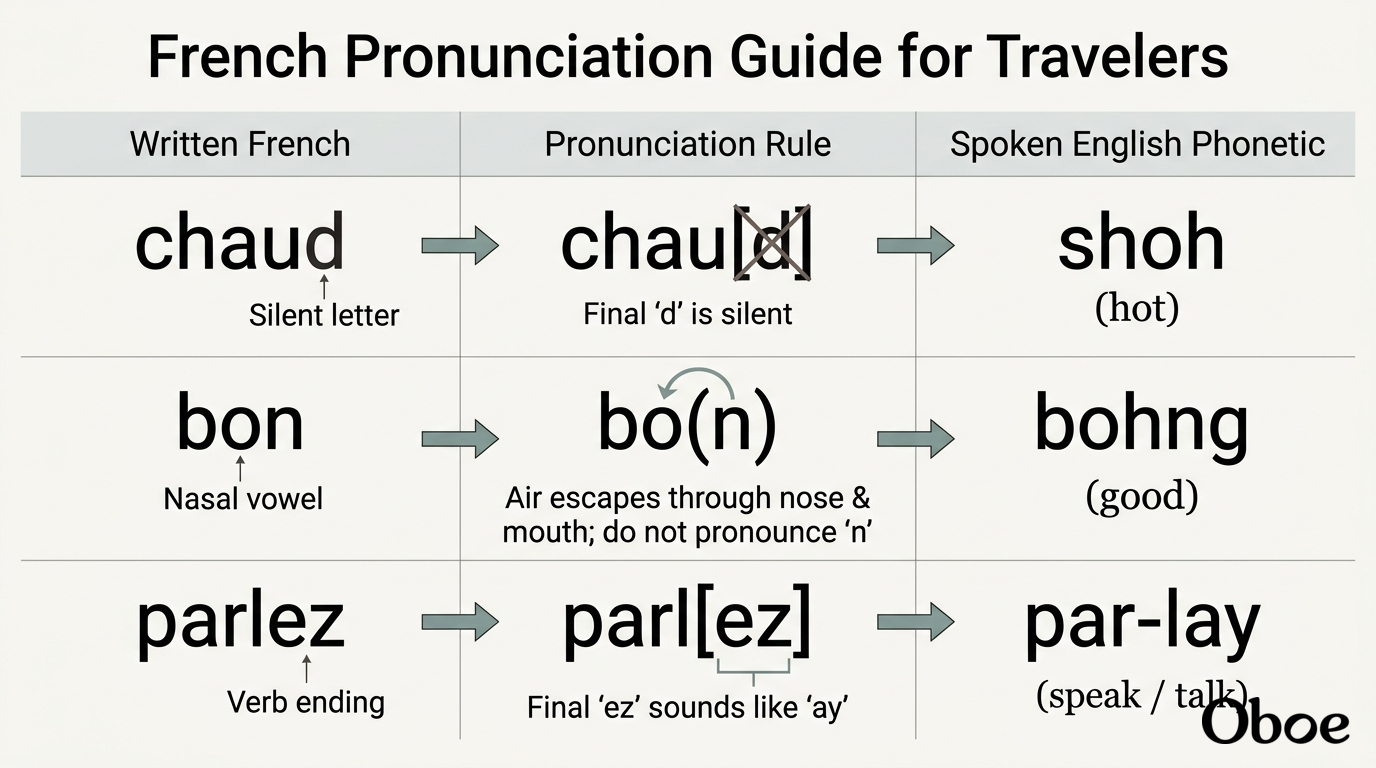
I've started generating that pronunciation diagram for you. While that is being built, let's keep moving forward with our first practical step for your trip: learning how to greet people and say hello!
Continue to basic greetings like Bonjour
Let's dive straight into the single most important word you will use on your trip: bonjour!
In France, saying is not just a polite way to start a conversation; it is a vital social contract. Walking into a shop, boarding a bus, or asking for help without saying it first is considered highly impolite.
Literally translated, bonjour means "good day" (from bon, meaning "good", and jour, meaning "day").
When it comes to pronouncing it, keep our quiet letter rules in mind. The final "r" is soft and airy, and the "on" is one of those classic nasal sounds we talked about. Try saying it like this:
bon-zhoor
Once you have greeted someone, the next natural step is to introduce yourself so they know who you are!