Introduction to DICOM Medical Imaging
Introduction to DICOM
The Universal Language of Medical Images
Imagine trying to play a video game from one console on a completely different one. It wouldn't work. The game is in a format that the second console can't understand. In the early days of digital medical imaging, doctors faced a similar problem. A CT scanner from one company created files that couldn't be opened on a machine from another. This created huge headaches for sharing patient scans between hospitals and specialists.
To solve this, the medical community created a universal standard. It’s called DICOM.
DICOM
noun
Stands for Digital Imaging and Communications in Medicine. It's the international standard for storing, transmitting, and managing medical imaging data and related information.
Think of DICOM as the USB of the medical world. It doesn't matter who makes the device—a laptop, a flash drive, a printer—if it has a USB port, it works. DICOM does the same for X-rays, MRIs, and CT scans. It ensures that an image created on any machine can be viewed, shared, and archived by any other system that follows the standard.
Digital Imaging and Communications in Medicine (DICOM) is the standard for the communication and management of medical imaging information and related data.
The Push for a Standard
Before DICOM, the situation was chaotic. Each manufacturer had its own proprietary image format. This forced hospitals to buy all their equipment from a single vendor, locking them into one ecosystem. Sharing images between different institutions was a technical nightmare, often requiring images to be printed on film and physically mailed.
In the early 1980s, the American College of Radiology (ACR) and the National Electrical Manufacturers Association (NEMA) teamed up to fix the problem. They knew a common standard was needed for medical imaging devices to talk to each other. Their collaboration produced the first version of the standard in 1985. After several revisions and the inclusion of network protocols, it was renamed DICOM in 1993.
Connecting the Dots with Interoperability
The core purpose of DICOM is to enable interoperability. This simply means that different systems and devices can exchange information and use it without special effort. For a patient, this is critical.
Consider this scenario: a patient has a CT scan at a small rural hospital. The images reveal a complex issue that requires a specialist at a large city hospital. Thanks to DICOM, the rural hospital can electronically send the complete, high-quality scan to the specialist. The specialist can then open the file on their own system, regardless of the brand, and make a diagnosis. The file doesn't just contain the image; it also includes vital patient information, details about the scan, and more, all in one standardized package.
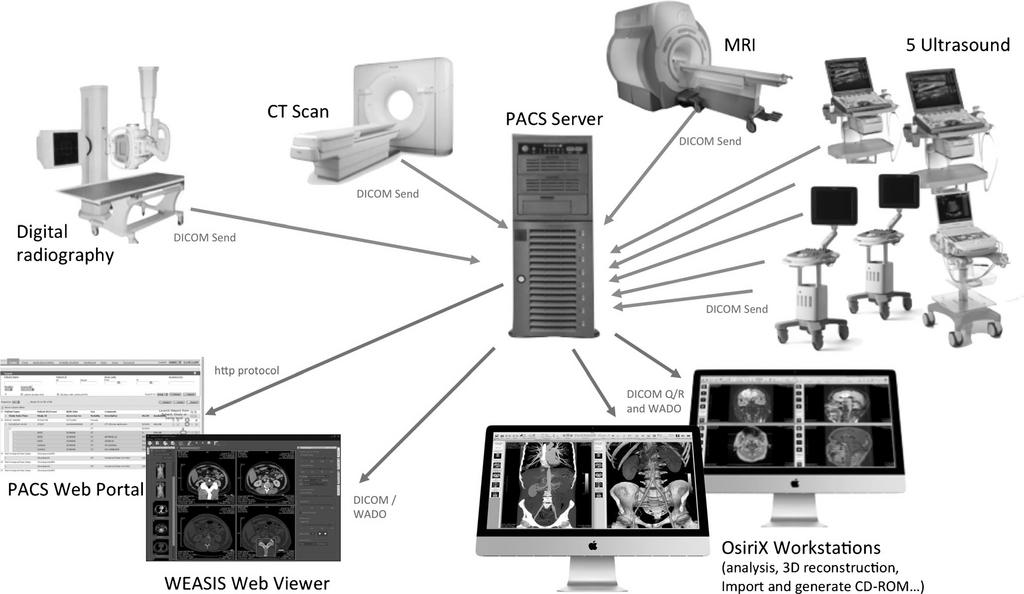
This seamless flow of information saves time, reduces costs, and can dramatically improve patient outcomes. There's no need to repeat scans, mail physical films, or struggle with incompatible file formats.
A Global Standard
DICOM isn't just an American standard; it's used worldwide. This global adoption is crucial for international collaboration and teleradiology, where radiologists interpret images for hospitals thousands of miles away. It ensures that a doctor in Europe can confidently read a scan from a patient in Asia or Africa.
The standard is continually updated to keep pace with new imaging technologies and healthcare needs. While it has provisions to be adapted for local requirements, its core principles remain the same everywhere. It's the backbone of modern radiology and a fundamental part of digital healthcare everywhere.
What is the primary purpose of the DICOM standard in medical imaging?
Which two organizations collaborated to create the standard that would eventually become DICOM?