Introduction to Chess
Chessboard and Pieces
The Battlefield
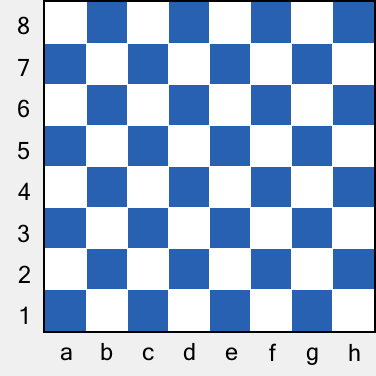
Every game of chess unfolds on an 8x8 grid of 64 squares, alternating between light and dark colors. This is the chessboard. The board has a specific orientation: each player should have a light-colored square at their bottom-right corner. Think of it as “light on the right.”
The columns are called files and are labeled with letters from ‘a’ to ‘h’. The rows are called ranks and are numbered 1 through 8. This grid system, called algebraic notation, gives every square a unique name, like a coordinate. The square in the bottom-left corner is ‘a1’, and the one in the top-right is ‘h8’.
The Armies
Each player starts with an army of 16 pieces. One player commands the White pieces, and the other commands the Black pieces. White always moves first.
Your army consists of:
- One King
- One Queen
- Two Rooks
- Two Bishops
- Two Knights
- Eight Pawns
Setting up the board is straightforward. The second row (rank 2 for White, rank 7 for Black) is completely filled with your eight pawns. The back row (rank 1 for White, rank 8 for Black) is for your other pieces. The rooks go in the corners. Next to them are the knights, and then the bishops. The queen goes on the central square of her own color (the White queen on the light ‘d1’ square, the Black queen on the dark ‘d8’ square). The king takes the last remaining square next to the queen.
How They Move
Each piece has its own unique way of moving across the board. Capturing an opponent's piece is simple: you move your piece to the square occupied by the enemy piece and remove it from the board. The only exception is the pawn, which captures differently than it moves.
The King
The king is the most important piece, but it's not the most powerful. It can move one square in any direction: horizontally, vertically, or diagonally. The whole point of the game is to trap the opponent's king. A king can't move to a square where it would be under attack by an enemy piece.
The king also has a special move called castling, where it moves two squares towards a rook and the rook jumps to the other side. It's a key defensive move, but we'll cover the specific rules for it later.
The Queen
The queen is the most powerful piece on the board. She can move any number of squares in a straight line, in any direction: horizontally, vertically, or diagonally. Think of her as a combination of a rook and a bishop. A queen can't jump over other pieces.
The Rook
The rook moves any number of squares horizontally or vertically, like a plus sign. Rooks are powerful pieces, especially when they can control open files or ranks. Like the queen, a rook can't jump over other pieces.
The Bishop
The bishop moves any number of squares diagonally. An important thing to note is that each bishop will spend the entire game on squares of a single color. You start with one light-squared bishop and one dark-squared bishop. A bishop cannot jump over other pieces.
The Knight
The knight's move is special. It moves in an 'L' shape: two squares in one direction (horizontally or vertically), and then one square at a 90-degree angle. The knight is the only piece that can jump over other pieces, friend or foe. Because of its unusual movement, it can attack a queen without being attacked back by it.
The Pawn
Pawns are the soul of chess. They have the most complex rules of movement.
- Moving: A pawn moves one square forward. However, on its very first move, it has the option to move two squares forward instead. Pawns can never move backward.
- Capturing: This is the strange part. Pawns don't capture the same way they move. They capture one square forward diagonally.
A pawn that pushes all the way to the other side of the board (rank 8 for White, rank 1 for Black) gets a promotion. It can become any other piece (queen, rook, bishop, or knight). This is a powerful ability that can change the course of a game.
Now you know the board and how each piece moves. This is the foundation for everything else in chess. The next step is to understand how these pieces work together to control the board, attack your opponent, and defend your king.
Which color square should be in each player's bottom-right corner when setting up the chessboard?
Which piece is the only one that can jump over other pieces?