Introduction to Artificial Intelligence
Introduction to Artificial Intelligence
What Is Artificial Intelligence?
Artificial Intelligence is the science of making machines that can think like humans. The goal is to create systems that can perform tasks that would otherwise require human intelligence, like learning, reasoning, and problem-solving. Think of it as teaching a computer to see the world, understand it, and make decisions based on what it learns.
Artificial Intelligence
noun
A field of computer science dedicated to creating systems capable of performing tasks that typically require human intelligence. This includes abilities like learning, reasoning, problem-solving, perception, and language understanding.
At its core, AI isn't about creating a mechanical human. It's about building tools that can process information and recognize patterns in ways that are far beyond human capability. These systems learn from vast amounts of data, enabling them to adapt and improve over time without being explicitly programmed for every single task.
A Brief History of AI
The idea of intelligent machines has been around for centuries, but the formal field of AI research began in the mid-20th century. One of the earliest pioneers was Alan Turing, a British mathematician who proposed a test for machine intelligence in 1950. The "Turing Test" challenged a machine to exhibit intelligent behavior equivalent to, or indistinguishable from, that of a human.
The term "artificial intelligence" itself was coined a few years later. In the summer of 1956, a group of researchers gathered at Dartmouth College for a workshop. They aimed to explore the idea that every aspect of learning or any other feature of intelligence could be precisely described so that a machine could be made to simulate it. This event is widely considered the birth of AI as an academic field.
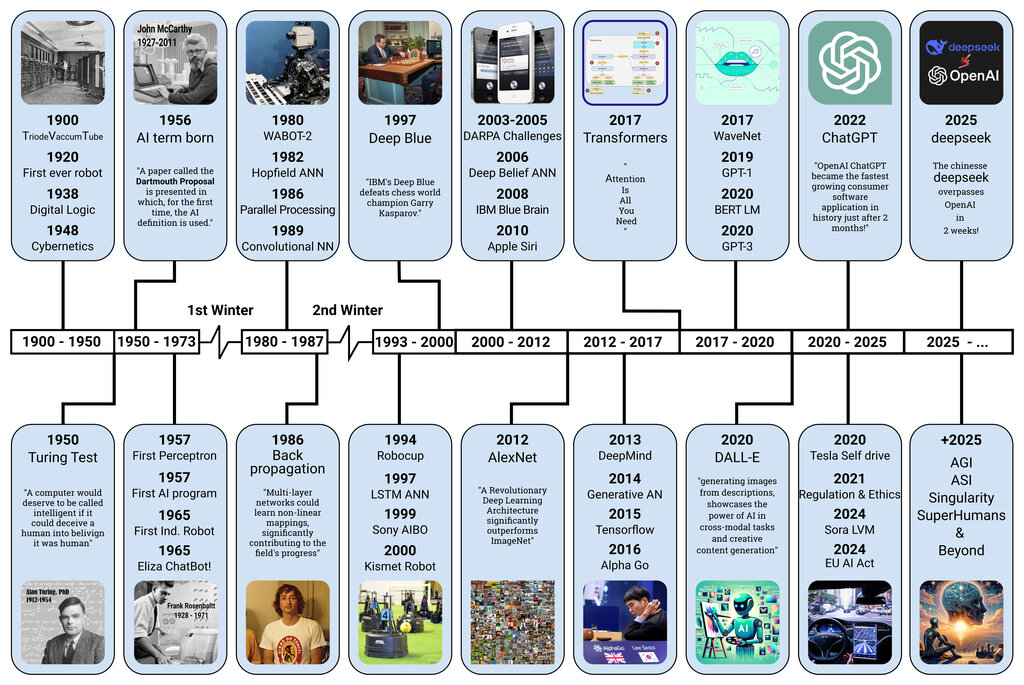
The years following the Dartmouth workshop were filled with excitement and discovery, but also with periods of reduced funding and interest known as "AI winters." Early successes in solving simple logic problems gave way to the immense difficulty of tackling real-world challenges. However, advances in computing power and the availability of large datasets eventually led to a resurgence. Breakthroughs in machine learning in the 1990s and deep learning in the 2010s have propelled AI into the powerful tool it is today.
Core Principles
AI technologies are built on a few fundamental principles. Understanding these concepts helps demystify how AI works.
First is learning. Just like humans learn from experience, AI systems learn from data. They analyze countless examples to identify patterns and relationships. This allows them to make predictions or decisions about new, unseen data. For example, by analyzing thousands of images of cats, an AI can learn to recognize a cat in a photo it has never seen before.
Next is representation. An AI needs a way to store knowledge about the world. This "knowledge representation" can take many forms, from simple rules like "if it's raining, bring an umbrella" to complex networks of interconnected concepts. The way knowledge is structured is critical for the AI's ability to use it effectively.
Finally, there's reasoning. Once an AI has learned from data and stored its knowledge, it needs to be able to use that information to solve problems. This is the process of reasoning, where the system applies logic to draw conclusions and make choices. It's how an AI goes from knowing the rules of chess to planning a winning strategy.
Together, these three principles—learning, representation, and reasoning—form the foundation that allows AI systems to tackle complex tasks and simulate intelligent behavior.
This introduction provides a glimpse into the what, why, and how of artificial intelligence. By understanding its definition, history, and core ideas, you're ready to explore its more advanced concepts and applications.