Introduction to Artificial Intelligence Concepts
Introduction to AI
What Is Artificial Intelligence?
At its core, artificial intelligence is the science of making machines smart. The goal is to create computer systems that can perform tasks that normally require human intelligence. This could be anything from recognizing a face in a photograph, to understanding spoken language, or even driving a car.
Think of it this way: We don't teach a computer how to identify a cat by describing its features. Instead, we show it thousands of cat pictures until it learns to recognize one on its own. This ability to learn from data is a key part of modern AI.
Most of the AI we interact with today is considered "Narrow AI." It's designed to perform a specific task, like playing chess or recommending movies. The long-term dream for some researchers is "General AI" (AGI), a type of AI that could understand and learn any intellectual task a human can. We aren't there yet, but the field is moving quickly.
Artificial Intelligence
noun
The theory and development of computer systems able to perform tasks that normally require human intelligence, such as visual perception, speech recognition, decision-making, and translation between languages.
A Brief History of AI
The idea of intelligent machines has been around for centuries, but the formal field of AI research began in the mid-1950s. A pivotal moment was the Dartmouth Workshop in 1956, where the term "artificial intelligence" was officially coined. Early researchers were optimistic, believing that a machine as intelligent as a human being was just a few decades away.
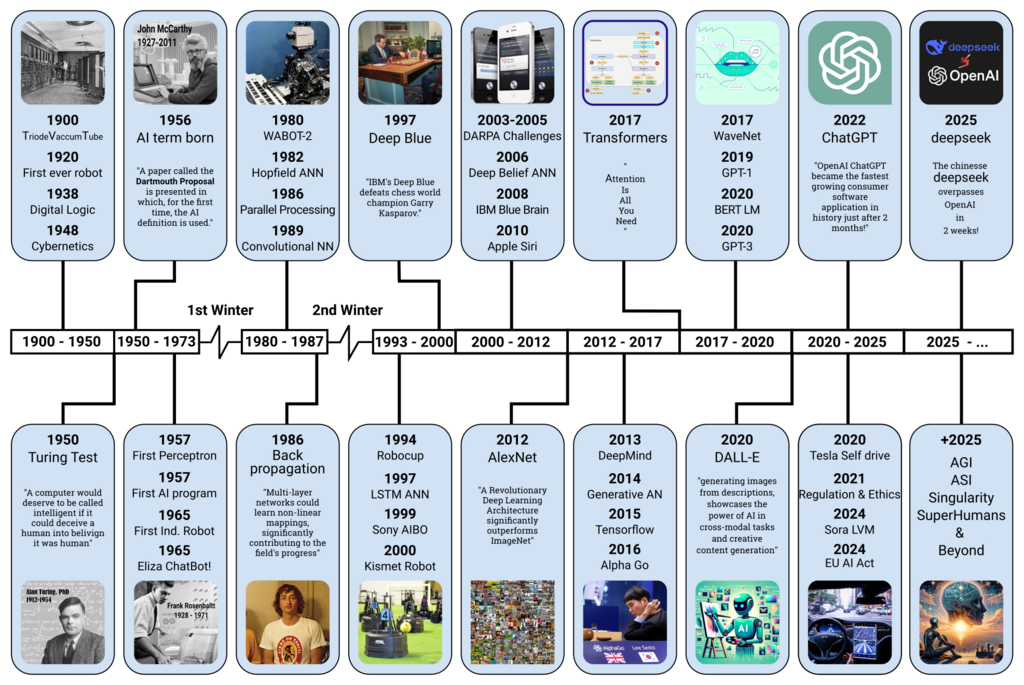
Progress wasn't always a straight line. The field experienced several "AI winters," periods when funding dried up and public interest waned because the promises of AI didn't match reality. The limited computing power and data of the time made it difficult to build systems that could solve complex, real-world problems.
However, breakthroughs in the 1990s and 2000s, like IBM's Deep Blue defeating chess grandmaster Garry Kasparov, brought AI back into the spotlight. This resurgence was fueled by faster computers and the explosion of data available on the internet.
The Core Components
To understand how AI works today, it helps to know its three essential ingredients: data, algorithms, and computing power.
Data is the raw material. It's the information that AI systems learn from. This can be images, text, numbers, or sounds. The more high-quality data an AI has, the better it becomes at its task. The internet has made vast amounts of data available, which has been a huge driver of recent AI progress.
Algorithms are the set of rules or instructions that the computer follows. In AI, these are often learning algorithms that allow the system to identify patterns and make decisions based on the data it's given. An algorithm is like a recipe that tells the AI how to process the data to achieve a goal.
Computing Power is the hardware that runs the algorithms. Modern AI, especially deep learning, requires processing massive amounts of data, which demands powerful computers. Advances in specialized hardware, like Graphics Processing Units (GPUs), have made it possible to train complex AI models much faster than before.
These three components work together. Without massive datasets, algorithms have little to learn from. Without powerful algorithms, data is just noise. And without fast computing, processing it all would be impossible.
Now that you have a sense of what AI is and where it came from, it's time to test your knowledge.
What is the primary goal of artificial intelligence?
The type of AI that can recommend movies or play chess, but is limited to its specific designed function, is known as:
Understanding these foundations is the first step in seeing how AI is already changing our world and what it might do in the future.