Introduction to Artificial Intelligence
Introduction to Artificial Intelligence
What Is Artificial Intelligence?
Artificial Intelligence, or AI, is about creating machines that can think, learn, and solve problems like humans. The main goal is to build systems that can perform tasks that usually require human intelligence. This includes things like understanding language, recognizing patterns, and making decisions.
At its core, AI is the science of making things smart. It's a system's ability to take in information, learn from it, and use that knowledge to achieve specific goals.
Think of it this way: when you learn to ride a bike, you process information about balance and pedaling. You learn from falling and trying again. AI systems do something similar, but with data. They analyze vast amounts of information to learn how to perform a task, whether it's identifying a cat in a photo or suggesting your next favorite song.
The ultimate objective isn't just to mimic human intelligence, but to create tools that can extend our own abilities, helping us solve complex problems in science, medicine, and everyday life.
The Dawn of AI
The idea of intelligent machines isn't new, but the formal journey of AI began in the mid-20th century. One of the first major thinkers was Alan Turing, a brilliant British mathematician. In 1950, he proposed a simple test to determine if a machine could exhibit intelligent behavior indistinguishable from that of a human. Known as the Turing Test, it challenged the very definition of thinking.
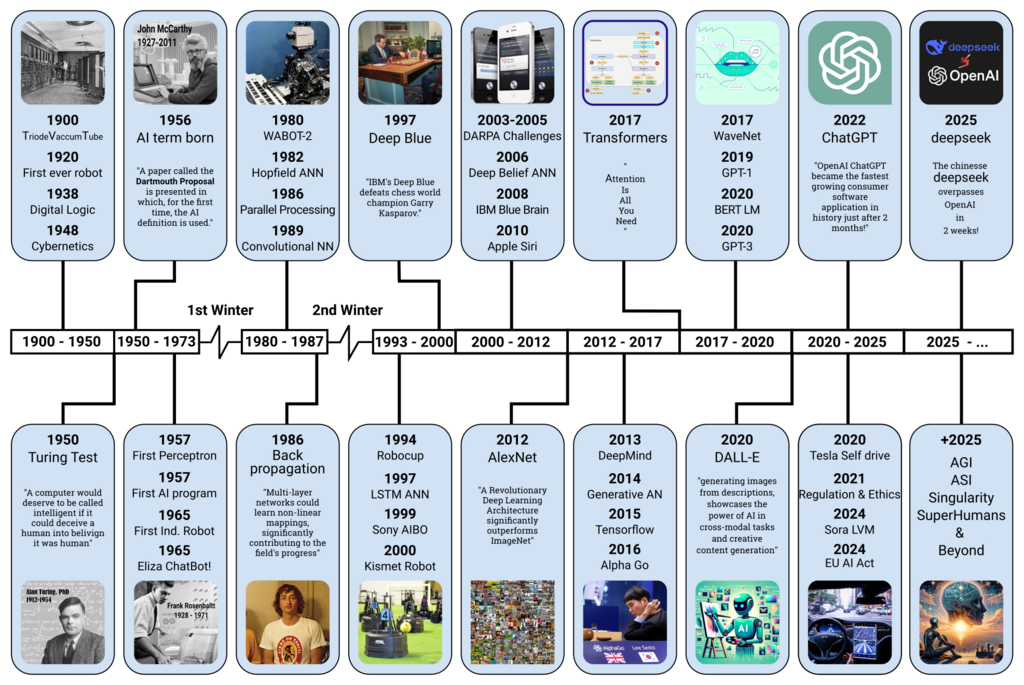
The field got its name just a few years later. In the summer of 1956, a group of scientists gathered at Dartmouth College for a workshop. They wanted to explore the idea that "every aspect of learning or any other feature of intelligence can in principle be so precisely described that a machine can be made to simulate it." It was here that computer scientist John McCarthy coined the term "Artificial Intelligence," and a new field of study was officially born.
Two Kinds of AI
Today, when we talk about AI, we're usually talking about one of two broad categories. It's important to know the difference, because one is all around us, and the other is still the stuff of science fiction.
Narrow AI
noun
Artificial intelligence that is designed and trained for a particular task.
Also known as Weak AI, this is the only type of artificial intelligence we have successfully created so far. Narrow AI is a master of one trade. It’s incredibly good at the specific, single task it's designed for. Examples are everywhere: the AI that recommends movies on streaming services, the software that recognizes your face to unlock your phone, or the virtual opponent you play against in a video game.
These systems can seem very intelligent, but their skills don't transfer. An AI that's a world champion at chess can't drive a car or even tell you if a picture shows a cat or a dog, unless it was also specifically trained for those tasks.
The second type is Artificial General Intelligence (AGI), or Strong AI. This is the hypothetical AI that can understand, learn, and apply its intelligence to solve any problem, much like a human being. An AGI wouldn't need to be specially trained for every new challenge. It could use its accumulated knowledge and reasoning skills to figure things out on its own.
Creating AGI is the long-term, ambitious goal for many AI researchers. However, it remains a massive challenge. Building a system with the flexibility, creativity, and common sense of the human mind is a complex problem we have yet to solve.
Now, let's test your understanding of these foundational ideas.
What is the primary goal of Artificial Intelligence as described in the text?
The 'Turing Test' was proposed to determine if a machine could...
Understanding these basic concepts—what AI is, where it came from, and its main types—is the first step in navigating this powerful and rapidly evolving field.