Introduction to Artificial Intelligence
Introduction to Artificial Intelligence
What is Artificial Intelligence?
Artificial Intelligence is the theory and development of computer systems able to perform tasks that normally require human intelligence. Think beyond simple automation. AI involves perception, reasoning, learning, problem-solving, and even language understanding.
At its core, AI is about creating agents—systems that can perceive their environment and take actions to maximize their chance of successfully achieving goals. This could be a self-driving car navigating traffic or a program recommending your next movie. The goal is not just to mimic human thought, but to create a rational agent that acts to achieve the best outcome.
The fundamental goal of AI research is to create intelligent agents that can reason, learn, and act autonomously.
The Journey of AI
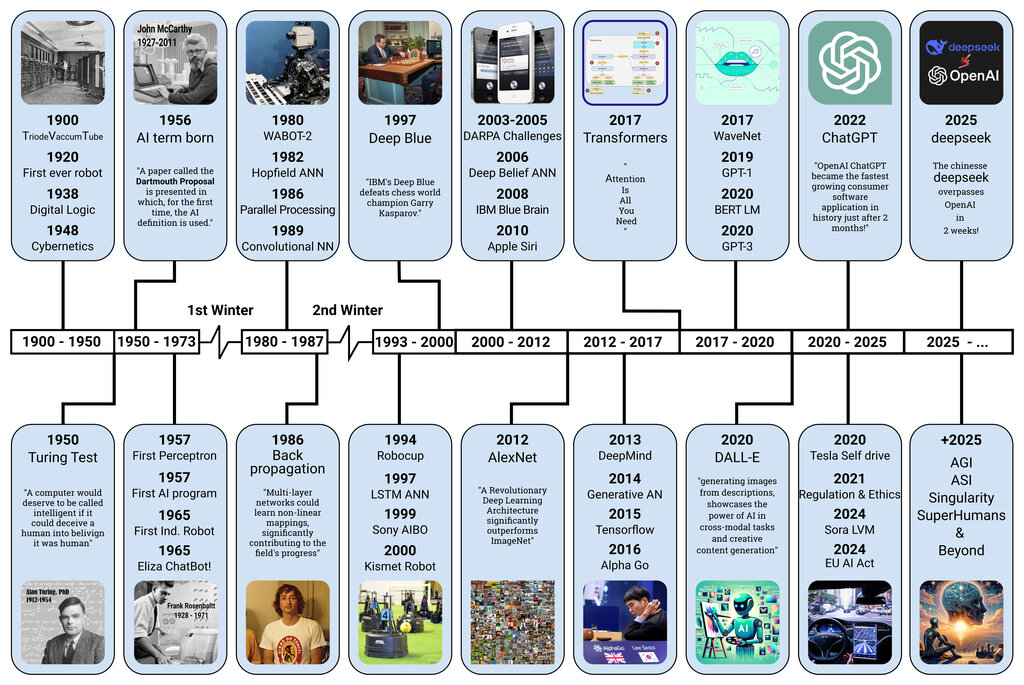
The dream of creating artificial beings is ancient, but the scientific pursuit of AI began in the mid-20th century. The field was officially born at a 1956 workshop at Dartmouth College, where the term "Artificial Intelligence" was coined. Early work focused on symbolic reasoning and logic, showing promise in solving puzzles and proving theorems.
Turing Test
noun
A test of a machine's ability to exhibit intelligent behavior equivalent to, or indistinguishable from, that of a human. Proposed by Alan Turing in 1950, it involves a human evaluator judging natural language conversations between a human and a machine designed to generate human-like responses.
Progress wasn't a straight line. The initial excitement was followed by periods of reduced funding and interest known as "AI winters," when the technology couldn't meet the lofty expectations. However, breakthroughs in the 1980s and 90s, driven by the rise of machine learning and increased computing power, revived the field. The 2010s marked another massive leap with the advent of deep learning, leading to the powerful AI we see today.
Narrow vs. General AI
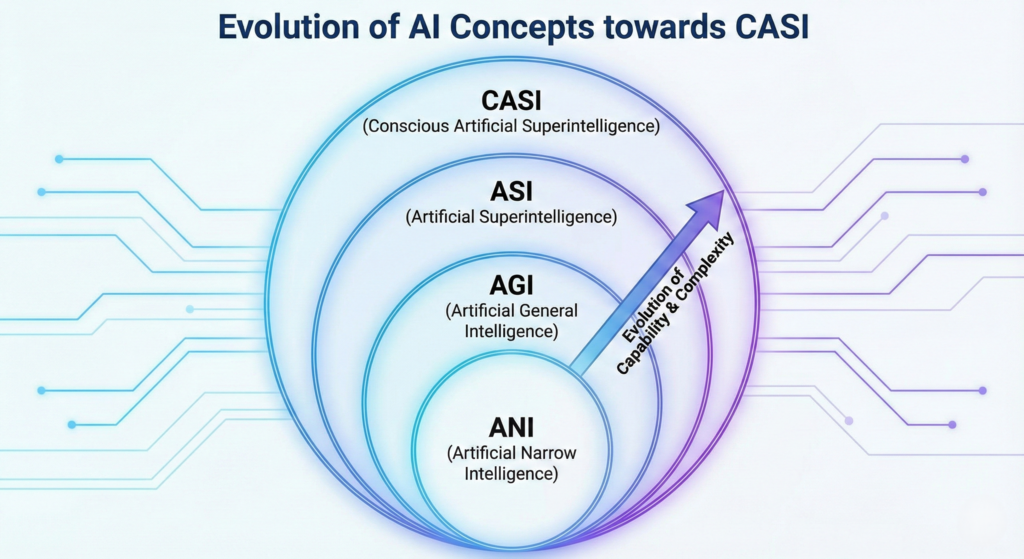
Not all AI is created equal. The most critical distinction in AI today is between Artificial Narrow Intelligence (ANI) and Artificial General Intelligence (AGI).
ANI, sometimes called Weak AI, is what we have now. These systems are designed to perform a single task or a narrow set of tasks exceptionally well. Your spam filter, a chess-playing computer, and a language translation app are all examples of ANI. They are masters of their specific domain but have no awareness or ability outside of it.
AGI, or Strong AI, is the hypothetical intelligence of a machine that can understand or learn any intellectual task that a human being can. An AGI would possess consciousness, self-awareness, and the ability to solve novel problems in entirely new contexts. It remains the stuff of science fiction, representing a long-term goal for many researchers.
| Feature | Artificial Narrow Intelligence (ANI) | Artificial General Intelligence (AGI) |
|---|---|---|
| Scope | Performs a specific, well-defined task. | Can perform any intellectual task a human can. |
| Example | Image recognition, voice assistants, game AI. | Not yet achieved. Hypothetical systems like Data from Star Trek. |
| Learning | Learns from data within its specific domain. | Can transfer knowledge between different domains. |
| Awareness | No consciousness or self-awareness. | Hypothetically conscious and self-aware. |
Significance and Future Impact
AI is already a transformative force, reshaping industries from healthcare to finance. It's the engine behind personalized medicine, efficient supply chains, and scientific discovery. Its ability to find patterns in vast datasets far exceeds human capability, unlocking new insights and driving innovation.
Looking ahead, the potential impact is even greater. As AI becomes more sophisticated, it could help solve some of humanity's biggest challenges, like climate change, disease, and resource scarcity. However, this progress also raises critical questions about ethics, bias, job displacement, and safety. Navigating this future requires not just technical skill but careful, responsible planning and governance.
Now, let's test your understanding of these core concepts.