Introduction to AI Agents
Introduction to AI Agents
What Is an AI Agent?
An AI agent is a system that can observe its surroundings, make its own decisions, and take actions to achieve a goal. Think of it like a smart thermostat. It senses the room's temperature, decides whether it's too hot or cold based on your settings, and then acts by turning the heat or air conditioning on or off. It does this all on its own.
Agent
noun
An entity that perceives its environment through sensors and acts upon that environment through actuators.
What makes an agent special are a few key traits. They are autonomous, meaning they operate without direct human control. They're also reactive, responding to changes they perceive in their environment. The most useful agents are proactive, taking initiative to meet their goals, not just reacting to things as they happen.
In short, an agent isn't just a program that runs a script. It's a system that perceives, thinks, and acts.
The Agent's Toolkit
Every AI agent, from the simplest to the most complex, is built from the same fundamental components. They all follow a basic loop: perceive, decide, and act. This cycle is how an agent interacts with and influences its world.
Let's break down each part of this loop.
Perception: This is how the agent gathers information. It uses sensors to detect things in its environment. For a self-driving car, sensors might include cameras, GPS, and radar. For a stock-trading bot, the sensors are data feeds providing real-time market prices.
Decision-Making: This is the agent's "brain." It takes the raw data from the sensors and decides what it means and what to do next. This logic can be simple, like a set of if-then rules, or incredibly complex, involving deep learning models. The decision is always aimed at achieving the agent's pre-defined goals.
Action: Once a decision is made, the agent needs to act. It uses actuators to affect its environment. A robotic vacuum's actuators are its wheels and brushes. A chatbot's actuator is its ability to generate and display text.
The Path to Today's Agents
The idea of AI agents isn't new. It has evolved alongside the broader field of artificial intelligence. Early agents were simple, rule-based systems. They were powerful for specific, well-defined tasks but lacked flexibility. If they encountered a situation that wasn't in their rulebook, they were stuck.
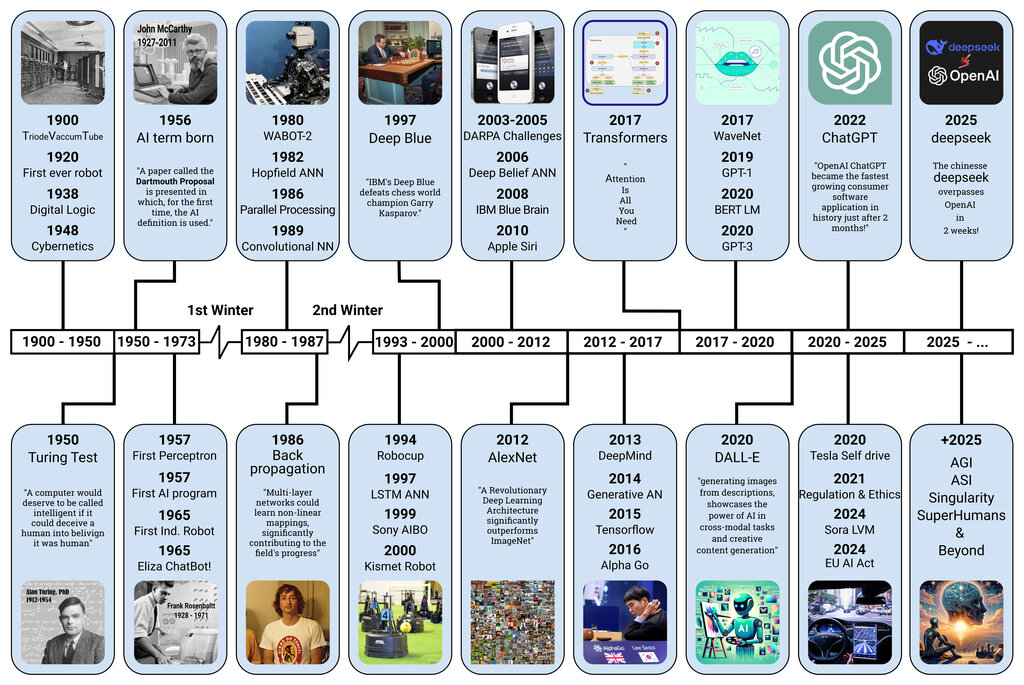
In the 1970s and 80s, so-called "expert systems" tried to capture the knowledge of human experts in a specific domain, like medical diagnosis. These were a step forward, but they were still brittle and expensive to build.
The real game-changer was the rise of machine learning. Instead of being programmed with explicit rules for every situation, agents could now learn from data. This allowed them to adapt, improve over time, and handle the uncertainty of the real world. This shift from hand-coded logic to learned behavior is what paved the way for the sophisticated AI agents we see today.
Now that we've covered the basics, let's review the key terms.
Ready to check your understanding?
What are the three fundamental steps in an AI agent's core operational loop?
An AI agent that takes initiative to achieve its goals, rather than simply responding to its environment, is best described as being what?
Understanding these core concepts is the first step toward seeing how agents can be designed for more complex tasks.