Internal Controls in the Digital Age
Internal Control Fundamentals
The Purpose of Internal Control
Think of an organization as a car driving toward a destination. The driver has a goal, but there are also traffic laws to follow and other cars to avoid. Internal controls are the steering wheel, brakes, and speedometer—the systems that help the driver navigate safely and efficiently to their destination.
At its core, internal control is a process designed to provide reasonable assurance about achieving an organization's objectives. It’s not just about catching mistakes; it’s about creating a system that helps things go right in the first place.
The main goals of internal control are to ensure operational effectiveness, provide reliable financial reporting, and maintain compliance with laws and regulations.
To help organizations build these systems, a widely accepted guide was created: the COSO Internal Control Framework. It breaks down the concept of internal control into five connected components. It provides a blueprint for building a strong and effective control system.
The Five Building Blocks
The COSO framework visualizes internal control as a cube, showing how its pieces fit together. The five components form the foundation of this structure. They aren't a checklist to be completed once, but a continuous, integrated cycle that operates at every level of an organization.
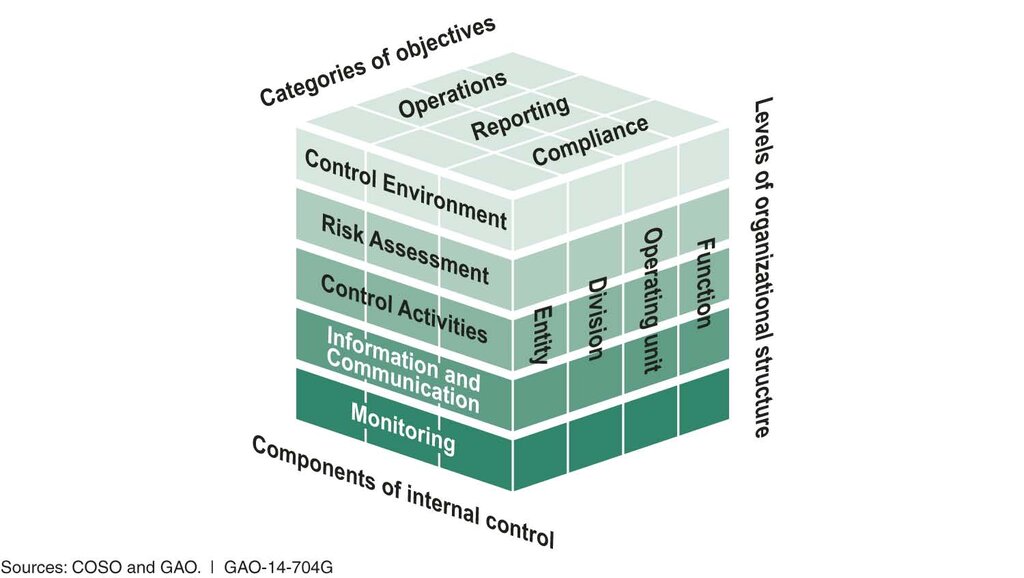
Let's break down each of these five components.
1. Control Environment
The control environment is the foundation for everything else. It’s the “tone at the top” set by leadership. This includes the organization's ethical values, its commitment to competence, and the management's philosophy and operating style. It’s about the culture of the company.
If leadership doesn't take controls seriously, no one else will. A strong control environment means integrity is non-negotiable and people are held accountable. A weak one creates opportunities for errors and fraud to occur, regardless of how well-designed the other components are.
2. Risk Assessment
Once the foundation is set, the organization must look at the road ahead and identify potential potholes. Risk assessment is the process of identifying and analyzing the risks that could prevent the company from achieving its objectives. This involves asking critical questions:
- What internal and external factors could jeopardize our goals?
- How likely is each risk to occur?
- What would be the potential impact if it did?
For example, a software company might identify the risk of a data breach, while a manufacturing company might see supply chain disruption as a major risk. Understanding these threats allows management to decide how to handle them.
3. Control Activities
Control activities are the specific actions, policies, and procedures put in place to address the identified risks. These are the practical, day-to-day controls that people engage with. They can be preventive, designed to stop an issue before it happens, or detective, designed to find problems after they've occurred.
| Type of Control | Description | Example |
|---|---|---|
| Preventive | Aims to stop errors or irregularities from occurring. | Requiring manager approval for purchases over $1,000. |
| Detective | Aims to uncover errors or irregularities after they have occurred. | Performing a monthly review of the budget vs. actual spending. |
| Segregation of Duties | Splits a task among multiple people to prevent fraud or error. | The person who receives cash payments cannot also be the one who records them in the accounting system. |
4. Information and Communication
A strong control system is useless if people don't know about it. This component focuses on ensuring that relevant, quality information is captured and communicated in a timely manner. Communication must flow in all directions—down, up, and across the organization.
Employees need to understand their roles in the internal control system. They need clear channels to report problems or concerns without fear of retaliation. Management needs reliable data to make informed decisions. This flow of information is the nervous system that connects all the other components.
5. Monitoring Activities
Finally, the system needs to be checked regularly to ensure it's still working as intended. Monitoring activities are ongoing evaluations, separate audits, or a combination of both used to assess the performance of internal controls over time.
Is the approval process being followed consistently? Are reconciliations being completed on time? Monitoring helps answer these questions and identifies deficiencies so they can be corrected. It ensures the control system remains effective even as the organization and its risks change.
Internal controls protect a business from fraud and errors by ensuring accountability and proper financial oversight.
Together, these five components form a dynamic framework that helps organizations stay on course, manage uncertainty, and operate with integrity.